
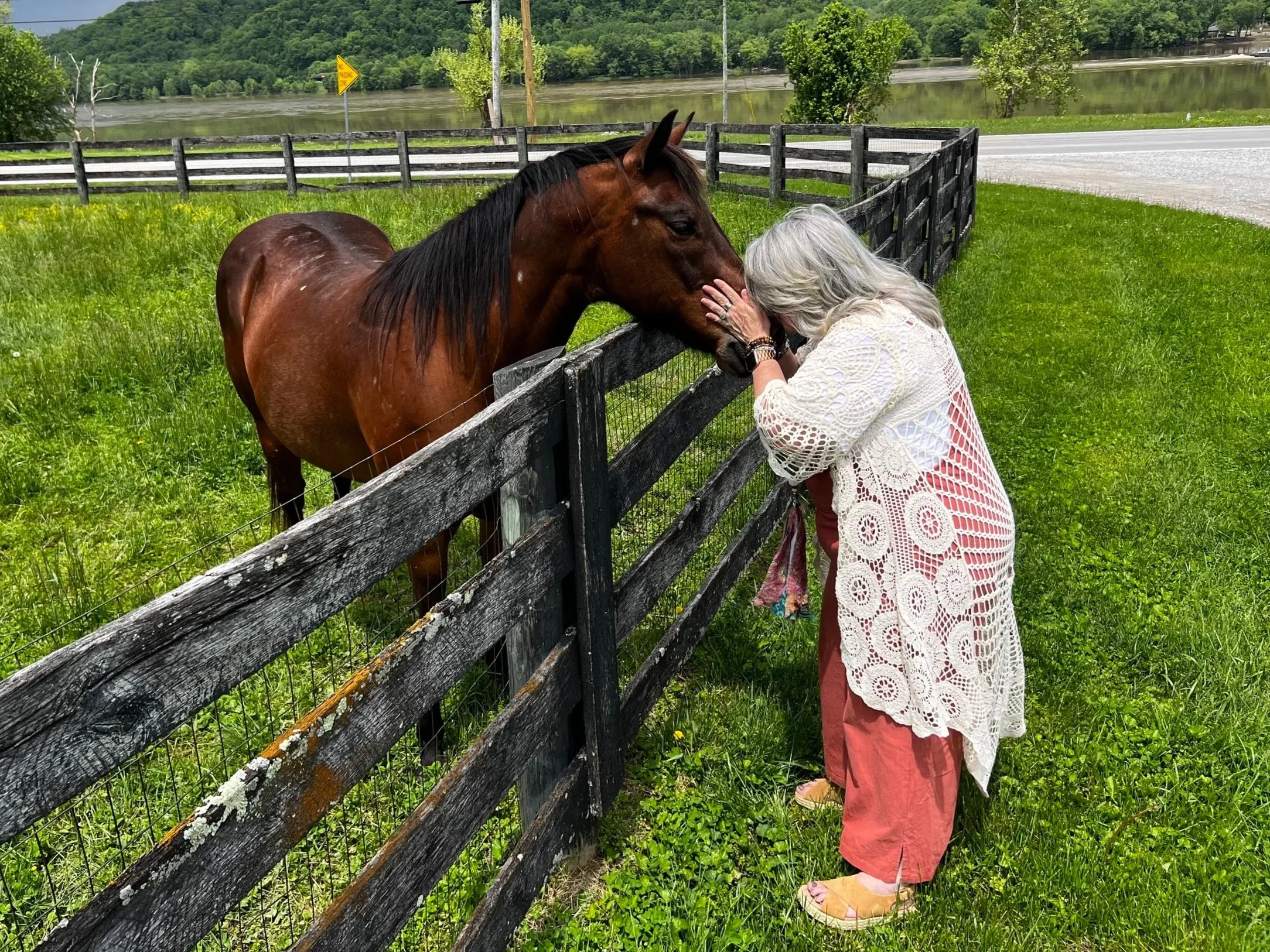
Rocking Toward Bliss
Rebloom Retreat May 2025
I recently watched a short contemplation about the Fire Horse, the Chinese New Year … a reflection on pace, intensity, and the way life can surge forward if we let it. I expected insight. Something philosophical, perhaps. Instead, what arrived was stillness … not what comes because everything outside has gone quiet, but the quiet that finds its way inward after a season of constant motion, the one that feels familiar, almost like coming home.
Over the past year, my rhythm changed without asking my permission. A traumatic moment, my father’s heart attack, shifted something deep inside me. Life tapped my shoulder and whispered, slow down. I didn’t respond immediately, and certainly not perfectly, but eventually I softened into a different tempo.
I began paying attention to what truly mattered.
Not how much information I could gather,
but the wisdom already living within me.
After watching that contemplation, a memory surfaced … or maybe more accurately, a story I’ve heard so many times it feels like memory. I could see myself on my childhood rocking horse, leaning forward with each push, the motion growing bigger and bolder. My father used to laugh when he told it, saying I would giggle louder and louder with every forward swing. He also admitted it made them nervous; they were certain I’d tip it over or fall at any moment.
I never did.
What stayed with him was the joy.
What stayed with me, apparently, was the motion.
There’s something almost poetic in that: the early love of rhythm, the forward pull, the sense of becoming one with the movement rather than trying to control it. I sometimes wonder if that was the beginning of my affection for horses, not just the horses themselves, but the feeling they carry. Even now, being near a horse brings an unmistakable calm over me. Their quiet strength, their steady breath, the way they respond to energy rather than noise … it all feels familiar. Perhaps that gentle rocking back and forth planted something deeper than anyone realized … a comfort with motion, a trust in momentum, a partnership with movement rather than resistance to it.
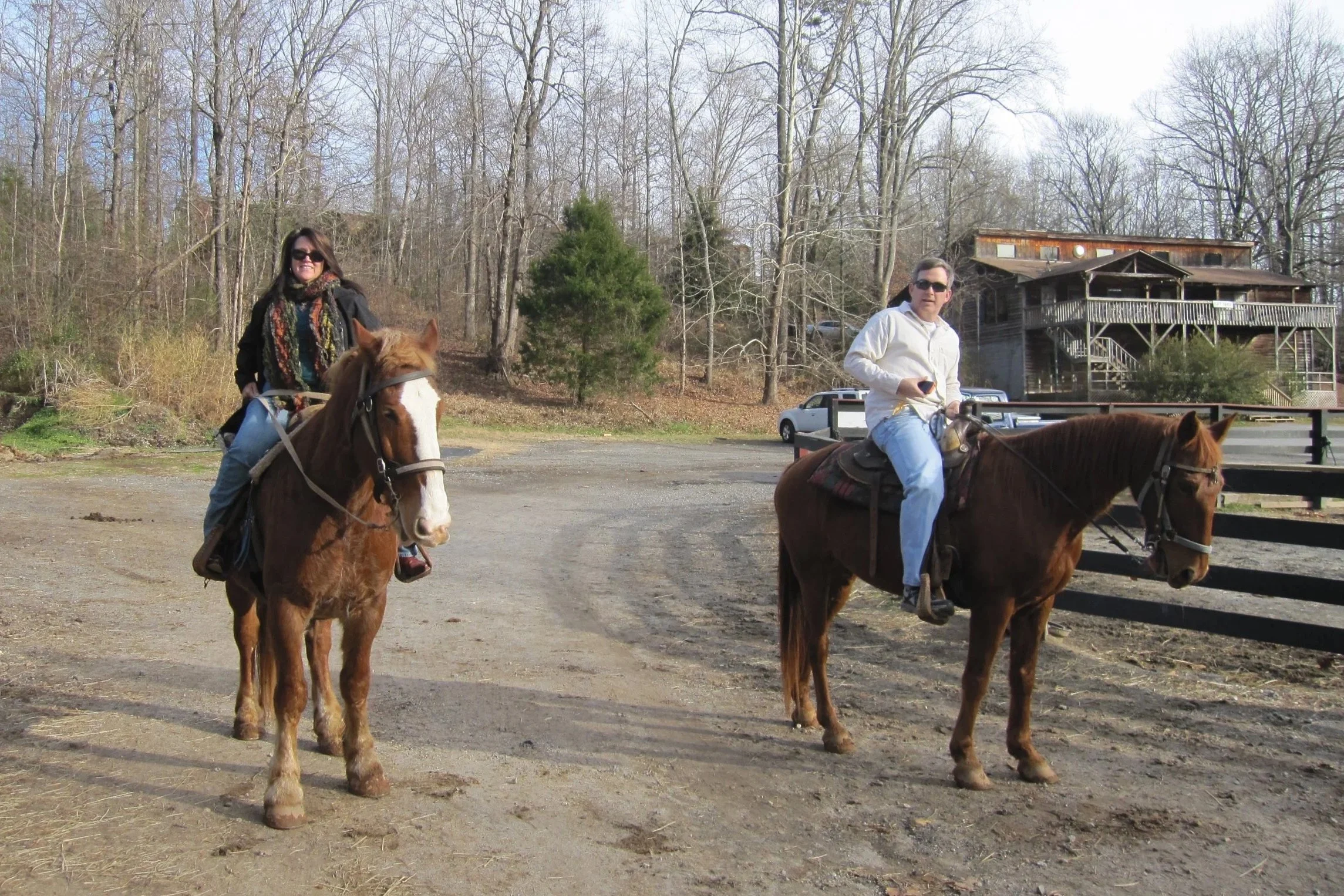
Riding with Jim on our honeymoon 2014 … a Horse year.
I was born in 1966, a Horse year. It’s the same era that carried the spirit of the Summer of Love, innovation, and cultural change. There’s poetry in that timing. A life that began in a season of collective acceleration now finding deep appeal in the quiet center between breaths. The world galloped forward, and here I am, discovering the grace of a gentle rock instead.
These days, my work feels simmered rather than rushed.
Ideas unfold instead of being chased.
I feel less drawn to cramming knowledge into already full spaces and more drawn to listening, really listening, for understanding. One fills shelves. The other fills the soul.
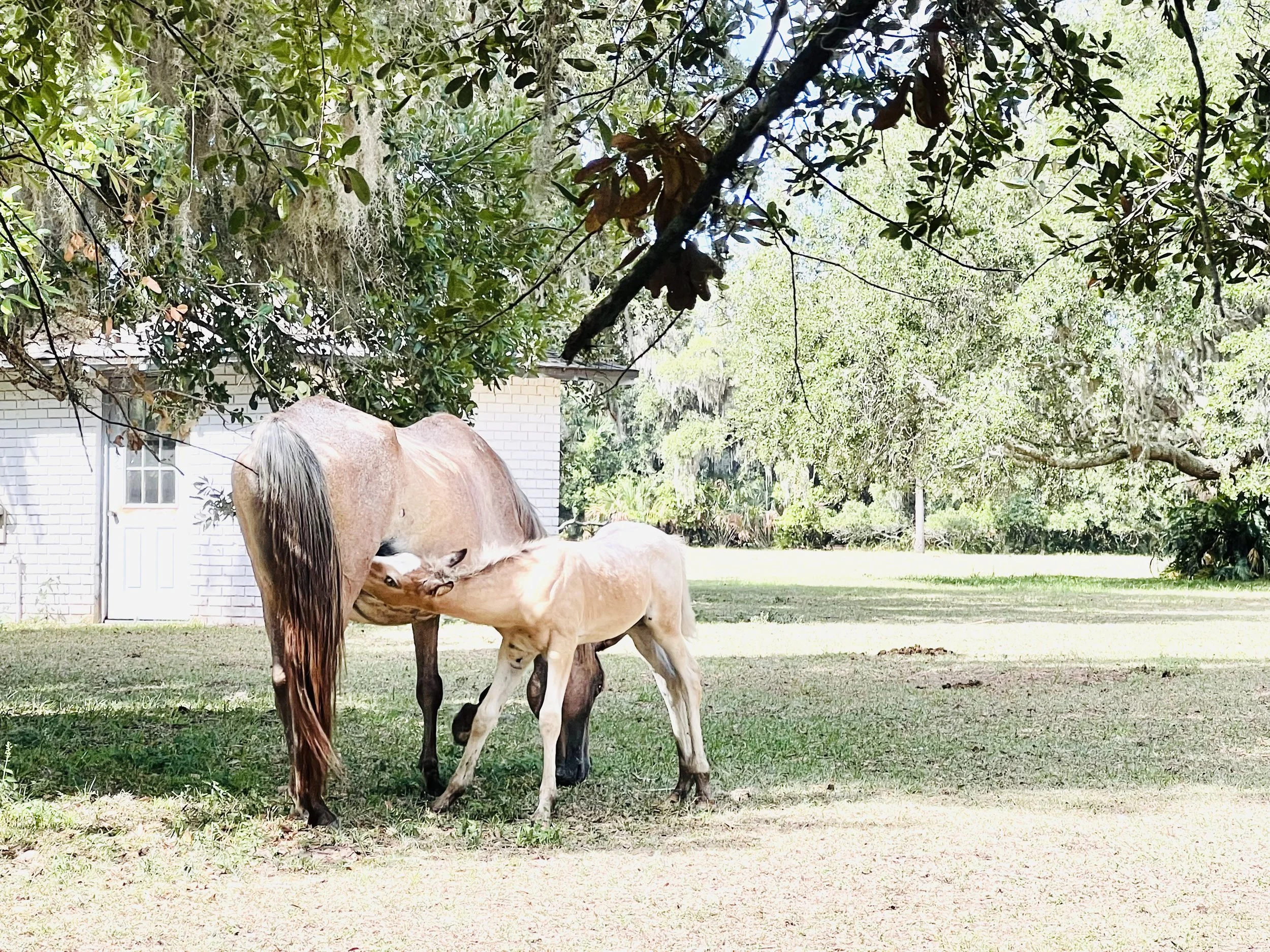
Cumberland Island 2022
Bliss, I am discovering, isn’t a burst of fireworks or a grand arrival.
It is a rocking motion.
A returning.
A recognition of the wisdom that has been present all along, simply waiting for room to speak.
Physically, mentally, spiritually, this season of life feels less like a race and more like a rhythm. The world still moves quickly, but I no longer feel compelled to match its speed. There is a certain freedom in trusting my own pace, in allowing insight to rise naturally instead of forcing it to appear.
I think of that rocking motion often now … the forward tilt, the backward return, the gentle certainty of movement without urgency. Somewhere along the way I realized that bliss isn’t always found by galloping ahead. Sometimes it is found in the quiet back-and-forth, in the simple act of slowing enough to hear the wisdom that has been within me all along.
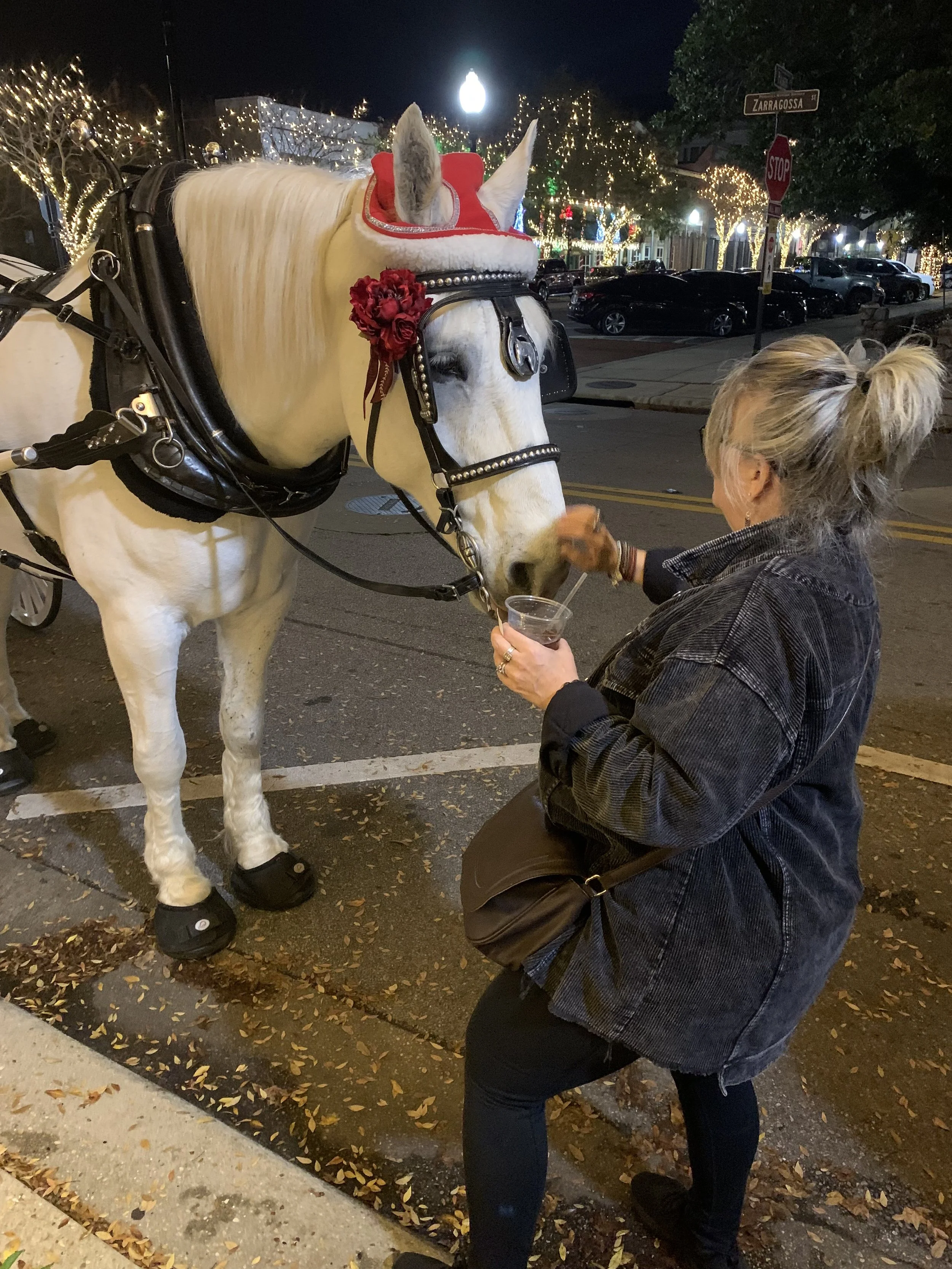
Pensacola 2022
Behind the Pages: When Publishing Isn’t Perfect
Publishing isn’t a straight line.
This week’s proof came back with print quality issues — not ours — so questions have been sent and adjustments are in motion.
We’re close. Very close.
Stay tuned.
There is a quiet myth about publishing that I am now learning.
It goes something like this:
You finish writing.
You upload the files.
A pristine proof arrives.
You exhale.
The book is born.
Reality, however, is far more human.
This week, another proof arrived for my book. I opened the package with the same flutter of excitement I’ve felt every time … that mix of anticipation and reverence that comes from holding months, sometimes years, of thought, memory, and effort in physical form.
And once again … there were issues.
Not something we missed.
Not the sort that comes from missed edits or overlooked margins.
But technical hiccups. Formatting quirks. Small misalignments that ripple across pages like tiny pebbles tossed into still water.

Houston, we have a trim problem!
For a moment, frustration knocked at the door.
I let it in just long enough to acknowledge it, then I remembered something important: publishing is not a straight line. It is a spiral. A return. A refinement. A conversation between vision and execution.
The proof stage is not a failure.
It is a collaboration.
It is where the book quietly asks, “Are we ready yet?”
And sometimes the honest answer is, “Almost.”
There is something deeply humbling about seeing your work in this unfinished state. It reminds me that creation is rarely glamorous. It is iterative. Layered. Patient. A little messy. Very alive.
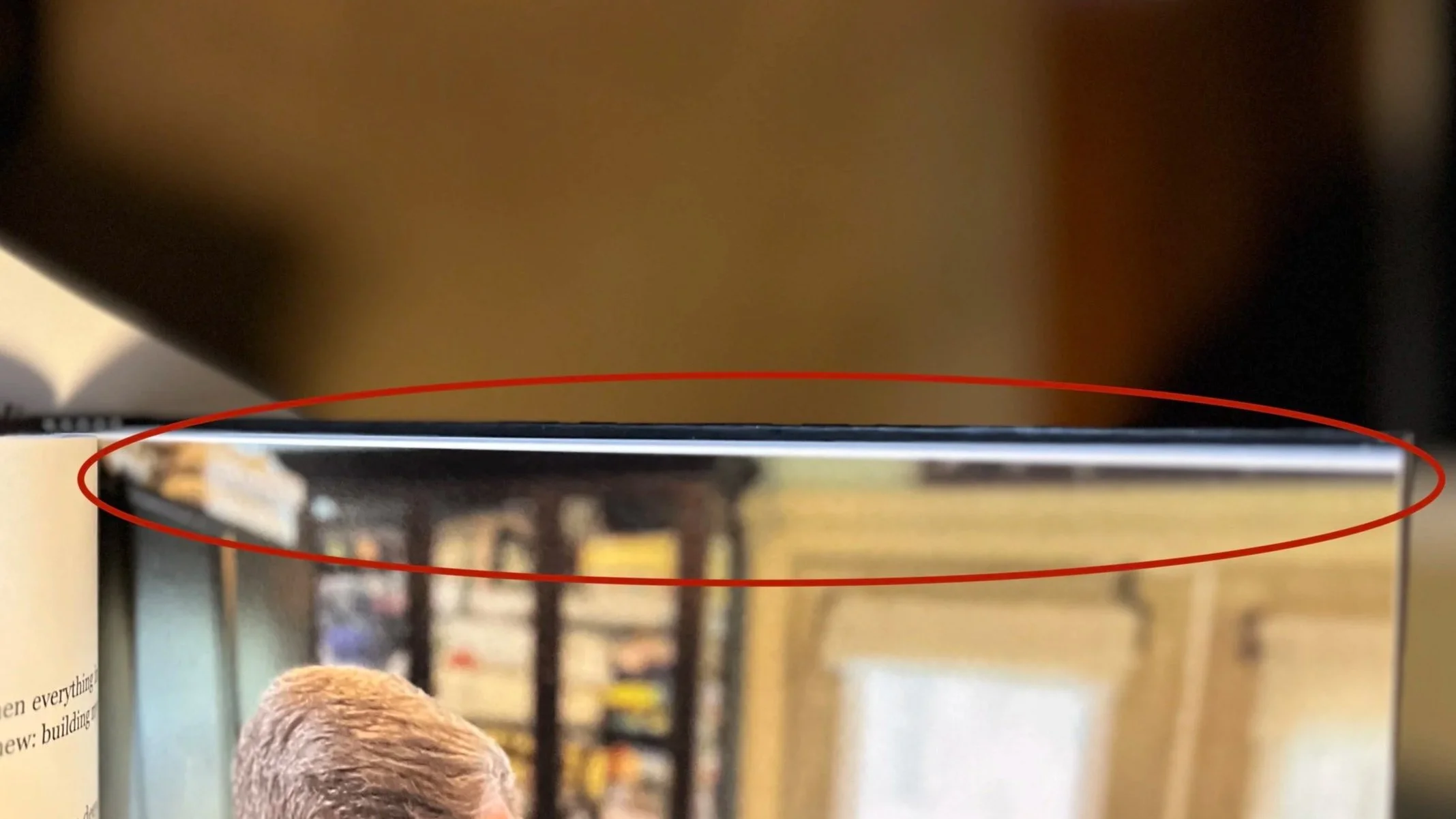
There is an alignment issue on their end … all of our photo pages have an unintended gap :(
I think many of us imagine that artists and authors reach a point where everything flows without friction. The truth is: friction is part of the process. It polishes the final piece. It slows us just enough to notice what matters.
This week’s lesson wasn’t about perfection.
It was about persistence.
Each proof, each correction, each unexpected delay is not a step backward. It is a step toward clarity, toward honoring the work enough to let it become what it is meant to be, instead of rushing it out the door just to say it’s done, and frankly I, we, have worked to hard just to put it out there.
If you are creating something right now … a book, a business, a painting, or even a new version of yourself … and it isn’t unfolding in a straight, smooth line, take heart.
Progress sometimes looks like pause.
Refinement sometimes looks like repetition.
And becoming often asks for more patience than we planned to give.
This week, emails have been sent about print quality.
Questions have been asked.
Adjustments are in motion.
So … we wait.
But it is a different kind of waiting now … not the waiting of uncertainty, but the waiting of almost. The kind where you can feel the finish line just ahead, even if you cannot quite step across it yet.
We are so much closer than we were yesterday.
So much closer than last month.
And each small correction brings this book one step nearer to the hands and hearts for whom it was written.
Stay tuned.
The story is still unfolding … and I cannot wait to share it with you when the pages finally land exactly as they are meant to.
Almost is not failure. Almost is the doorway to refinement.
If you’re on your own creative journey, I’d love to hear what you’re bringing to life this season.
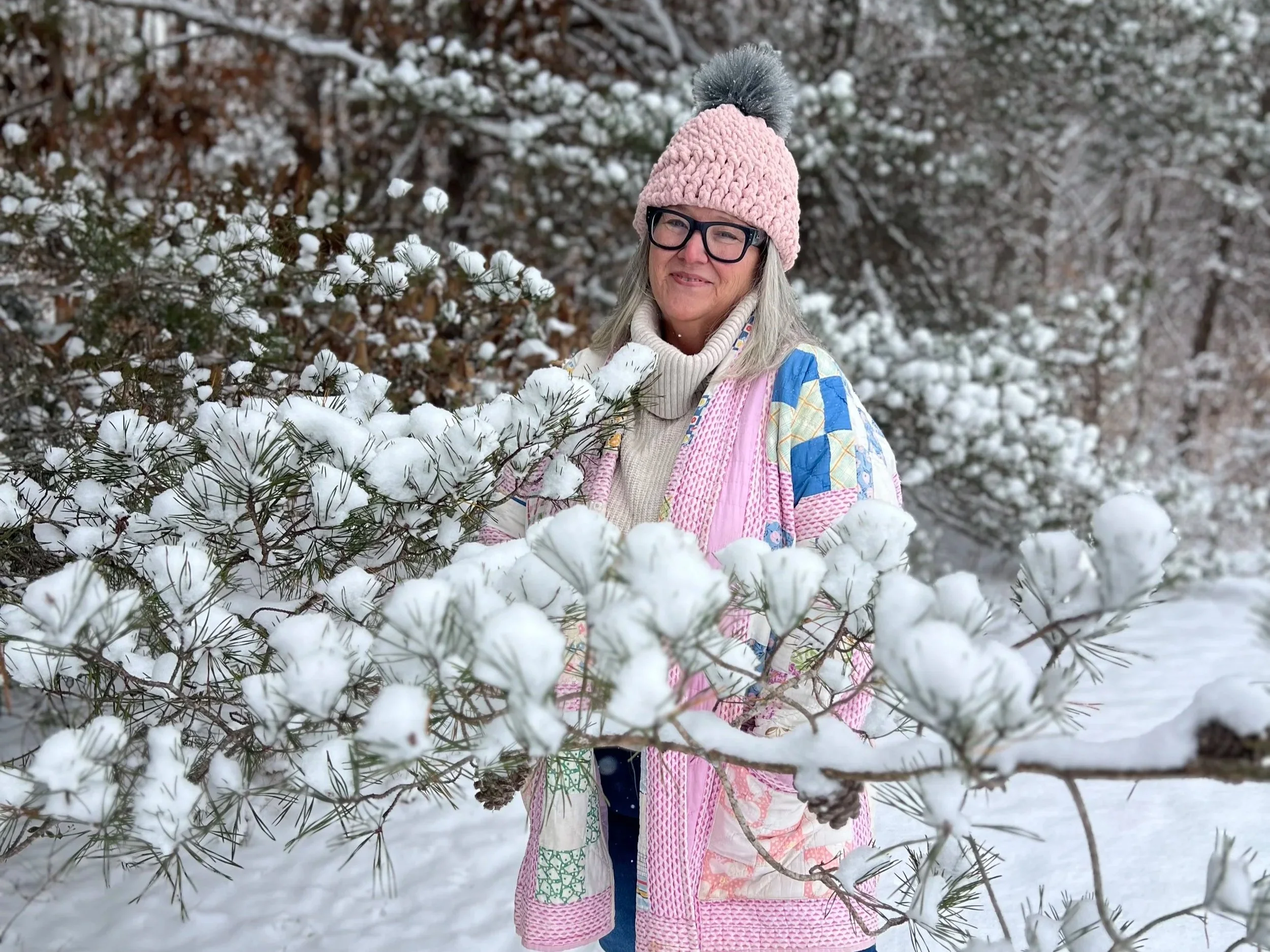
The Quiet of Snow
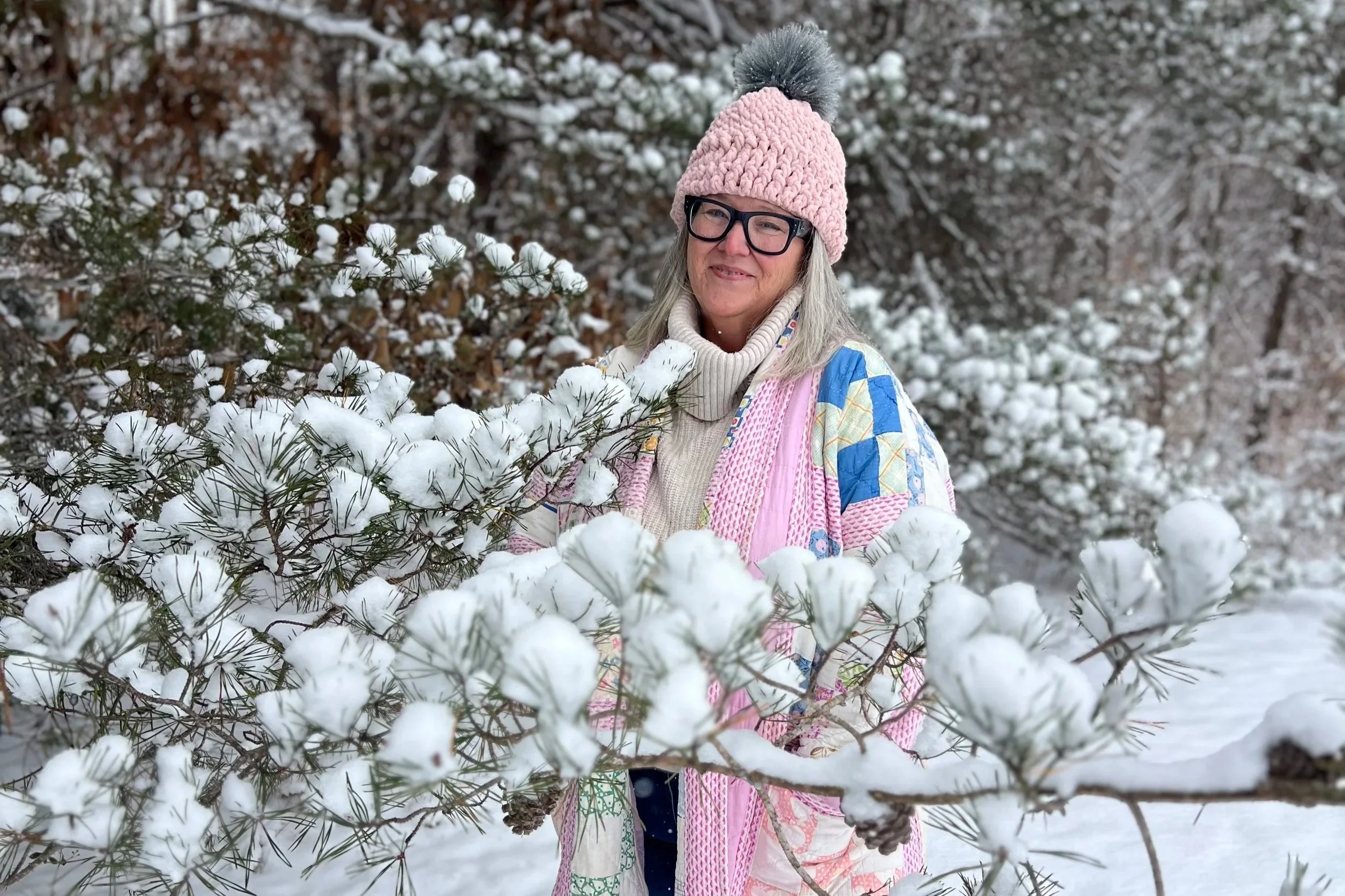
Snow changes a place without asking permission.
It does not arrive to impress or announce itself. It comes quietly, almost apologetically, and yet everything bends in response.
When snow begins to fall, the world seems to enter into a quiet agreement. The usual edges soften. Distance shortens. Sound retreats, as if it has been gently called home. Even time loosens its grip, no longer demanding progress or productivity, only presence.
Snow has a way of revealing how loud life has become.
What we notice first is not the cold, but the hush. The way familiar spaces feel altered without being rearranged. The way the air itself seems to listen. There is less urgency in movement, less insistence in thought. The world feels briefly unburdened of explanation.
There is something deeply invitational about snow. Not an invitation to retreat, but to reverence. To step more slowly. To pay attention to what remains when the noise pulls back.
We move differently when snow is present. Our steps shorten. Our bodies grow more aware. We notice the way breath gathers in the chest, the way cold sharpens the senses, the way quiet settles not just outside us, but within.
And in that stillness, something ancient remembers how to speak.
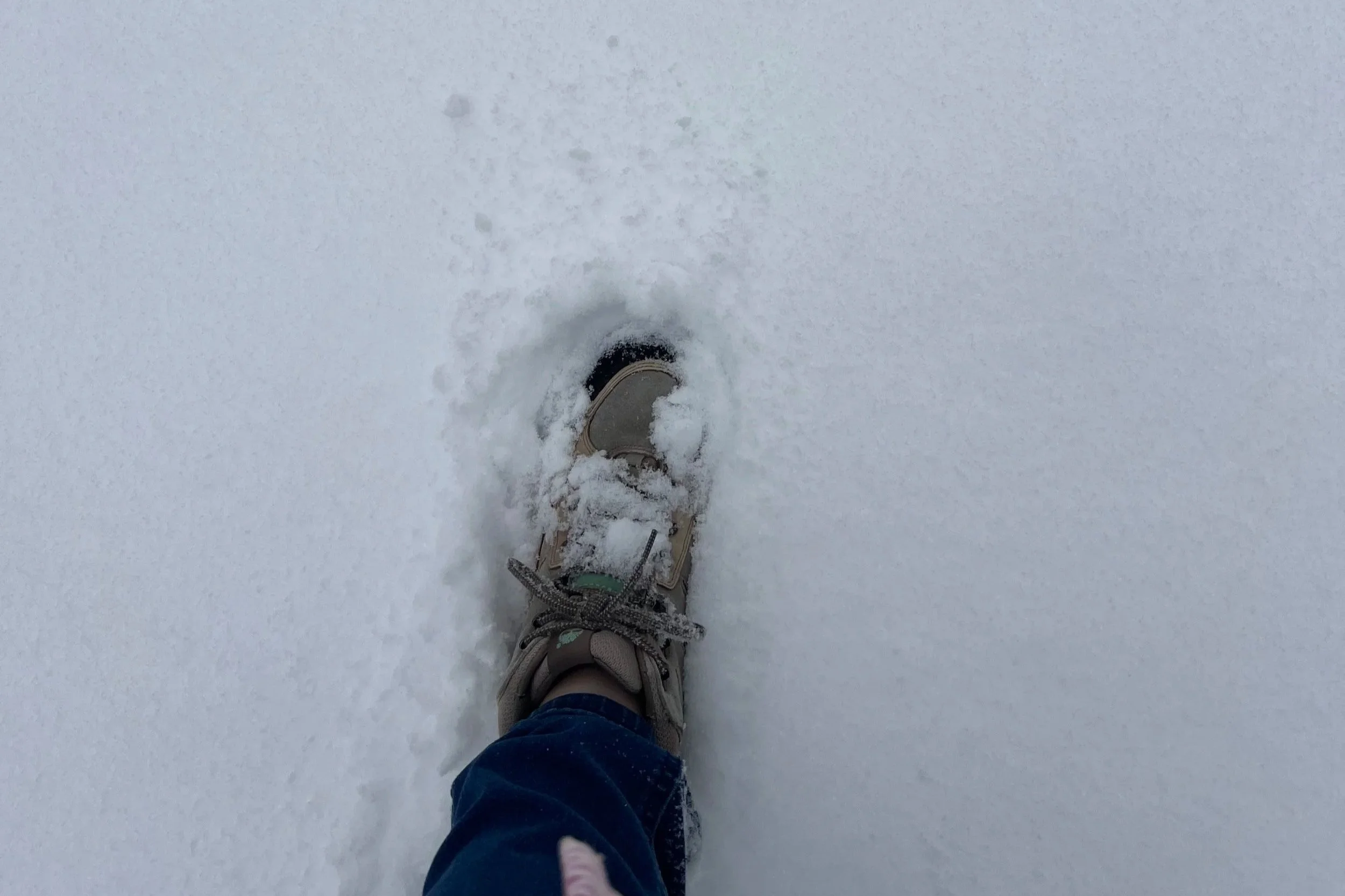
And when we pass through it, we leave very little behind.
A set of tracks.
A soft disruption.
The only evidence that someone was here at all.
Snow holds the memory of its travelers without commentary. It does not name them. It does not keep score. It simply bears witness, until even that disappears.
The Quiet of Snow
Snow does not arrive with announcements.
It comes like a held breath.
The world softens first.
Edges blur.
Sound learns how to whisper.
Footsteps become careful,
as if the earth itself is resting
and we are guests passing through
a sacred room.
Our tracks are the only witnesses,
brief signatures written in white,
gone almost as soon as they appear.
Snow quiets what has been loud for too long.
It settles arguments,
pauses momentum,
smooths the sharp corners of thought.
There is a kind of mercy in it.
A reminder that nothing needs fixing right now.
Nothing needs explaining.
Under snow,
everything is allowed to be unfinished.
The fields rest.
The branches bow.
The ground receives what it has been waiting for.
Snow teaches us that stillness is not empty.
It is full of listening.
The Quiet Leaves a Trace
When the snow melts, the world will rush back in. It always does. The noise, the pace, the expectations return as if nothing happened. Roads clear. Schedules resume. The hush lifts.
But something has happened.
The quiet leaves a trace, even after the evidence disappears. Long after the tracks are gone, the body remembers what it felt like to walk more gently. To leave less behind. To move through the world without needing to announce itself.
Snow reminds us that not all presence requires permanence. Some moments are meant to pass through us, not stay. Some truths only arrive when there is nothing competing for our attention.
Even after the snow recedes, the earth remembers who crossed it.
And perhaps, so do we.
Snow doesn’t ask us to explain what we felt while standing in it.
It simply asks whether we noticed.
If this piece stirred something quiet for you, you’re welcome to leave a trace here.
Not a conclusion. Not a performance.
Just a small mark of having passed through.
What did the quiet of snow reveal to you?
Snow has a way of softening the world without asking anything in return. This week’s blog isn’t about winter or weather, really. It’s about what happens when sound steps back and presence steps forward. If you’re craving a few quiet moments, I left a path open for you here.
Read when the world feels loud.
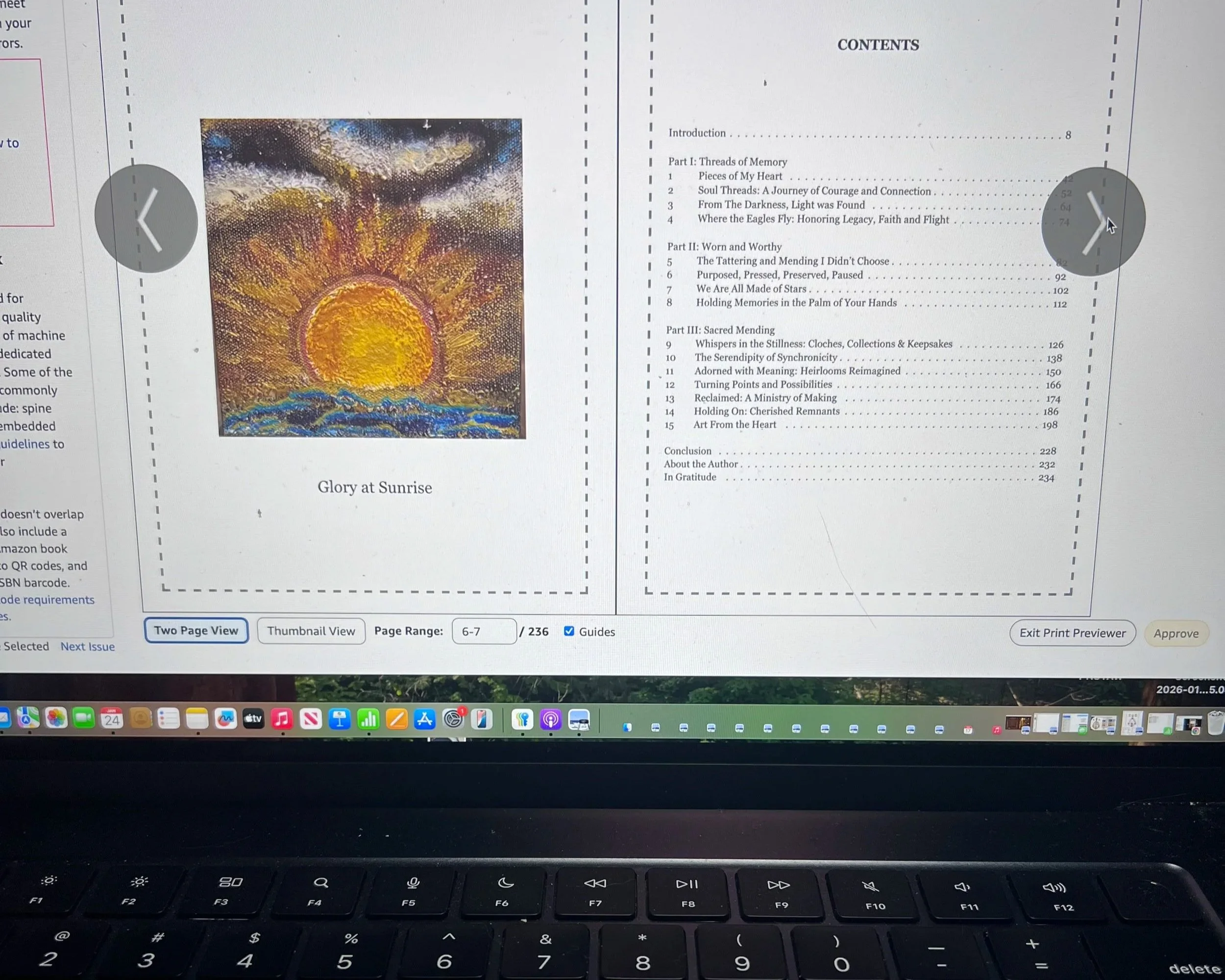
Not for the Faint of Heart (That’s How I Knew It Mattered)
Submitting my book wasn’t just a milestone, it was a threshold. A reflection on courage, vulnerability, and sharing what matters most.

“And the day came when the risk to remain tight in a bud was more painful than the risk it took to blossom.”
— Anaïs Nin
I submitted my book this week … and I realized something I didn’t expect to feel so deeply:
This wasn’t for the faint of heart.
Not mine.
Not anyone’s.
Because submitting a book isn’t just uploading files and clicking a button. It’s not simply “done.” It’s not a tidy finish line with confetti and a clean exhale.
It’s a threshold.
It’s standing in the doorway of something you made with your own hands and your own history, holding it out into the world, and realizing … this is real now.
And suddenly, it hits you.
This isn’t just a project.
This is a piece of your life.
The truth is … I felt exposed.
I don’t mean in a dramatic way. I mean in a quiet, honest way.
Like the kind of vulnerability that doesn’t announce itself.
It just shows up in your body.
A tight chest.
A lump in your throat.
A long stare at the screen.
Because when you’ve poured yourself into something that carries memory, grief, legacy, love, and the type of healing you can’t always explain … you don’t hit “submit” and skip away like it’s nothing.
You hit submit and realize you’ve offered your heart in public.
And for a moment, you wonder if you should pull it back.
But here’s what I know now:
If it scares me to share it, that’s usually the part someone needs most.
Not the polished part.
Not the perfect part.
Not the “look how productive I’ve been” part.
The real part.
The part that cost me something.
The part that required tenderness.
The part that asked me to be brave in a way that had nothing to do with confidence.
Because confidence is loud.
But courage … courage is often quiet.
Courage looks like showing up even when your voice shakes.
Courage looks like creating anyway.
Courage looks like saying, “This matters,” even when you’re not sure who will understand it.
This book asked more of me than I expected.
I knew Tattered & Mended would be meaningful. I knew it would be personal.
But I don’t think I fully realized how much it would ask of me until I reached this moment.
Because the stories inside it aren’t just words on paper. They are lived. They are carried.
They hold the ache of missing someone.
The strange holiness of keeping what remains.
The way grief lives in the fabric of ordinary things.
And they hold something else too:
The beauty of transformation.
The way a piece of cloth can become a keepsake.
The way a garment can become a story.
The way a woman can become herself again, one stitch at a time.
The fear didn’t mean I was doing it wrong.
This week reminded me that fear isn’t always a warning sign.
Sometimes fear is simply the nervous system recognizing:
“This is big.”
“This is sacred.”
“This is new.”
Sometimes fear is the cost of stepping into visibility.
Sometimes it’s the price of letting something private become shared.
And sometimes it’s proof that what you’re doing has weight, and meaning, and a pulse.
Not for the faint of heart… but for the willing.
For the ones who have lived through hard things and still believe in beauty.
For the ones who are learning how to carry love and loss in the same hands.
For the ones who are tired of rushing past their own feelings.
For the ones who want to make something meaningful out of what remains.
This is what I keep coming back to:
The things that matter most rarely come easy. They come honest.
And maybe that’s the whole point.
A gentle reflection for you (if you’re in a brave season too)
If you’ve ever stood at the edge of something you created … and felt that same tender fear, I want to ask you this:
What are you holding back because it matters so much?
And what might happen if you let it be seen anyway?
Because maybe the trembling doesn’t mean you’re not ready.
Maybe it means you’re standing in the exact place where growth begins.
And maybe, just maybe …
Not being faint of heart is simply another way of saying: You’re alive. You’re healing. You’re becoming.
“Vulnerability is not winning or losing; it’s having the courage to show up and be seen …”
— Brené Brown
What’s one brave thing you’ve done recently that didn’t feel “easy” … but felt true?
Tattered & Mended: The Story Behind the Story
Some love doesn’t leave.
It lingers in the fabric, the memory, the thread.
Tattered and Mended is a story-filled collection of women transforming loss into wearable art, stitching legacy into something you can hold, wear, and carry forward.
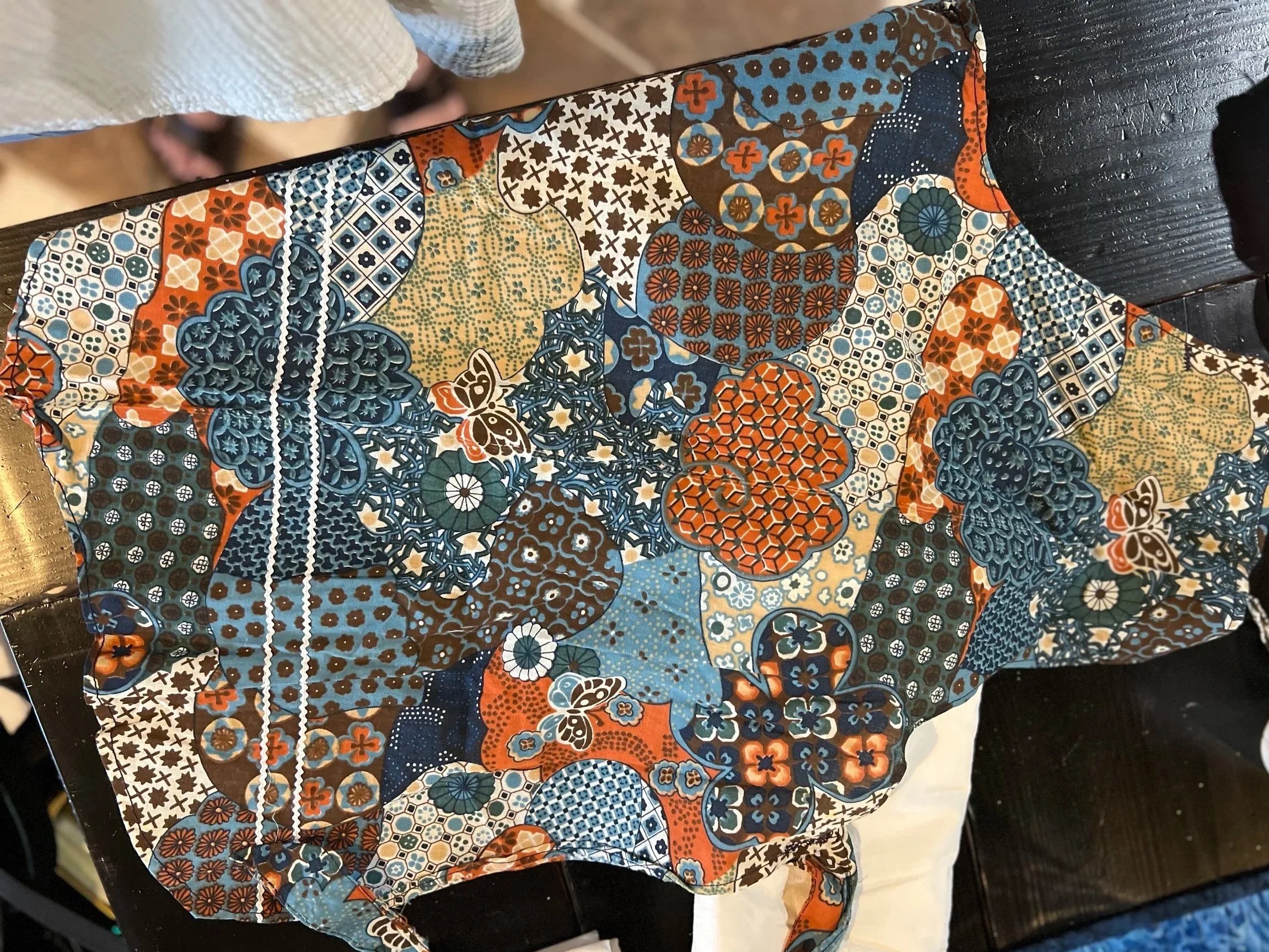
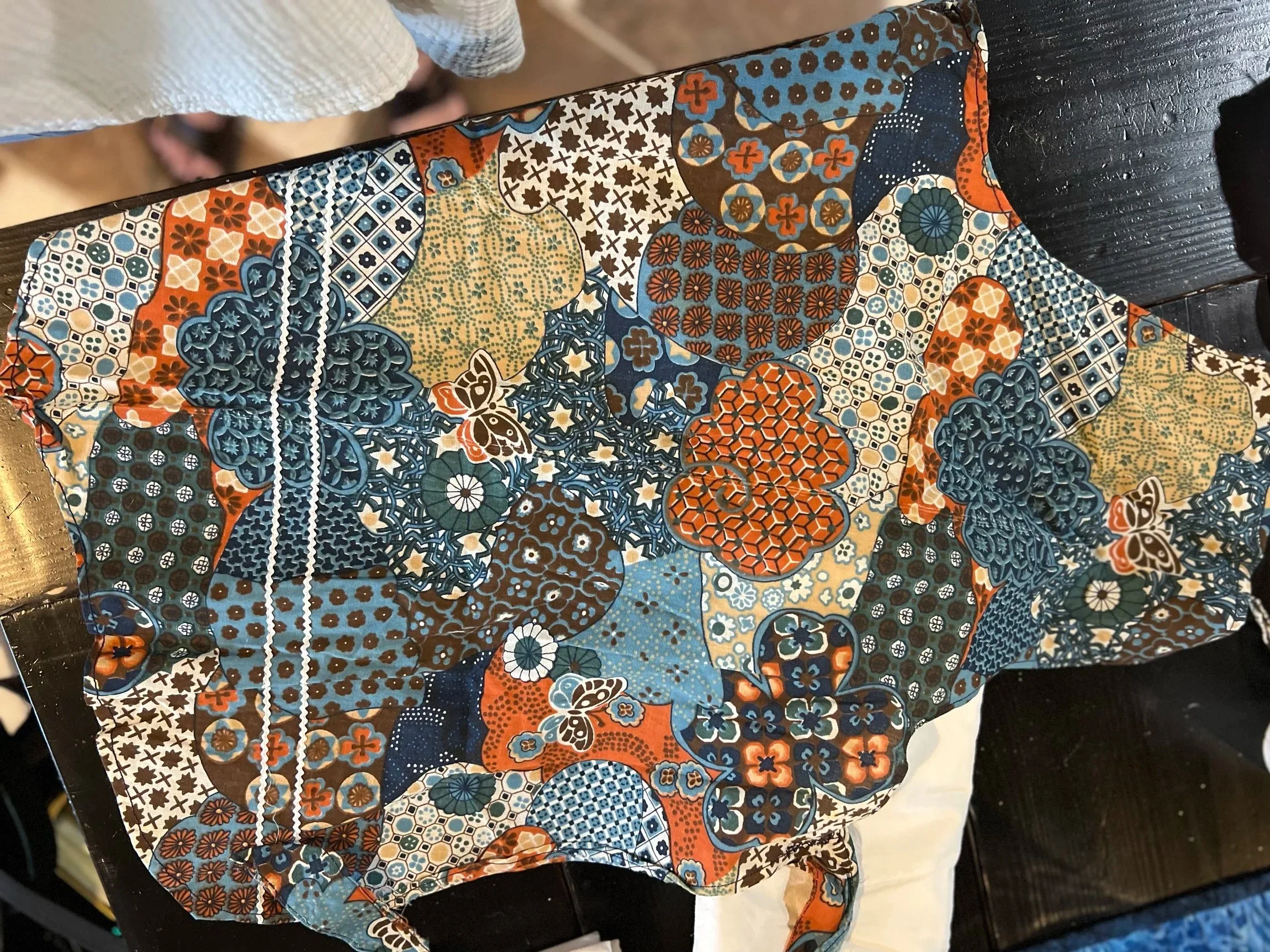
Apron I made for my mother when I was twelve.
There are some projects you choose …
and then there are the ones that choose you.
Tattered and Mended didn’t begin with a business plan or a publishing checklist. It began the way so much healing begins, quietly. In the background. In the soft places of life where grief lives, where love lingers, and where the heart keeps reaching for something it can hold.
For a long time, I thought I was simply making art.
But somewhere in the process, I realized I was doing something deeper.
I was learning how to hold what remains.
Because when we lose someone we love, the world doesn’t just feel different, it is different. And yet … their presence doesn’t disappear. It changes form. It becomes memory. It becomes scent and sound. It becomes certain songs you can’t hear without tearing up. It becomes a kitchen chair you still glance toward. It becomes the way your hands still reach for them in the dark.
And sometimes, it becomes fabric.
A denim jacket that still smells like home.
A flannel shirt that once held a heartbeat.
A stack of quilts folded carefully and put away because the idea of using them feels like erasing something sacred.
If you’ve ever held onto something like that, you already understand the beginning of this book.
The Why
I’m writing Tattered and Mended because I believe we all carry stories, and many of them are stitched into the things we keep.
This book is about grief, yes.
But it’s also about love and legacy.
It’s about the way love doesn’t end, it transforms.
It changes shape.
It asks for a new language.
And for me, that language has often been made of thread and needle, paint and paper, scent and warmth, texture and time.
I’ve come to understand something that surprised me:
Mending isn’t what I do.
It’s who I’ve become.
Because mending is not just repairing what was torn.
It’s learning how to live again.
It’s learning how to carry what hurts without hardening.
It’s making something beautiful without pretending the broken parts never happened.
The Process (The Part People Don’t Always See)
The process of creating this book has been equal parts art and reverence.
Each story begins with a woman, a man, a life, a loss … and a handful of pieces that mattered. Sometimes those pieces come from a cedar chest. Sometimes from a closet that hasn’t been opened in years. Sometimes from a box that has traveled through multiple moves because no one could bear to let it go.
And then we begin.
I listened.
I asked questions.
I learned who the person was, what they loved, what they wore, what they carried, what made them laugh, what made them who they were.
Then I began to create.
Not to replace what’s gone, because nothing can do that.
But to honor it.
To shape something wearable, repurposed, and tangible that says:
I see you.
You’re not broken.
You’re becoming.
Sometimes the sewing is the easy part.
Sometimes the hardest part is simply holding the weight of the story with tenderness and care.
There are moments I sit down to sew, and what I really end up doing is remembering.
There are moments the fabric feels like a doorway, and I have to pause and breathe before I step through … a threshold.
And there are moments when I realize the most sacred part of this work is not the keepsake itself, but what happens in the person receiving it.
Because it isn’t just clothing.
It’s a continuation.
It’s a way of saying:
Love still lives here.
What This Book Is Really About
On the surface, Tattered and Mended is about up-cycled garments or keepsakes created from cherished relics.
But underneath, it’s about something more timeless.
It’s about how we carry legacy.
How we hold memory in our hands.
How we make meaning from what remains.
How we keep going, even after the unthinkable.
It’s about the courage it takes to let grief transform you instead of closing you down.
And it’s about creativity as a holy act, not because it’s perfect, but because it’s honest.
Because there is something deeply human, deeply sacred, about taking what was torn and saying:
I will not waste this.
I will make something from it.
I will let it become part of my healing.
Why I’m Sharing This Now
I’m sharing this now because I’m still in the middle of it.
I’ve created.
I’ve listened.
I’ve gathered stories and shaped them into something worthy of the people they represent. And I think there’s something powerful about letting you witness the process, not just the finished product.
We live in a world that celebrates the “after.”
The polished.
The final reveal.
But I’ve learned that the most meaningful parts of becoming happen in the “during.”
The quiet.
The in-between.
The slow stitching of a life being rebuilt.
And that’s where I am.
A Gentle Invitation
If you’ve ever loved someone deeply and didn’t know what to do with the love after they were gone … this book is for you.
If you’ve ever kept a shirt, a scarf, a quilt, a jacket, not because it was valuable, but because it held them … this book is for you.
And if you’re in a season where you are learning to mend, not just fabric, but your own heart … I hope you’ll stay close.
I’ll be sharing more behind the scenes as Tattered and Mended continues to unfold, story by story, stitch by stitch, arrangement by arrangement.
Thank you for being here.
Thank you for witnessing.
And thank you for believing, as I do, that what’s been torn can still become beautiful.
Closing Blessing
May what we’ve lost become what we carry with tenderness.
May what we mend become what heals us too.
And may every thread of love find its way forward.
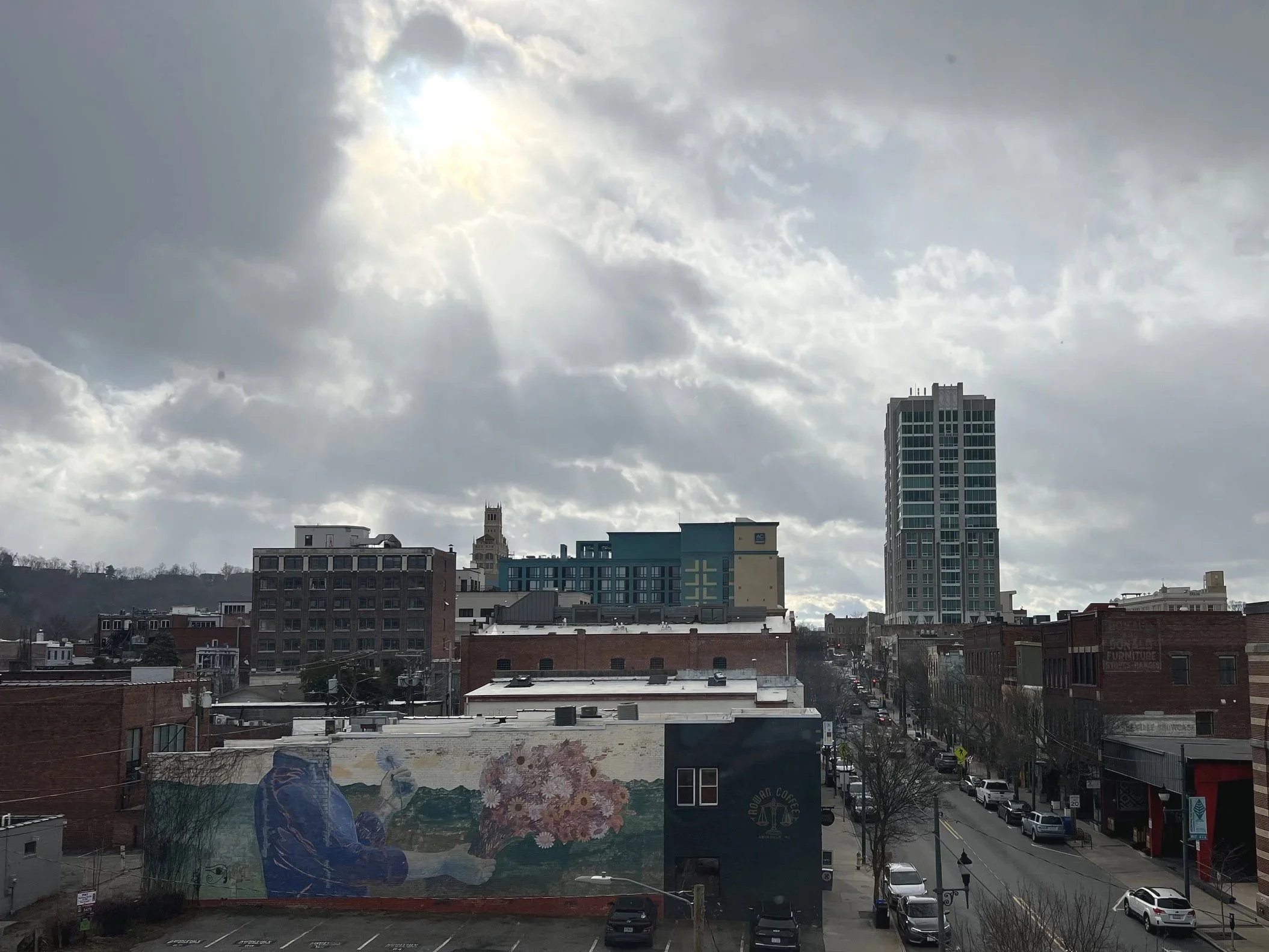
Rewriting Urgency: Choosing Ease
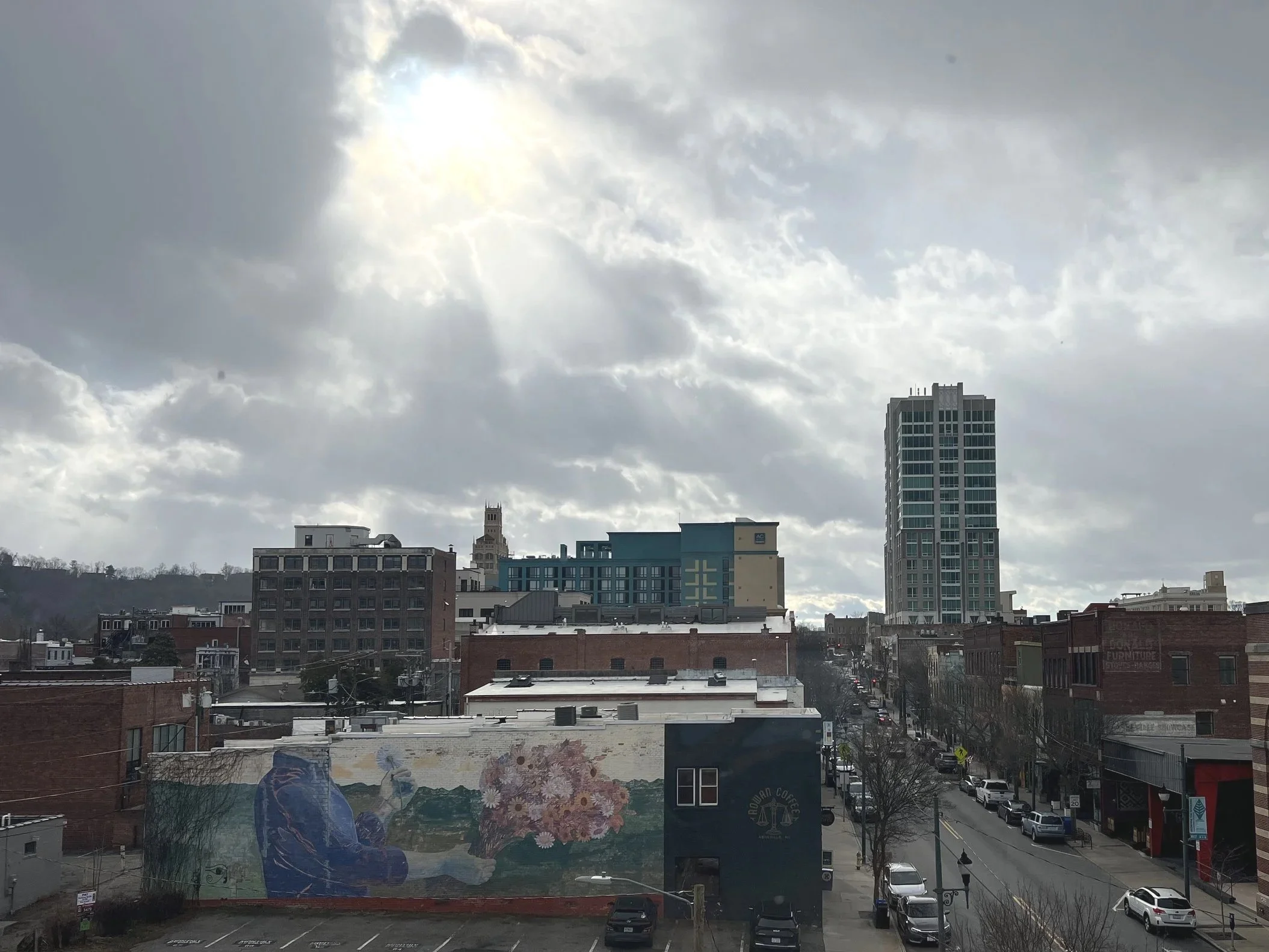
Pausing to admire the view, part of the Asheville skyline
“To pay attention, this is our endless and proper work.”
— Mary Oliver
The conversation that sparked this reflection didn’t happen in a rush.
It unfolded during a weekend workshop I attended in Asheville, in one of those in-between moments. It was during instruction, and we discussed it more in-depth during group discussion. It showed up in the pause that followed, when the room grew quiet and no one hurried to fill the space.
We had been talking about urgency. ASAP … as soon as possible …about how quickly we move to respond, to decide, to act. About how often speed is mistaken for clarity.
Then, in the stillness, someone offered a simple observation. It wasn’t framed as advice or teaching. Just something noticed and gently shared.
If we can stay in the pause long enough, and truly listen to the quiet, what we’re seeking often reveals itself.
No one rushed to respond. The room held it. And in that holding, something softened.
That thought stayed with me on the ride home as this weekend ended. Not as something to do, but as something to notice. A reminder that attention, not acceleration, is often what brings us back into alignment. That so much of what we chase through urgency might already be present, waiting not for effort, but for listening.
For a long time, urgency wore a convincing costume.
It sounded responsible.
It looked productive.
It promised that if I just moved faster, tried harder, pushed a little more, everything would fall into place.
ASAP became the quiet drumbeat beneath my days.
As soon as possible.
As fast as possible.
As much as possible.
What urgency rarely asks is whether the pace is sustainable, or humane, or even true.
Urgency is not the same as importance.
Urgency is not the same as devotion.
Urgency is often fear in a well-tailored suit.
The Subtle Cost of Urgency
Urgency compresses time.
It tightens the body.
It pulls us out of presence and into performance.
When urgency leads, listening becomes secondary.
Rest becomes negotiable.
Joy becomes optional.
Over time, urgency trains us to believe that ease is laziness and that slowness is failure. It teaches us to abandon ourselves just to keep up with an invisible clock.
And yet, so much of what matters most cannot be rushed.
Grief does not obey deadlines.
Healing does not respond to pressure.
Creativity refuses coercion.
Love unfolds on its own calendar.
Ease Is Not the Enemy of Progress
Ease has been misunderstood.
Ease is not giving up.
Ease is not apathy.
Ease is not doing nothing.
Ease is the right effort.
Ease is alignment.
Ease is movement that does not require self-betrayal.
When ease is present, the nervous system stays open. The body stays available. The work becomes a conversation instead of a command.
Ease allows wisdom to enter the room.
From Attention to Action, Gently
What that quiet moment in Asheville reminded me is this: attention shapes pace.
When we pay attention, we naturally move differently. We stop forcing timing and start trusting rhythm. And from that place, even our language begins to change.
That’s where my relationship with ASAP began to shift.
Reframing ASAP
After our discussion, I began to rewrite the meaning of ASAP in my journal. Not as a rejection of momentum, but as a reclamation of how momentum feels.
Here are a few new translations that were shared, and a few that came to mind:
ASAP: As Softly As Possible
ASAP: As Sustainable As Possible
ASAP: At a Steady, Attuned Pace
ASAP: As Supported As Possible
ASAP: At the Speed of Presence
None of these eliminate forward motion.
They simply refuse harm as a requirement.
My favorite became this:
As Supported As Possible, Without Leaving Myself Behind
The Body Knows the Difference
The body can feel the difference between urgency and ease immediately.
Urgency is shallow breath.
Ease is a fuller inhale.
Urgency narrows vision.
Ease widens the field.
Urgency asks, “How fast can I get there?”
Ease asks, “Can I arrive intact?”
When we choose ease, we do not abandon responsibility. We abandon unnecessary strain.
A Different Kind of Discipline
There is discipline in urgency, yes.
But there is also discipline in restraint.
It takes practice to pause.
It takes courage to slow down in a culture that equates speed with worth.
It takes trust to believe that what is meant for you will not disappear if you move with care.
Ease is not passive.
Ease is deeply intentional.
It is the discipline of listening before acting.
Of choosing rhythm over force.
Of allowing life to meet you halfway.
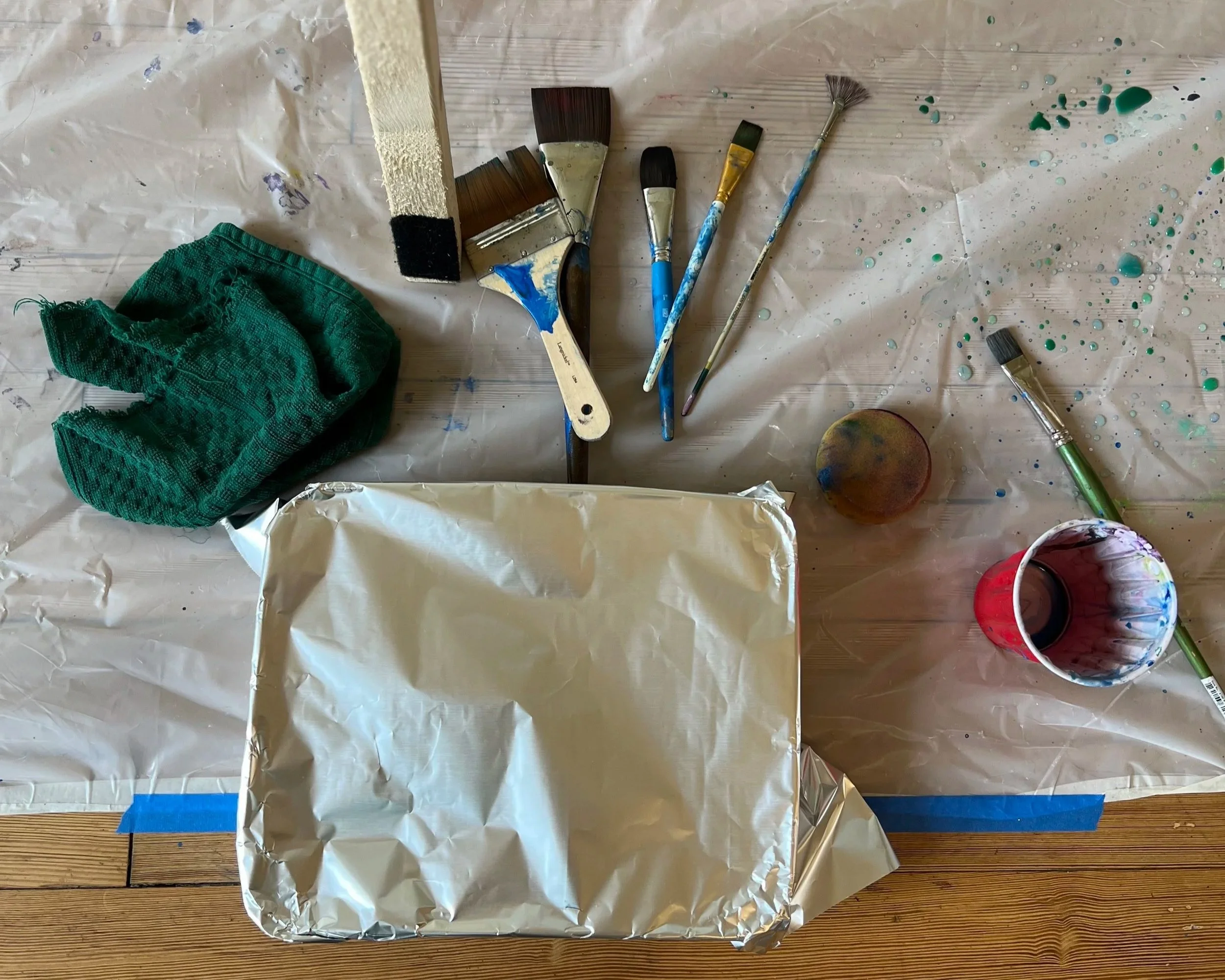
Pausing before I paint
Closing
This past weekend’s workshop didn’t offer answers. It offered space.
And in that space, I was reminded that what I’m seeking rarely responds to pressure. It responds to presence.
Nothing meaningful blooms on demand.
Presence is not a delay.
Gentle is still forward.
And maybe ASAP was never asking us to hurry at all.
Maybe it was inviting us to move
as softly as possible.
An Invitation
If you find yourself living under the constant pressure of “now” and “faster” and “already late,” consider this a gentle invitation.
You are allowed to move at the pace of truth.
You are allowed to take up time.
You are allowed to choose ease and still be devoted, committed, and productive.
And maybe, just maybe, ASAP can mean something entirely new now.
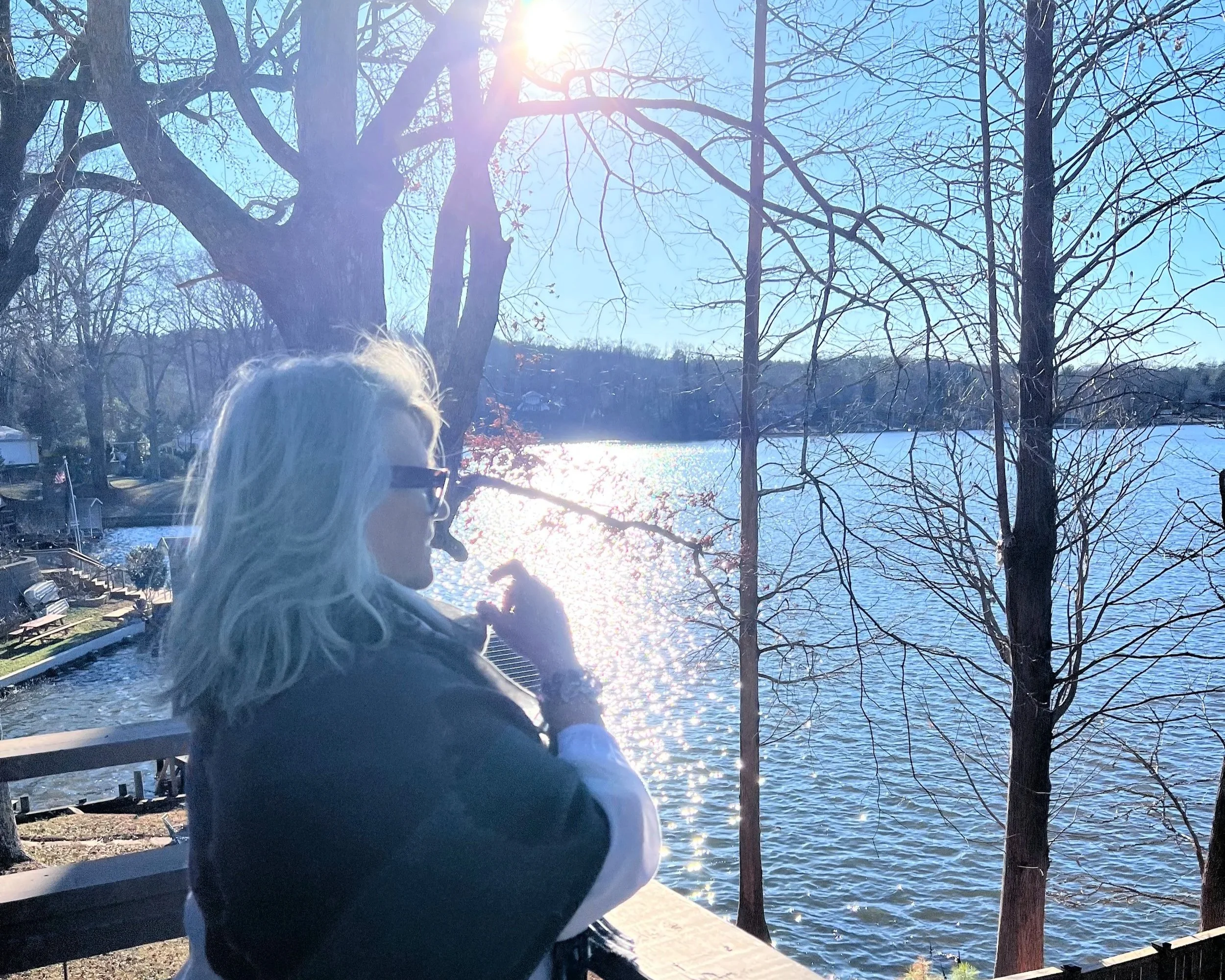
Ode to 2025
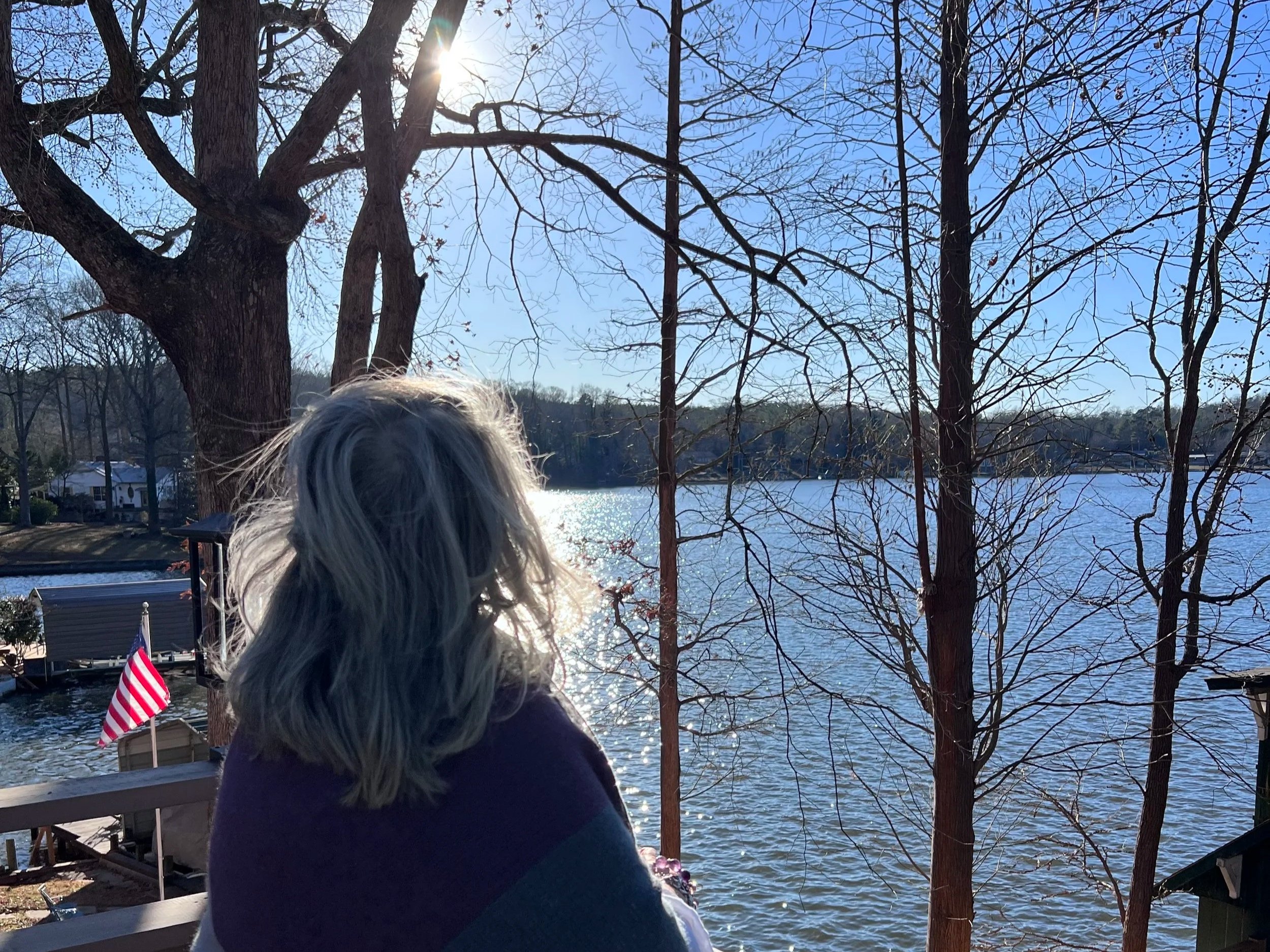
A Year Lived Fully, Even When It Didn’t Go as Planned
“Becoming is not about arriving somewhere new.
It is about remembering what has always been true.”
2025 asked a lot of me.
Not in loud, triumphant ways, but in the quiet endurance of showing up again and again, even when the path bent, stalled, or disappeared altogether.
So much of this year was held together with emails. Long ones. Tender ones. Updates written from hospital rooms, hotel rooms, and kitchen tables. Messages sent to keep people in the loop when my own life felt anything but linear.
When Life Reorders the Calendar
Early in the year, my dad’s health shifted everything. Multiple hospitalizations, cardiac arrest, and a long road to regaining his health. The chaotic feeling of no control, wishing that you stop time and reorder priorities without asking permission. Days were measured in waiting rooms and test results. Gratitude became very specific: another day, another conversation, another chance to sit across from him and laugh.
We are, once again, borrowing time.
And I do not take that lightly.
Devotion, Disappointment, and the Page
Creatively, this was a year of connection and devotion.
And yes, also disappointment.
I wrote. Fully. Faithfully. I stopped circling the work and stepped into it. I embraced writing not as something I fit in, but as something I showed up for. I became consistent. I kept my word to myself.
My book did not get published as I had planned. My retreat I had planned, cancelled. That truth still carries weight. But the work itself mattered. The pages mattered. The voice that formed and strengthened through repetition mattered. Sometimes the harvest isn’t visible yet, but the roots are undeniable. Timing … divine timing.
Holding Space and Telling the Truth
In 2025, I became a curator for The Turquoise Iris Journal, a role that stretched me and grounded me all at once. Holding space for other women’s stories while continuing to honor my own felt like a full-circle moment.
I also spoke publicly about my story among my peers, something that once would have felt impossible. I didn’t polish it. I told the truth. And in doing so, connection happened.
Out of that shared courage, I became part of a YouTube documentary with 13 other women, centered on The Art of Becoming. Standing alongside other creatives and storytellers, each naming our own unfolding in real time, was both humbling and affirming. It reminded me that becoming is not a destination. It’s a lived practice.
On the Road and On the Return
Travel became a teacher this year.
Madison Indiana, Chicago … Edgerton Wisconsin, Colorado Springs, Sedona, and back to Madison Indiana again. Each held a different lesson.
Some trips were about work.
Some were about rest.
Some were about remembering who I am when I’m not rushing.
Returning to Sedona felt less like a trip and more like a pilgrimage. A coming back to something ancient, steady, and familiar in my bones. Certain places don’t just welcome you, they recognize you.
Community, Craft, and Capacity
Friendships deepened. Some were forged on the road, others strengthened through shared meals, long walks, and honest conversations. A few fell away quietly, without drama, simply because seasons change. I learned again that not every connection is meant to last forever, but every one leaves an imprint.
There were shows. Some exhilarating. Some exhausting. Some that confirmed I’m exactly where I’m supposed to be, and others that reminded me what no longer fits. I learned more about pacing, capacity, and honoring my energy. I met amazing people, and new opportunities.
I completed certifications this year. That matters. Even when outward momentum felt slow, inwardly I was becoming more rooted, more skilled, more sure.
I also faced the truth about goals. Some were met. Some were exceeded in unexpected ways. Others simply didn’t happen. Not because I failed, but because life intervened, priorities shifted, or timing wasn’t right.
A goal unmet is not a moral failure.
It’s information. I took note.
What This Year Was Really About
What stands out most, looking back, is connection.
2025 was about connection.
To family. To friends. To community. To my own voice. To the work itself.
And beneath all of it, I felt guidance. Quiet. Steady. Unseen, yet unmistakable. A presence that nudged, reassured, and reminded me when to pause and when to proceed. I am deeply mindful of that blessing.
Looking Ahead with Joy
And now… I feel excited.
As I look toward 2026, I do so with anticipation and clarity. This is a year I will align with my goals, beginning in March, with intention and momentum. It is also a milestone year for me understanding that it will mark 60 trips around the sun for this lady. I hold that with joy, reverence, and gratitude. Not everyone is granted this many revolutions.
I feel ready. Energized. Rooted and curious all at once.
I’m welcoming the rest of winter as a season of preparation and imagination, knowing that the work taking shape now will bloom in beautiful ways come spring.
A Thought to Carry Forward
You don’t have to rush the beginning.
Some of the most meaningful work starts quietly, beneath the surface.
And I’m curious about you.
Do you begin your year right away, mapping work and goals by the calendar?
Or do you ease into it, letting winter finish its work before you hit the ground running in spring?
I’m firmly in the second camp.
Here’s to 2026.
To alignment. To creativity. To courage.
To becoming, again and again.
Thank you for rooting for me.
Thank you for following along.
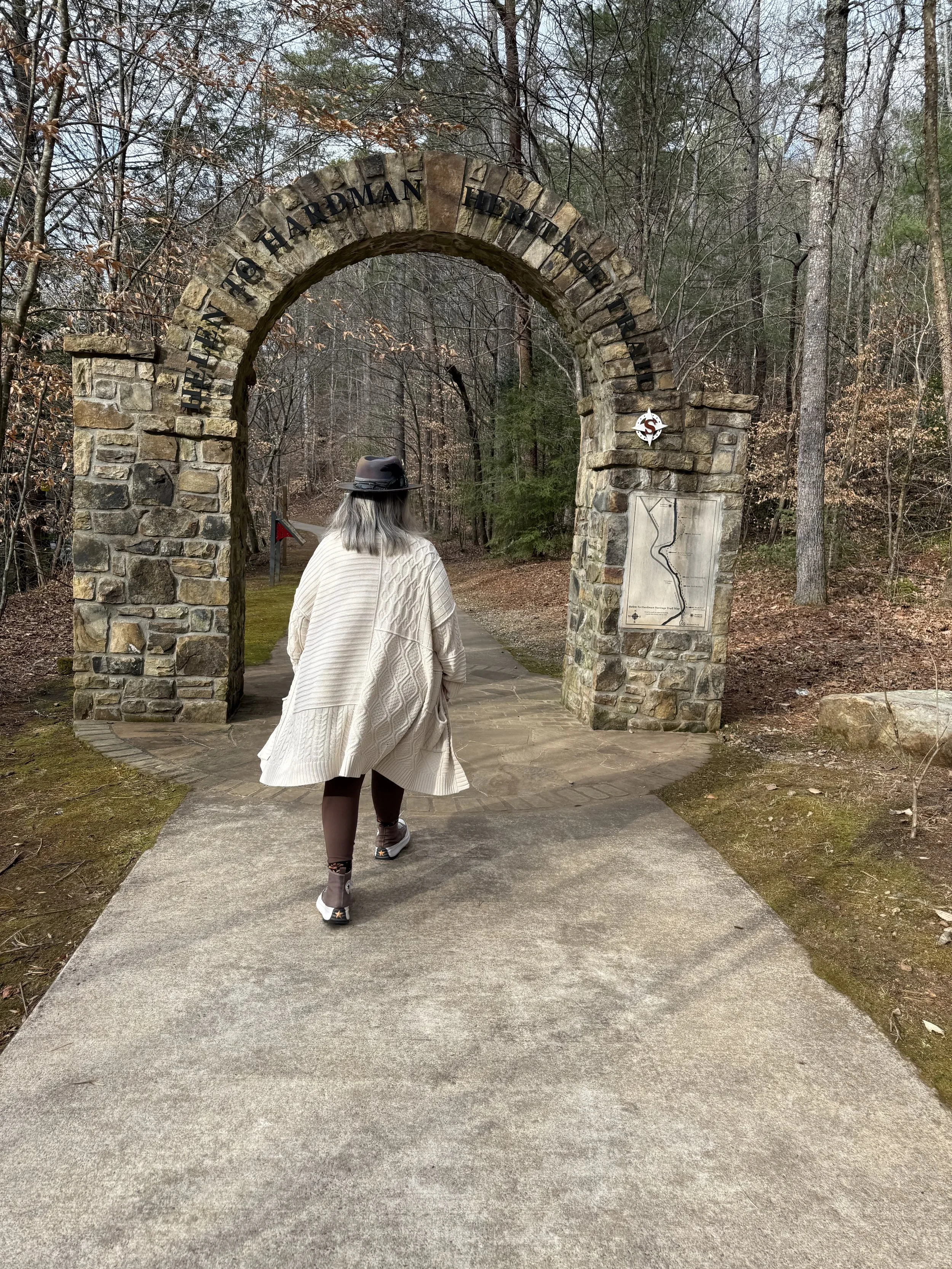
At the Turning of the Year: What We Carry Forward
There is a quiet that arrives at the end of a year.
Not the hush of everything being finished, but the softer stillness of something listening. The calendar turns, yes, but the soul lingers. It asks different questions than the ones we started with.
What did this year shape in me?
What did it loosen?
What am I still holding, even as the season asks me to open my hands?
As this year draws to a close, I’ve found myself less interested in resolutions and more drawn to remembrance. Not the polished highlight reel, but the honest remembering. The moments that taught me something. The ones that asked me to slow down. The places where grace met me quietly, sometimes without announcement.
The Year Didn’t Go as Planned … and Still, It Was Good
If I’m being honest, this year didn’t unfold the way I imagined when it began. Some doors opened later than expected. Some stayed closed. Some plans softened into something else entirely.
And yet, when I look back with gentler eyes, I can see how much was still at work beneath the surface.
There were lessons in patience.
In tending what is already here.
In trusting that fruit can grow underground long before it shows itself.
Scripture reminds us that “to everything there is a season, a time for every purpose under heaven” (Ecclesiastes 3:1, NKJV). This year may not have been a season of arrival for everyone, but it was very much a season of preparing, rooting, and becoming.
What I’m Choosing to Carry Forward
As I reflect, there are a few things I know I want to take with me into the coming year:
A deeper commitment to presence over productivity
A softer relationship with time
The courage to keep creating, even when the path isn’t fully visible
The reminder that rest is not a reward, but a rhythm
I’m also choosing to carry forward gratitude. Not forced, but genuine gratitude for the people who showed up. For the work that continues to evolve. For the small moments that felt like quiet blessings along the way.
What I’m Gently Releasing
Just as important as what we carry is what we lay down.
I’m releasing the pressure to have everything figured out.
The need to explain every step.
The belief that growth must always be loud or fast to be meaningful.
There is a freedom in allowing the year to end without rushing to name the next one. Sometimes the most faithful thing we can do is simply trust the turning.
A Moment for You
Before the year slips fully into memory, I invite you to pause for a moment too.
You might reflect on these questions:
What did this year teach you about yourself?
Where did you notice unexpected grace?
What are you ready to release as you step forward?
What feels quietly hopeful right now?
You don’t need perfect answers. Just honesty.
Looking Ahead, With an Open Heart
As we step into a new year, my hope for you is not that everything becomes easier, but that you feel more anchored. More connected. More willing to trust the unfolding.
May you enter the next season with curiosity instead of pressure.
With faith instead of fear.
With room for both intention and mystery.
Thank you for being here, for reading, for walking alongside me in this shared space of reflection and becoming. I’m grateful for this community, and I look forward to what we’ll create, explore, and hold together in the year ahead.
“The Lord bless you and keep you;
The Lord make His face shine upon you,
And be gracious to you;
The Lord lift up His countenance upon you,
And give you peace.”
— Numbers 6:24–26 (NKJV)
Thought to Carry
As this year closes, remember this:
you are not behind.
You are becoming.
What feels unfinished may simply be waiting for the right season to bloom. Carry forward what has rooted you, release what has asked too much of you, and trust that the work of becoming continues—even in the quiet.
“Where we stand determines what we see, and what we see determines what we do next.”
— Parker J. Palmer
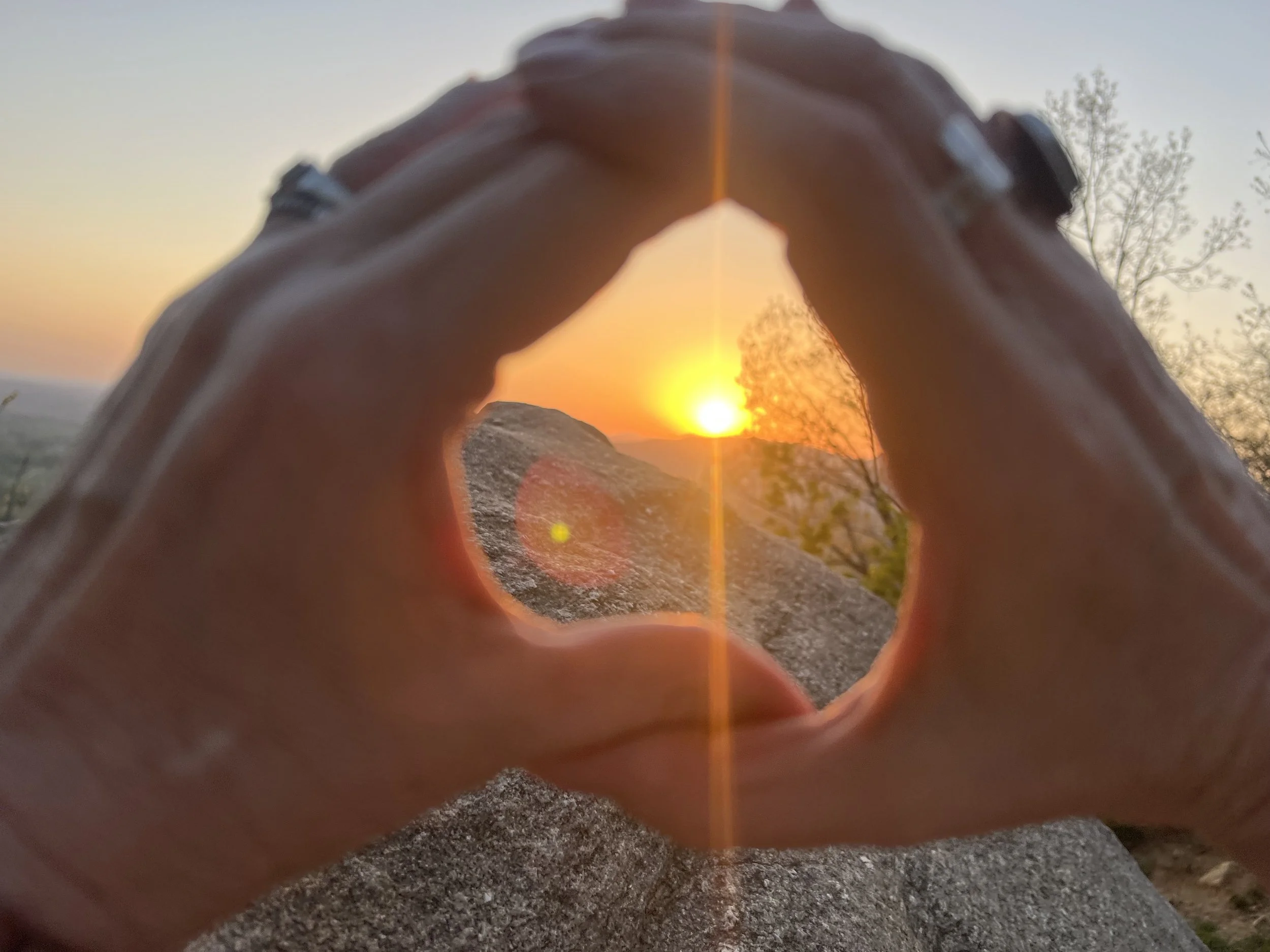
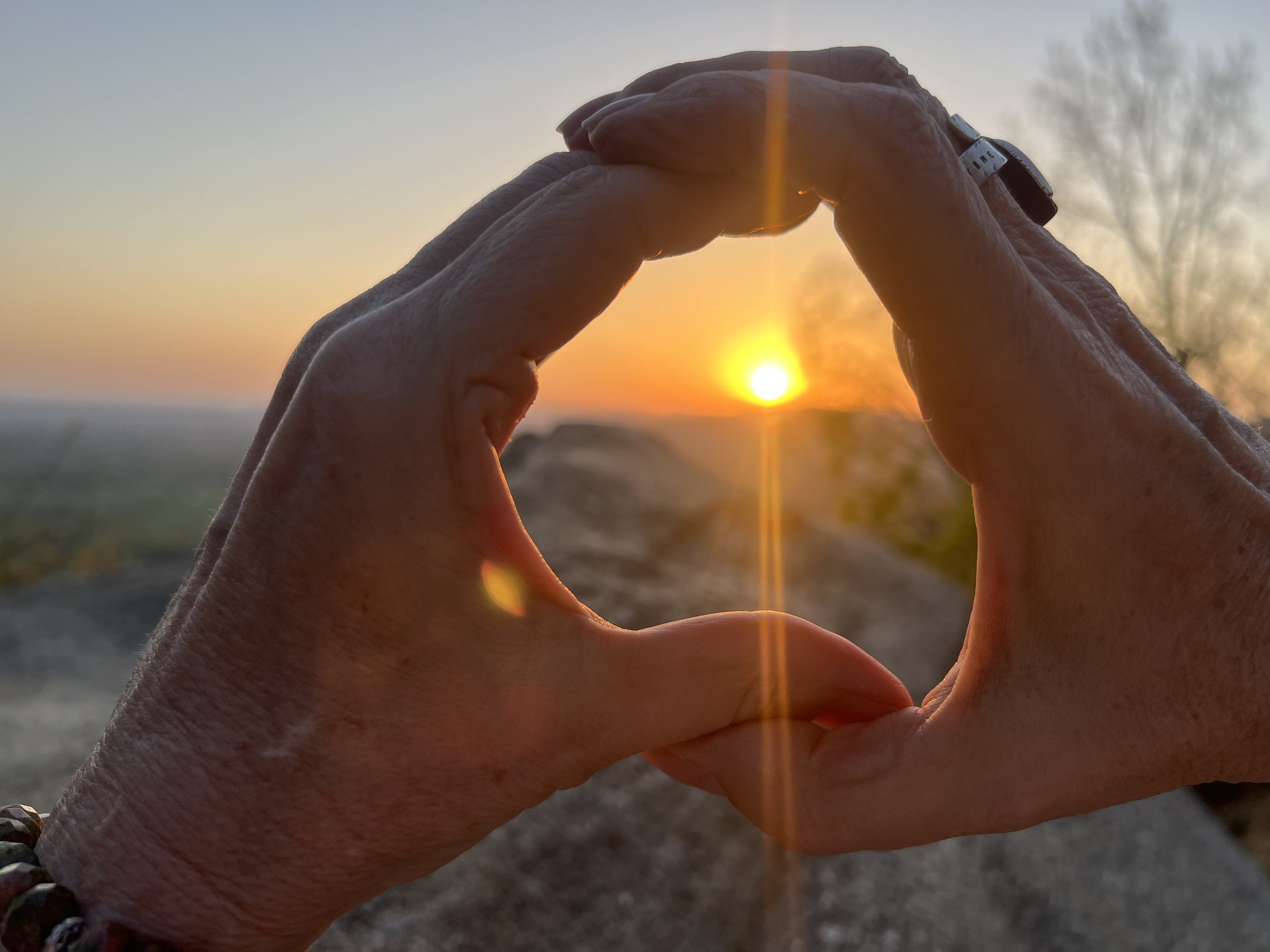
The Day After the Solstice
The Solstice came and went quietly yesterday.
No fireworks.
No dramatic shift.
Just the steady turning that has been happening all along.
I always feel something settle in the day after. A soft exhale. As if the year itself pauses long enough to say, you made it here. The longest night is behind us now, and even if we can’t quite feel it yet, the light has begun its return.
This day has become one I treasure. Not for what it announces, but for what it allows.
Looking Back, Gently
I’ll be honest. December has always been a hard month for me.
It carries memory, absence, and the weight of years layered one on top of another. There are moments when the season feels tender in ways that are difficult to name. For a long time, I thought I had to push through that discomfort, to move past it quickly.
This practice has taught me something different.
Honoring the Solstice has given me permission to embrace my feelings, whatever they are. Not to fix them. Not to explain them. Just to let them be present alongside the beauty of the season.
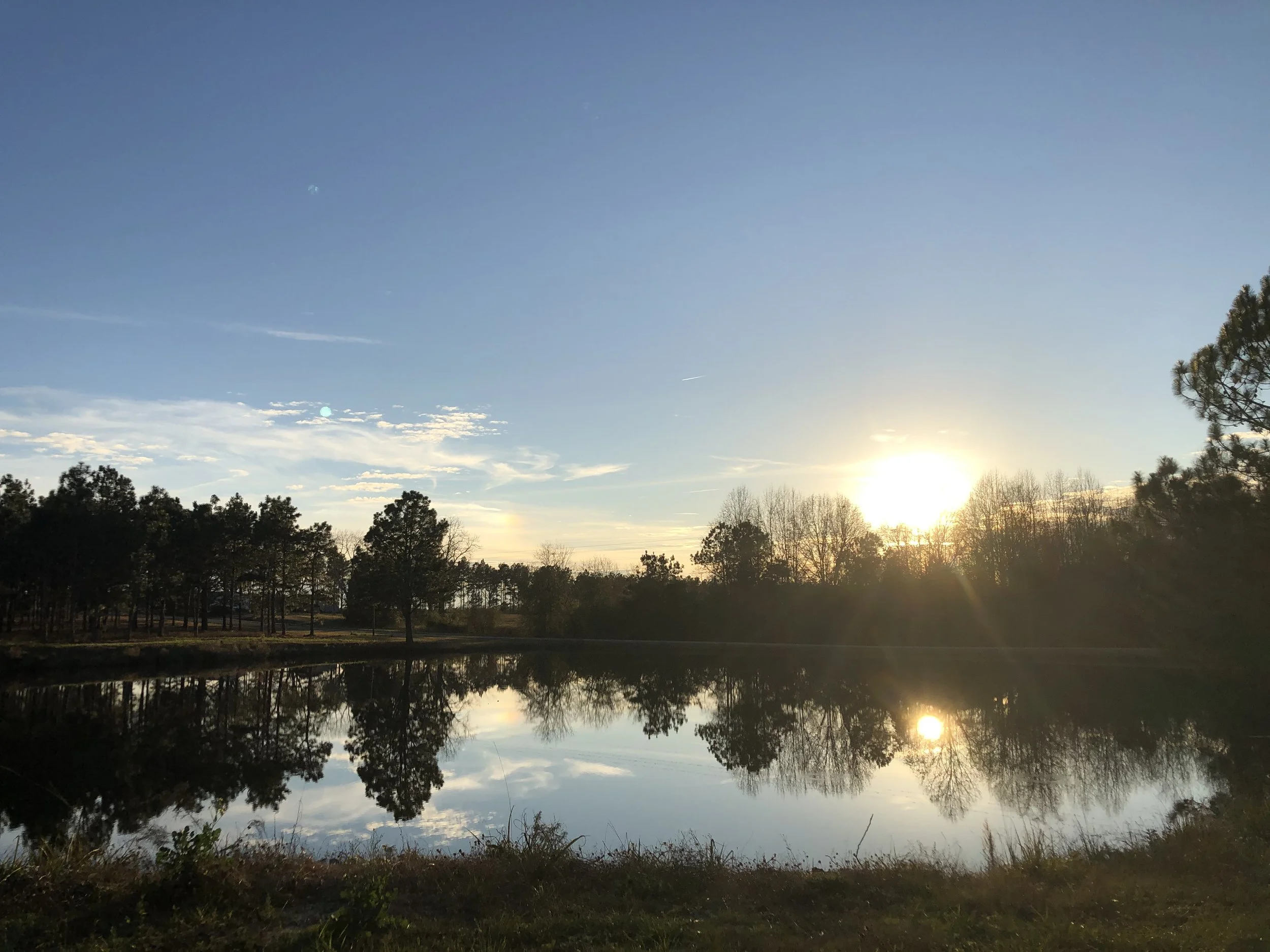
When Beauty and Tenderness Share the Same Space
There are moments when it all comes together in the most unexpected ways.
Like standing in a room on a Solstice night, listening to children sing beautiful Christmas songs, their voices clear and unguarded, surrounded by people you love and cherish. In moments like that, the heaviness softens. The beauty doesn’t erase the ache, but it sits beside it, offering warmth.
Those moments remind me that joy doesn’t require the absence of sorrow. They can exist together, quietly holding hands.
A Year That Unfolded Differently
This year did not begin the way I thought it would.
There were early days filled with uncertainty. Plans shifted. Expectations unraveled. At times, the path ahead felt unclear, and not in a poetic way.
And yet, as this year comes to a close, I can say this with a grateful heart: it has wrapped itself up in ways I could not have imagined.
I have been blessed by our Creator in ways I could not have seen arriving. Through people, conversations, opportunities, and moments that revealed themselves only once I was already walking forward. Looking back, I can see how grace met me along the way, not always where I expected it, but always right on time.
Blessing, in Both Directions
One of the gifts this season has reminded me of is this: when you are able to bless another person, you are often being blessed as well.
There have been moments when a simple conversation, a shared tear, or an unexpected embrace revealed that I had crossed paths with someone in the middle of a struggle I knew nothing about. In those moments, it becomes clear that you may have been part of an answered prayer without even realizing it.
Sometimes, the embrace afterward is all that’s needed. No words. No fixing. Just presence.
I no longer question why I meet people. I trust now that there is always a plan, a rhyme, a reason. And sometimes, that reason is simply to remind us of the goodness of God, made visible through one another.
Intention Without Expectation
As I look toward 2026, I do so with hope, but without demands.
Much like when I travel for shows, I carry a simple expectation: I will meet cool people, and I will enjoy my time, however it unfolds.
That way of moving has changed me. There is freedom in being intentional without being attached to outcome. In showing up open-handed. In trusting that blessings will meet us along the path as we are traveling through it.
The Quiet Work of Winter
Winter invites us into a slower, deeper kind of work.
It is the work of reflection, rest, and discernment. Of choosing what to carry forward and what can finally be laid down. It may not look productive from the outside, but it is deeply formative.
This is where roots strengthen.
Where vision clarifies.
Where the heart steadies.
An Invitation for Today
If you’re reading this today, the day after the Solstice, I invite you to pause for just a moment.
Light a candle.
Take a breath that reaches all the way down.
And ask yourself gently:
What am I allowing myself to feel right now?
Where have I noticed beauty or blessing meeting me, even unexpectedly?
There is no rush for answers.
A Thought to Carry
As you move through the days ahead, notice where the light is already returning in your own life. Not all at once, not loudly, but quietly and faithfully. Let this season be an invitation to honor where you are, trust what is unfolding, and remain open to the blessings that meet you along the way.
“The light shines in the darkness, and the darkness has not overcome it.”
— Madeleine L’Engle
“Weeping may endure for a night,
But joy comes in the morning.” —Psalm 30:5 (NKJV)
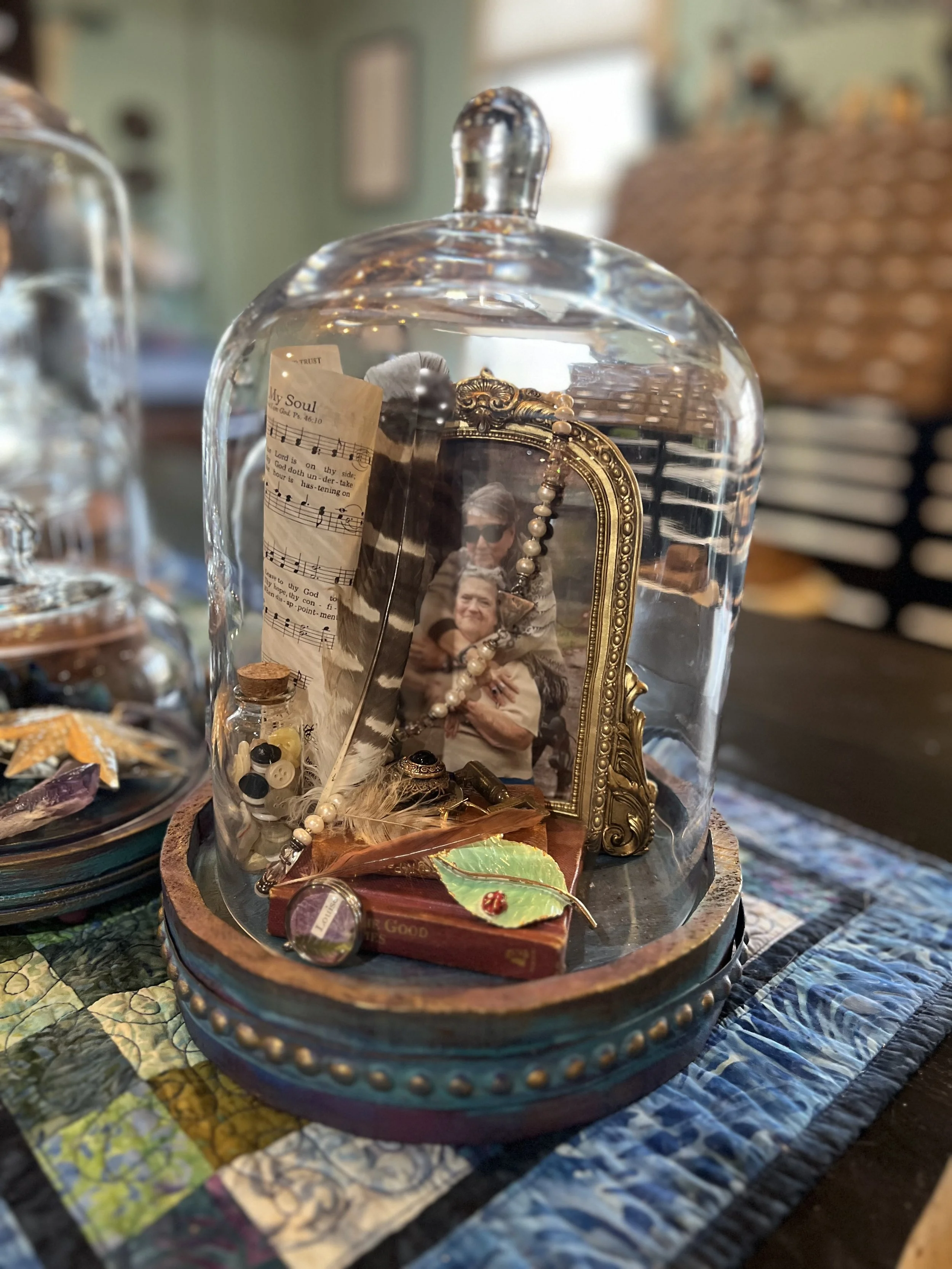
A Wintering of the Heart
There are seasons that arrive gently, like a familiar song, and then there are seasons like winter … quieter, heavier, carrying memory in both hands.
Each year, this time marks itself in my body and heart. It is the season when people I deeply love made their journey home. Their absence becomes more pronounced against the stillness. Their names surface more easily. Their stories drift through my days like breath on cold glass.
Winter asks me to remember.
And remembering asks me to feel.
Grief has its own weather, and for me, it often settles in during these colder months.
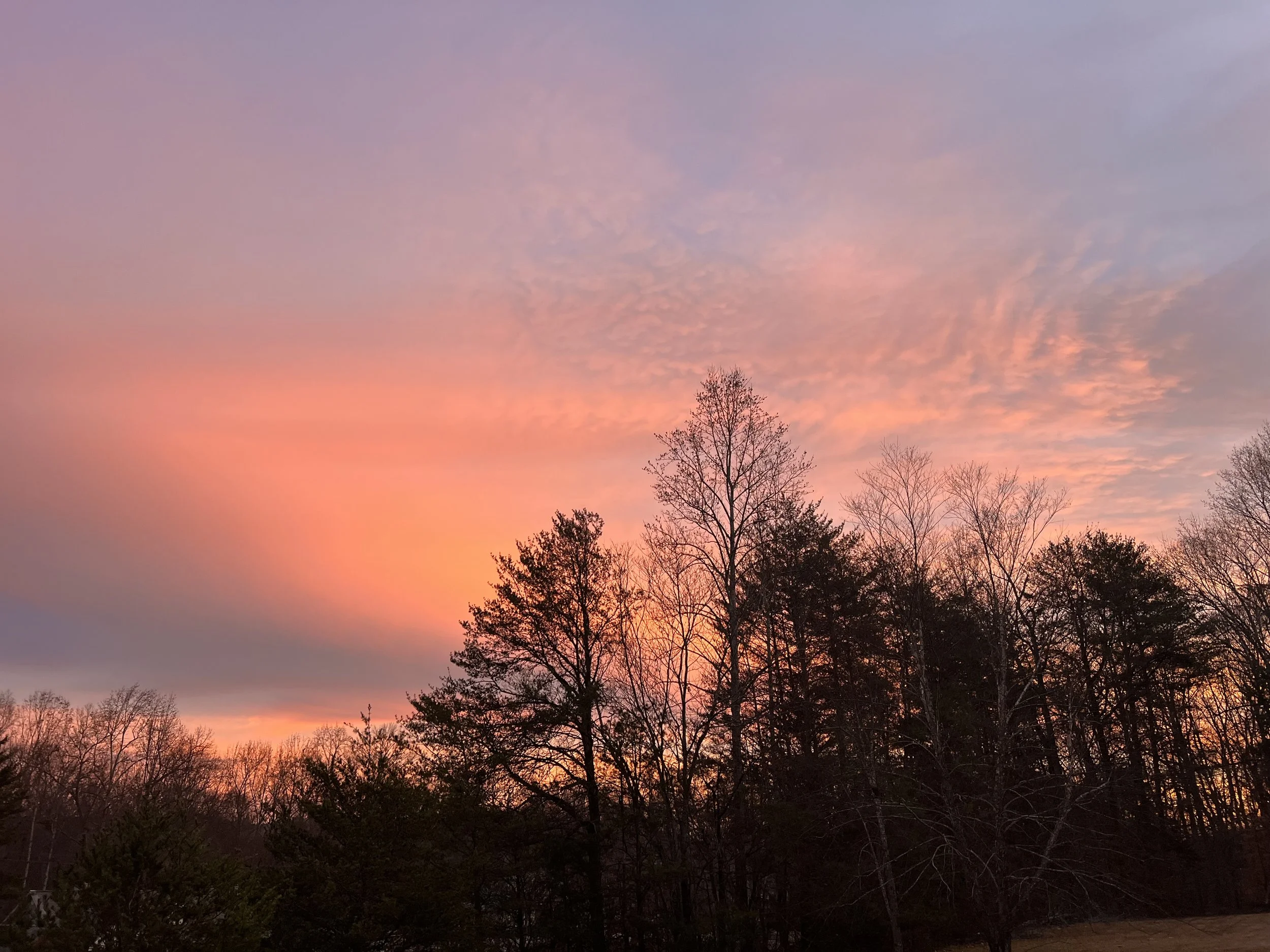
Over time, I’ve learned that this season will always hold a certain ache. What has changed is how I meet it. I no longer try to outrun the sorrow or rush myself toward “better.” Instead, I have learned to live beside it, to make room for it, while still tending to my own wholeness.
This is not resignation.
This is devotion.
Learning to Live Without Physical Presence
When people you love leave this world during winter, the season itself becomes marked.
Certain dates carry more weight.
Certain rooms feel quieter.
Certain traditions ache in ways they never did before.
Loss reshapes the landscape of our lives. It requires adjustment, not just emotionally, but practically, spiritually, creatively. We learn how to walk through the world again, carrying love without bodies, memories without voices, presence without proximity.
But I have come to believe this: love does not disappear when physical presence does. It simply changes form.
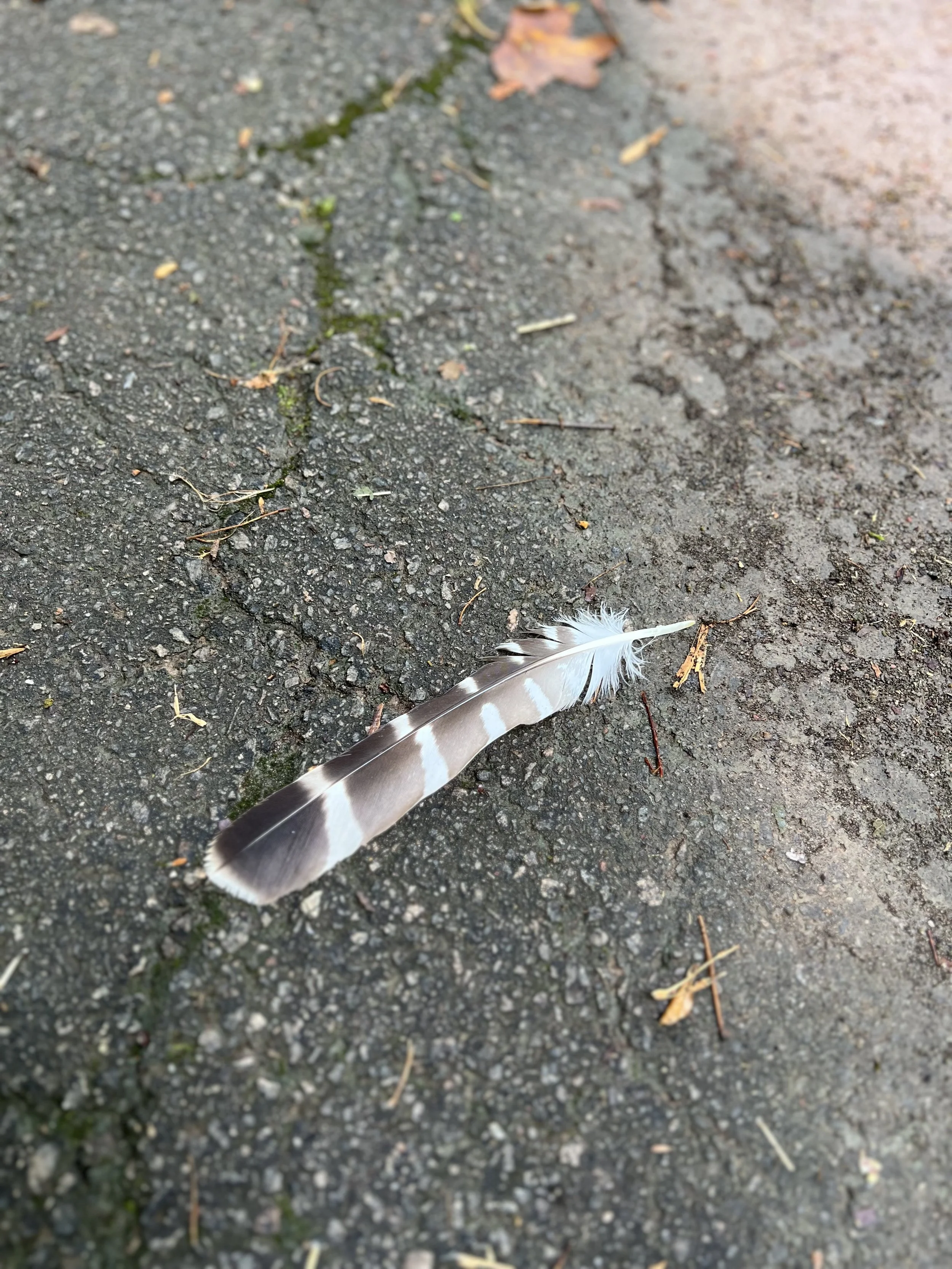
The people I have lost are no longer beside me in the ways they once were, but they are woven into who I am becoming. They are present in my work, my art, my pauses, my prayers, and the way I tend to others. Their lives continue to inform mine … quietly, steadily, faithfully.
Practicing the Work I Teach
This winter, I find myself returning again and again to the practices that have carried me through grief and toward wholeness. Not as concepts. Not as theory. But as lived experience.
I am practicing the work I plan to teach.
I light candles at dusk, not as decoration, but as a ritual of returning, a reminder that light is never fully lost, even in the shortest days.
I sit at my quiet table and write a few words, touch color, arrange objects, tend beauty. Creativity has become one of my most faithful healing companions … a way to speak when language feels thin.
I warm my body intentionally. Baths. Oils. Soft fabrics. Slower mornings. These are not indulgences; they are acts of self-respect. Ways of telling my nervous system that it is safe to rest.
I walk outside, even when the air is cold, letting nature mirror what I’m learning: that stillness holds life, that dormancy is not absence, that something is always preparing beneath the surface.
I practice sound, breath, stillness, and presence, not only for those I serve, but for myself. These practices are not something I step into when I teach; they are the way I move through my days.
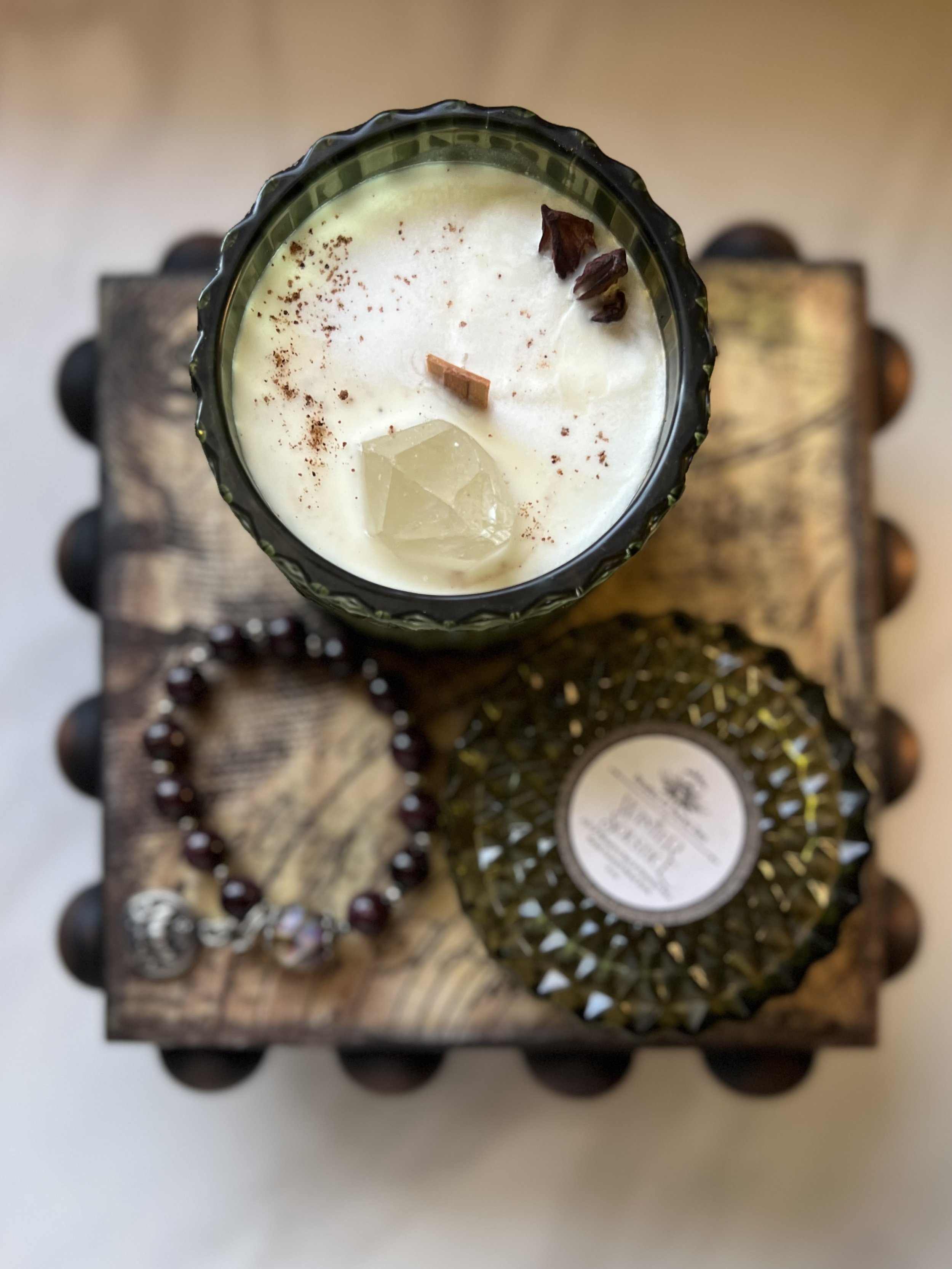
Becoming a Living Visual of Self-Care
Somewhere along the way, I realized that the most honest teaching comes from embodiment. Not from perfection, but from presence.
If I am to guide others toward wholeness, I must first be willing to walk the path myself, in real time, with my own tenderness fully included.
This season, I am choosing to be a living visual of self-care.
Not polished.
Not immune to grief.
But attentive, grounded, and honest.
I am learning that wholeness does not mean the absence of sorrow. It means tending to myself while carrying it. It means allowing grief and love to share the same space without trying to force one out.
Integrity is built quietly, in the moments no one sees. In the way I rest. In the boundaries I keep. In the compassion I extend toward myself when old waves return.
Winter is teaching me how to slow down enough to listen.
A Season of Remembering and Renewal
As I move through this winter, I hold two truths at once. I grieve what I have lost. And I honor what is still growing.
This season will always be tender for me. But it is also a season of deepening … a time when my roots are strengthened, my practices refined, and my sense of purpose clarified.
Grief lives here.
So does love.
So does creativity.
So does healing.
This is my wintering of the heart … a season of remembering those who shaped me, practicing the care that sustains me, and learning, again and again, how to live fully in the presence of both loss and love.
As this winter unfolds, I am learning to let tenderness be a teacher rather than something to overcome. I am allowing myself to move at the pace my heart requires, trusting that wholeness is not something I must achieve, but something I practice, moment by moment, breath by breath.
This season may always carry grief for me. But it also carries devotion to the life I am living now, to the love that remains, and to the care that allows me to stay present to both. Winter is no longer just something to endure. It has become a place where I listen more closely, rest more honestly, and tend the parts of myself that ask to be held.
A Thought to Carry
Wholeness is not the absence of ache, but the way I tend to myself while walking with it. Each gentle act becomes a lantern, lighting the path back home to my own heart.
Winter reminds me that grief and renewal often arrive together. That even in the quietest season, something within us is listening, learning, and preparing to rise again.
If you find yourself struggling in this season too, know this: you are not broken for feeling deeply. You are human. And even here, especially here, there is room for gentleness, for rest, and for renewal.
If this time of year is tender for you too, I hope you allow yourself the same grace. To slow down. To rest. To practice care in ways that feel simple and sustaining. You don’t have to rush your healing or explain your sorrow. There is room here for remembering, for mending, and for becoming whole in your own time.
“I am learning that grief and grace can share the same room within me.” —PC
“He heals the brokenhearted and binds up their wounds.” —Psalm 147:3 (NKJV)
Borrowed People
A tender reflection on the borrowed people in our lives — the ones we love, lose, and carry within us. This piece explores the sacredness of impermanence, the beauty of returning others “better than we received them,” and the deep ache this season brings as we remember our own beloved borrowed people.
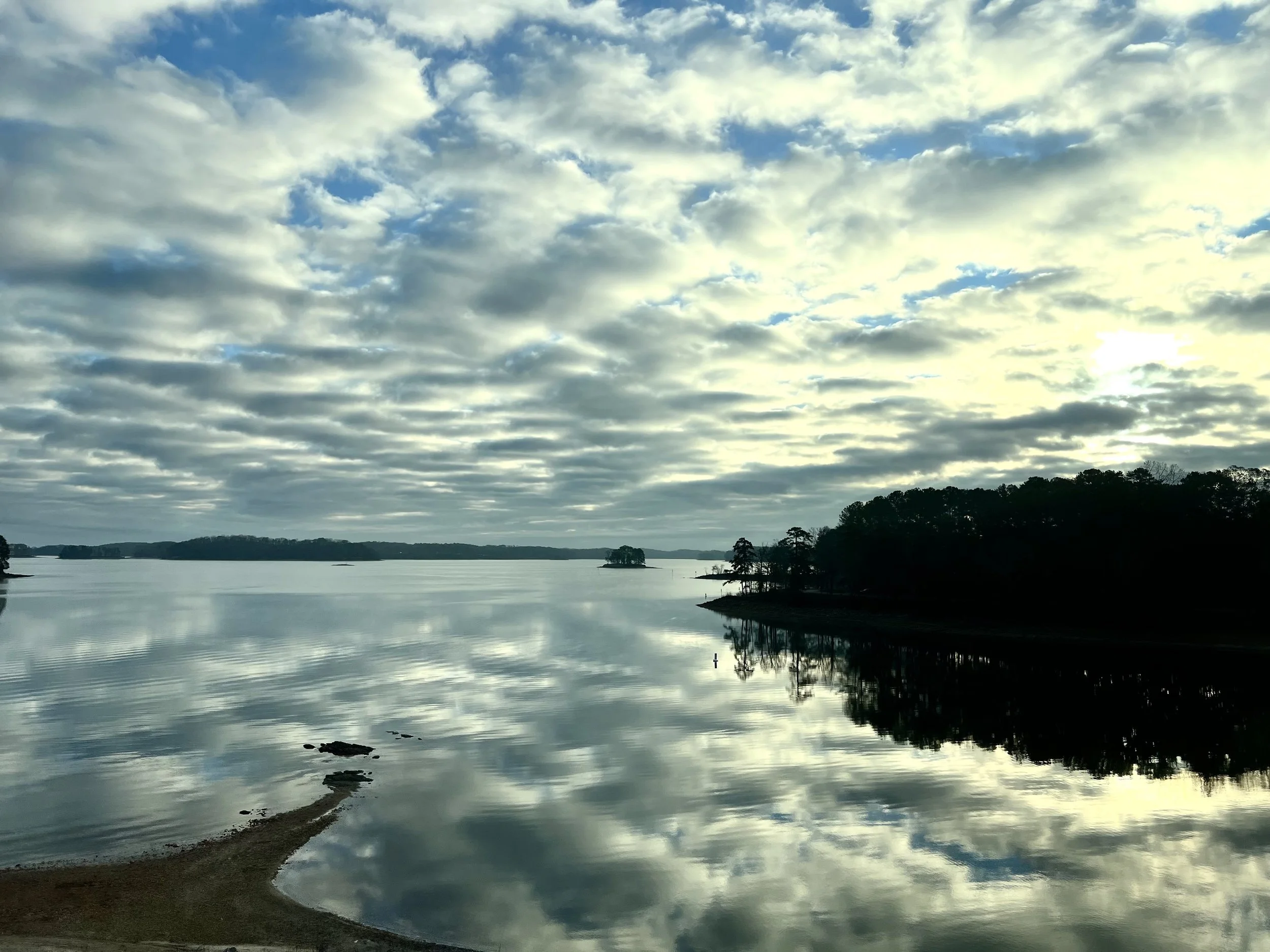
Borrowed (adj.): Something taken or received for a limited time with the understanding that it must be returned, often with care, gratitude, or improvement.
A Reflection on the Sacred Temporariness of Our Lives
I was inspired by something I read recently, a simple line about borrowed people, and it caught me in that quiet place behind the ribs where truth often settles long before we have words for it. The idea was tender, almost fragile: that every person in our life is borrowed.
No one belongs to us, and we do not belong to anyone else. We are entrusted to one another for a little while, held lightly by time, shaped by presence, and then ushered forward into whatever comes next.
The more I sat with it, the more I realized how deeply this idea speaks to the way I love, the way I grieve, the way I create, and the way certain people live forever in my work long after their physical presence is gone.
This isn’t a lesson in loss.
It’s a lesson in reverence.
It invites us to cherish the sacred temporariness of our lives.
The Ones Who Stay and the Ones Who Visit
Some people thread themselves into our story so completely that their colors become woven into the fabric of who we are. These long-haul hearts are the companions and witnesses who stay across seasons, holding space through winters and summers alike.
Others appear for only a short moment … a conversation, a kindness, a shared breath of understanding … and somehow, they change the shape of our inner landscape. They remind us that meaning doesn’t require permanence; it requires presence.
Sometimes the briefest encounters carry the deepest lessons.
Returning What We Borrow Better Than We Received It
There’s an old saying I’ve heard all my life:
“When you borrow something, you return it better than you received it.”
And suddenly, this wisdom feels like a compass for how to love people well while they are given to us.
How do we “return” someone better?
Maybe by offering gentleness in a world that’s often sharp.
By speaking encouragement at the exact moment their heart needs steadying.
By listening without rushing to fix.
By honoring their story without trying to reshape it.
By reflecting back to them the parts they’ve forgotten are beautiful.
Maybe it’s simply this:
That people leave our life feeling a little more themselves … more whole, more seen, more cherished … than they were when they arrived.
We don’t get to keep them,
but while they are in our care,
we can treat them with the respect we give to anything borrowed:
with tenderness, gratitude, and an open hand.
Borrowed things require gentleness.
Borrowed people require reverence.
Grief as Proof of Borrowed Beauty
When someone’s chapter in our life ends, whether through distance, transition, or passing, grief rises as the unmistakable signature that something sacred was here. Grief is the echo of love that was never meant to be owned, only experienced.
Every loss I’ve lived through has left a room inside me.
And each of those rooms glows with the memory of someone I was entrusted with … family members, mentors, friends, clients, loves, strangers who became sacred, and the people who taught me how to live with a softer heart.
Borrowed people shape us long after they’re gone.
We Are Borrowed, Too
One day, someone will say of each of us:
“She was borrowed too,
and while she was here,
she loved with her whole heart.”
There is freedom in knowing we are temporary.
It invites us to lighten our grip, to tell people what they mean to us, to soften our pace, and to savor the ordinary moments that become extraordinary when viewed through the lens of impermanence.
We are not here long.
But we are here meaningfully.

A More Tender Way to Live
If the people we love are borrowed, then every encounter becomes a blessing.
Every shared moment becomes something precious.
Every goodbye becomes a sacred return.
Borrowed does not mean lesser.
Borrowed means precious.
Borrowed means chosen for a breath of eternity.
Borrowed means we were trusted with each other …
not to possess, but to honor.
We are all traveling this earth as borrowed souls, carrying borrowed stories, shaping borrowed moments that somehow stitch themselves into permanence within us.
Seasonal Reflection on Loss
This time of year has a way of stirring old aches, doesn’t it? The colder nights, the quiet pauses, the familiar rituals … they all seem to make room for memories to rise. Many of us walk through the holidays holding both gratitude and grief, celebrating with one hand while touching the tenderness of absence with the other.
I feel it too. The longing for my own “borrowed” people, the ones who shaped my life and then had to go, settles differently in my heart as the season turns. If you’re feeling it as well, please know you’re not alone. This reflection is for all of us who loved deeply, who were entrusted with souls we could not keep, and who are learning to carry both the blessing and the ache of their memory.
Maybe this is the quiet invitation of our lives:
to love people in such a way that when the world receives them back, they carry a little more light than when they arrived. To add gentleness to their journey. To reflect their worth back to them. To be a soft place for their becoming.
Closing Reflection
Maybe, when our own time comes to be returned, we will go carrying the imprints of all the borrowed hearts that loved us into the person we became.
What a sacred exchange:
to borrow one another for a moment
and call it love.
A Thought to Carry
May we tend to the hearts entrusted to us … gently, honestly, reverently … so that when their season with us ends, they leave feeling more whole, more cherished, and more themselves.
Then shall the dust return to the earth as it was, and the spirit shall return unto God who gave it.
— Ecclesiastes 12:7 NKJV
“To love another person is to see the face of God.”
— Victor Hugo
Thanksgiving, As We Are Now
Thanksgiving looks different these days.
Not in a dramatic, obvious way …
but in the subtle shifts that happen when life keeps unfolding,
when families grow,
when we lose people we love,
and when everyone is quietly trying to figure out
how to keep traditions alive
while also finding their new rhythm.
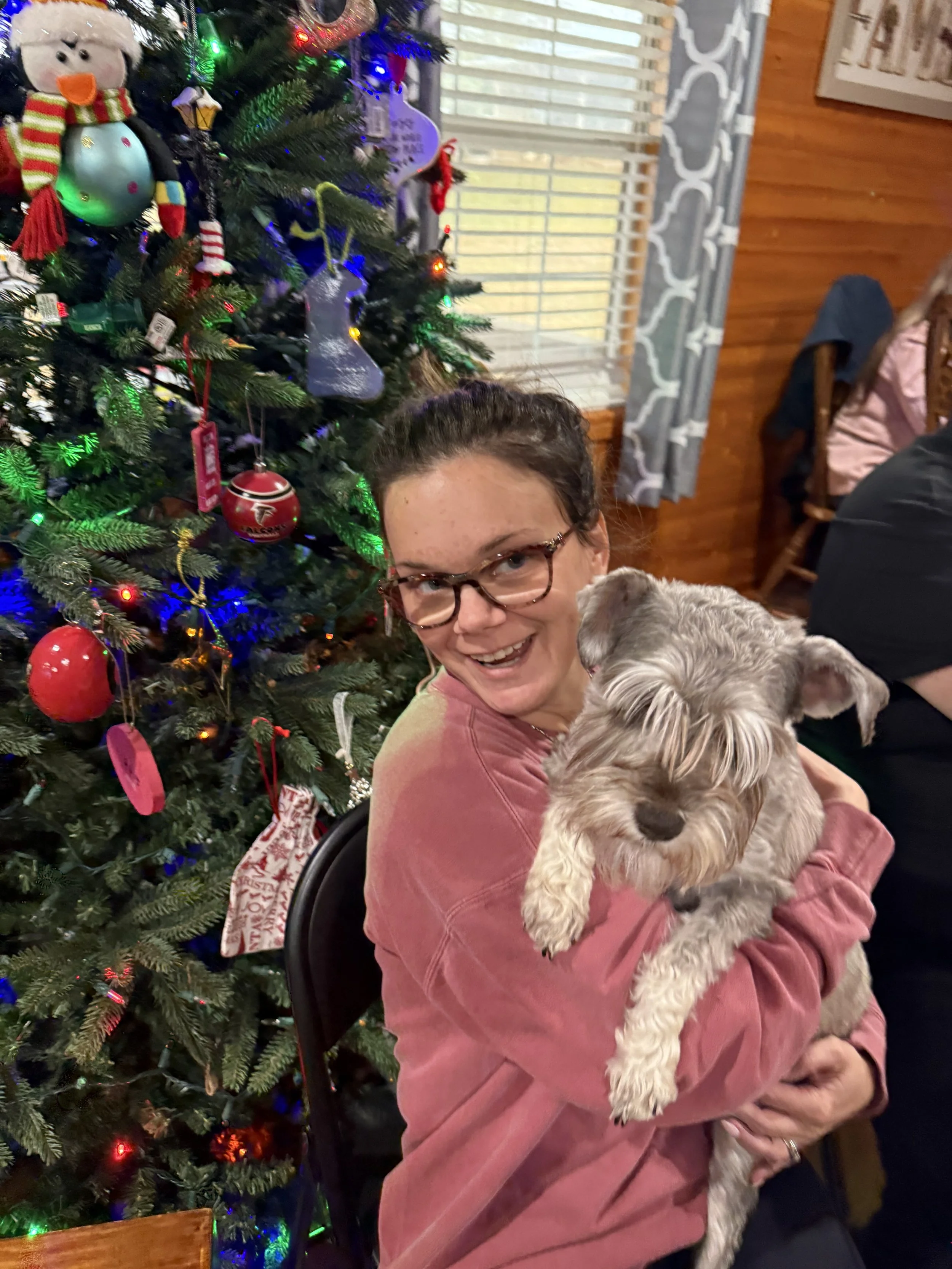
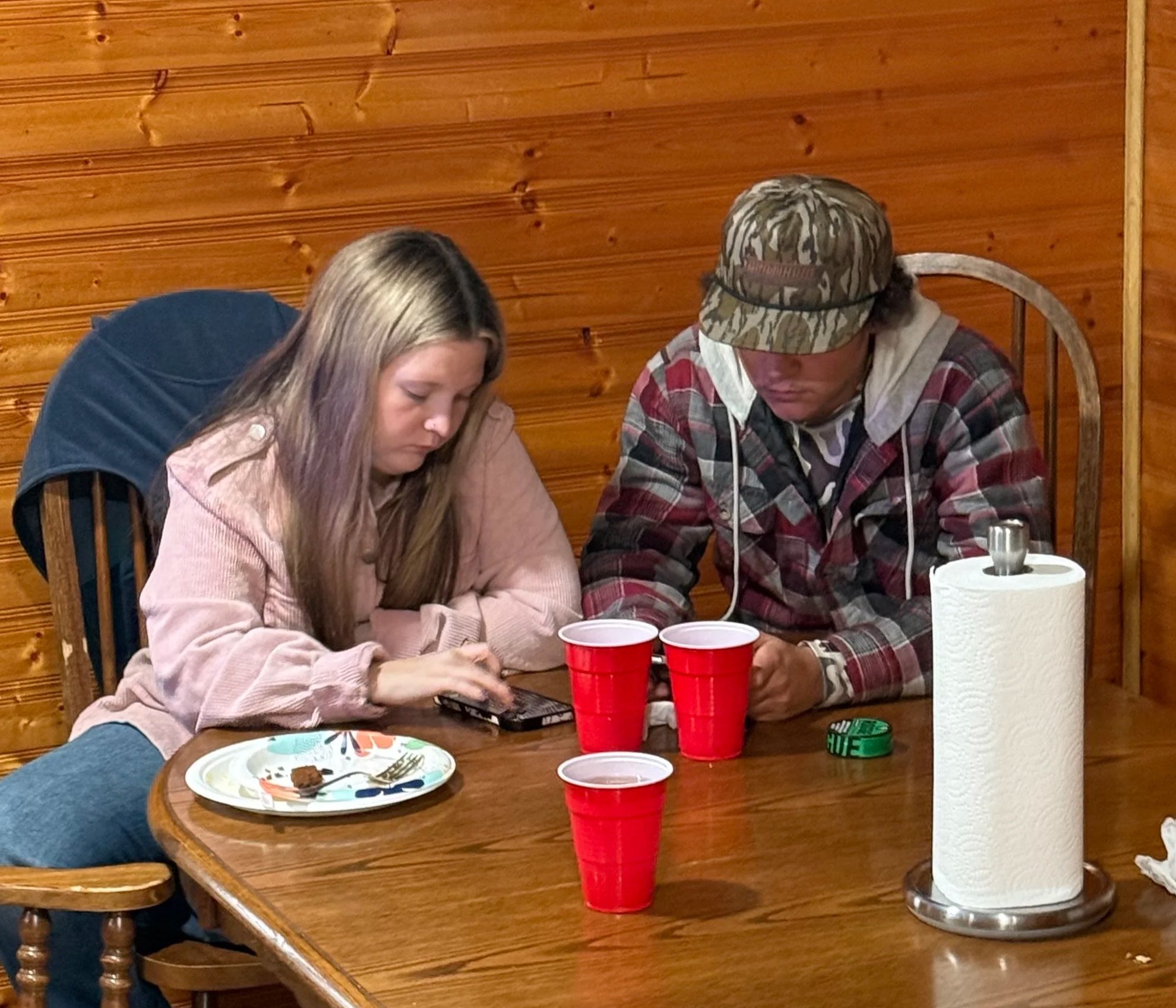
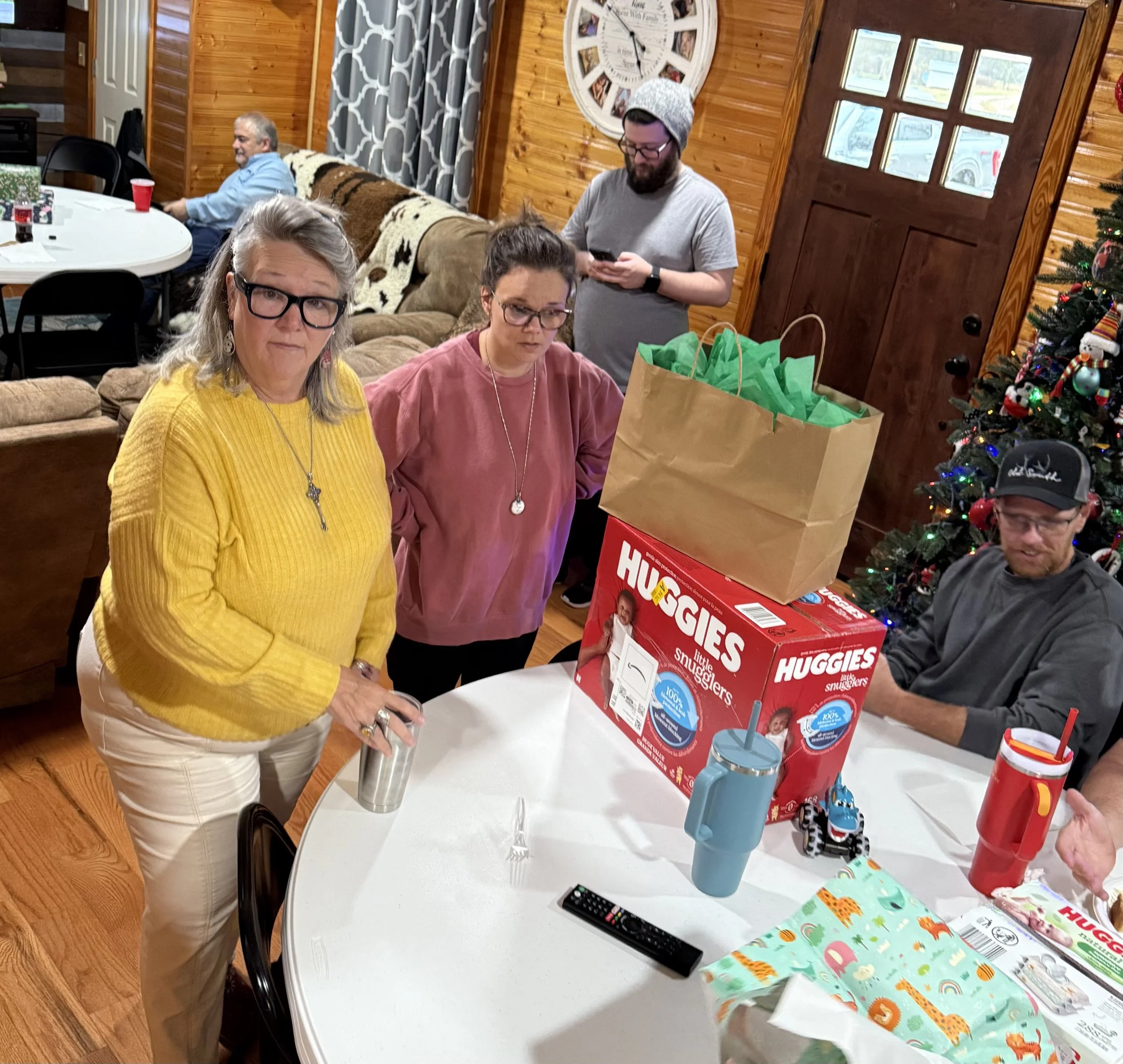
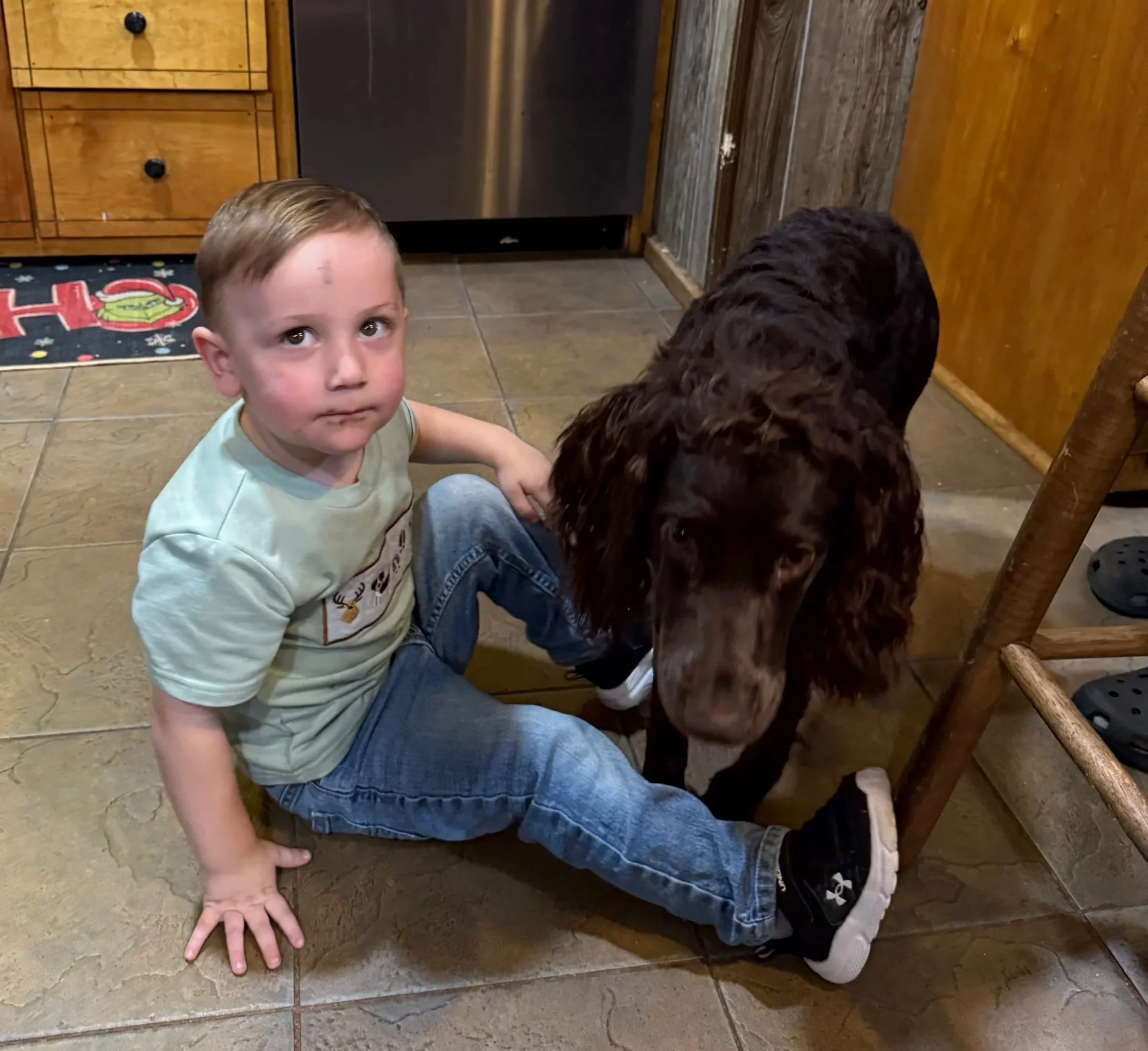
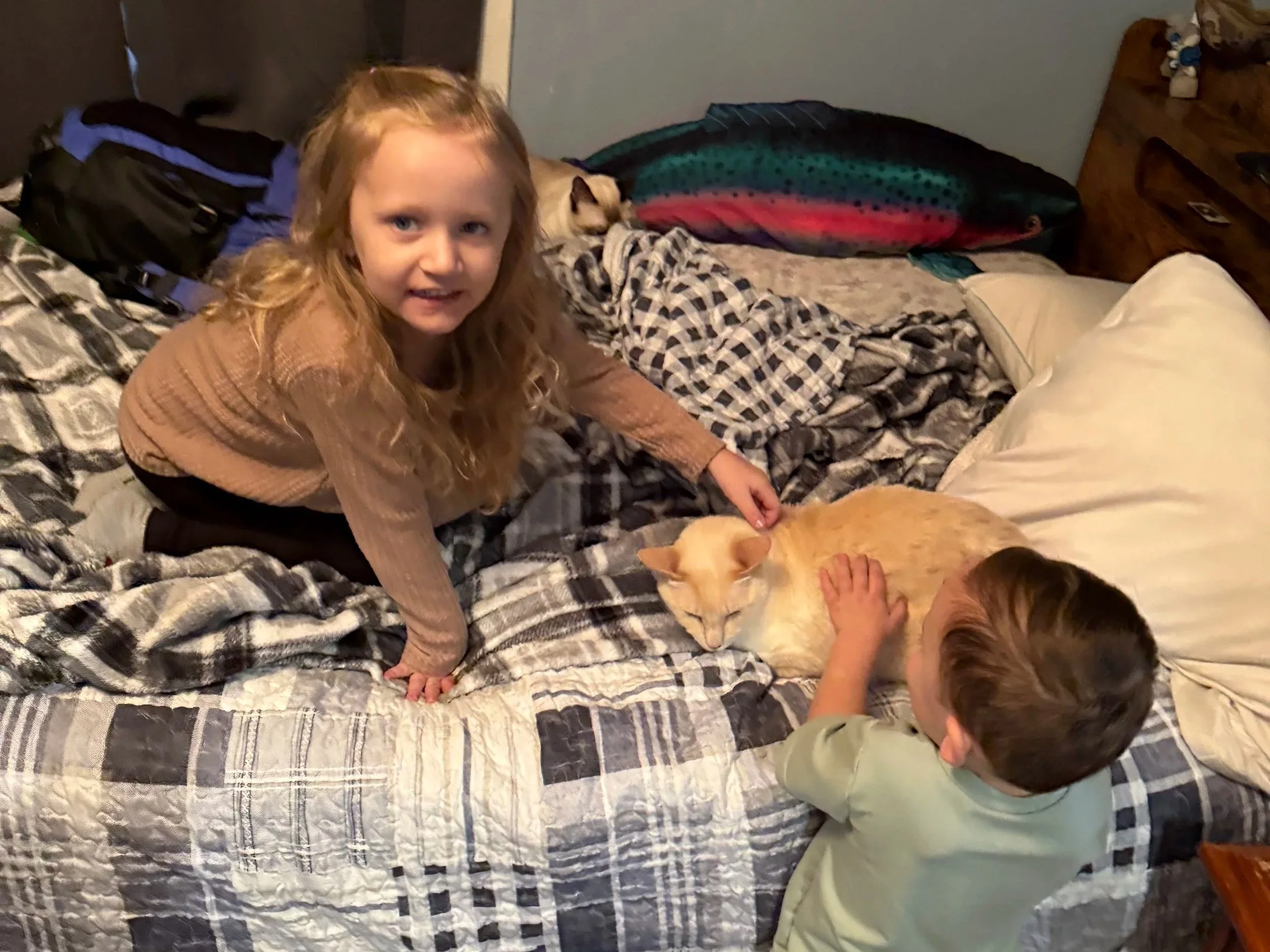
This year we gathered at my brother’s house.
Not because it was planned,
but because we were celebrating something beautiful …
a little sprinkle for his son and daughter-in-law,
who are expecting a baby boy in December.
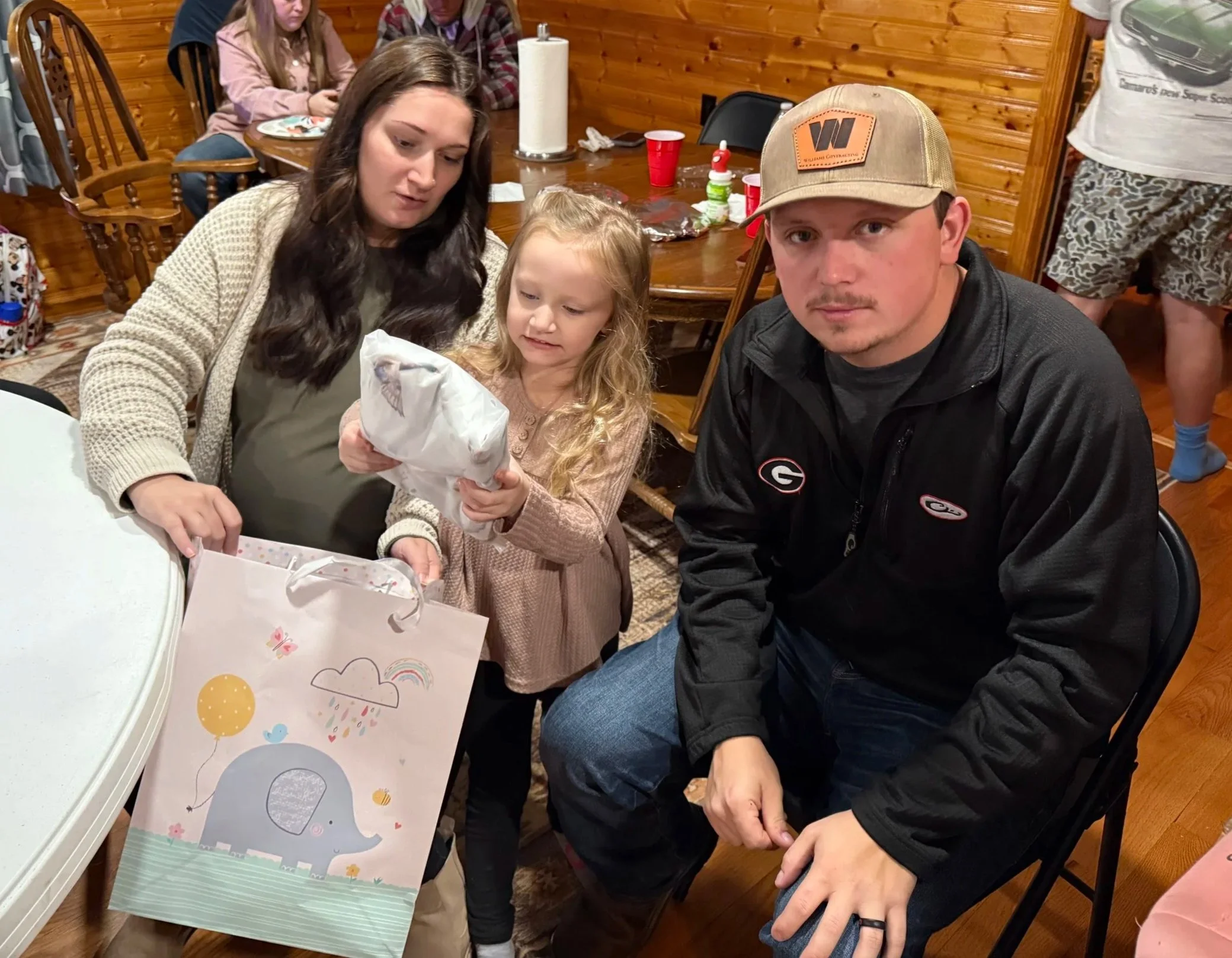
There was something really sweet about mixing Thanksgiving with baby gifts,
passing the dressing and the pie
right alongside onesies and tiny socks.
It felt like a reminder that life keeps expanding
even when grief and change have had their say.
Holding On, Letting Go, and Doing What Feels Like Home
Some years, we go through the motions
because doing what we’ve always done
feels like the closest thing to home we have left.
We pull out the same recipes.
We make the same dishes.
We tell the same jokes.
We hope our dish doesn’t end up being fed to the dog.
But the truth is
we’re all quietly yearning for what once felt familiar …
for the voices that used to fill the kitchen,
for the hands that taught us how to stir,
for the laughter of the ones who aren’t sitting at the table anymore.
And yet, in the middle of all that longing,
there is gratitude.
Deep, steady gratitude
for the ones who are here,
the ones who keep showing up,
the ones who keep trying alongside us
as we figure out this ever-evolving version of Thanksgiving.
Passing Recipes, Remembering the Hands Who Made Them
In our family, remembering looks like
passing the dressing,
cutting into the pies,
and carrying forward the cookie recipes
my mother and grandmother made year after year.
We don’t recreate their meals perfectly …
but we remember them in every bite.
We remember them in the way the kitchen smells.
We remember them in the stories that somehow resurface
the moment someone pulls out the pecan pie.
Tradition isn’t about getting everything right.
It’s about feeling connected
… to our past,
to our people,
to ourselves.
Choosing What Matters Going Forward
We realized something this year:
Cracker Barrel on Thanksgiving Thursday
isn’t cutting it anymore.
Not because the food isn’t good,
but because what we actually need
is each other.
So next year, instead of waiting an hour in line
for a table that rushes us,
we’re planning a simple brunch for anyone in the family
who doesn’t have other plans …
a way to slow down,
to gather without pressure,
to share time instead of stress,
and to honor what Thanksgiving is really about.
It doesn’t have to be a full spread.
It doesn’t have to look like Pinterest.
It doesn’t have to be the same as it once was.
What matters is the gratitude:
for the ones we have,
for the moments we share,
for the blessings we sometimes forget to name,
and for the chance to sit with people we love
over a cup of coffee
and a cookie or a slice of pecan pie
made from Mom’s recipe.
That …
right there …
is Thanksgiving.
Thought to Carry
As the shape of our holidays evolves, may our gratitude remain steady.
May we remember that what makes the day sacred is not perfection, but presence.
This week, I invite you to pause and honor one small moment of gratitude each day … write it down, whisper it aloud, or share it with someone you love. Let it become a quiet reminder as you move through this season.
“Gratitude turns what we have into enough, and who we gather with into home.”
— Anonymous
“In everything give thanks; for this is the will of God in Christ Jesus for you.”
— 1 Thessalonians 5:18, NKJV
The Many Lives of a Secondhand Cabinet
A Story About Transformation, Studio Magic, and Letting Creations Evolve
There are certain pieces that arrive in our lives and quietly become part of our story. Not because they’re valuable in the way the world measures value, but because they carry a whisper of possibility … a feeling that they could be something more.
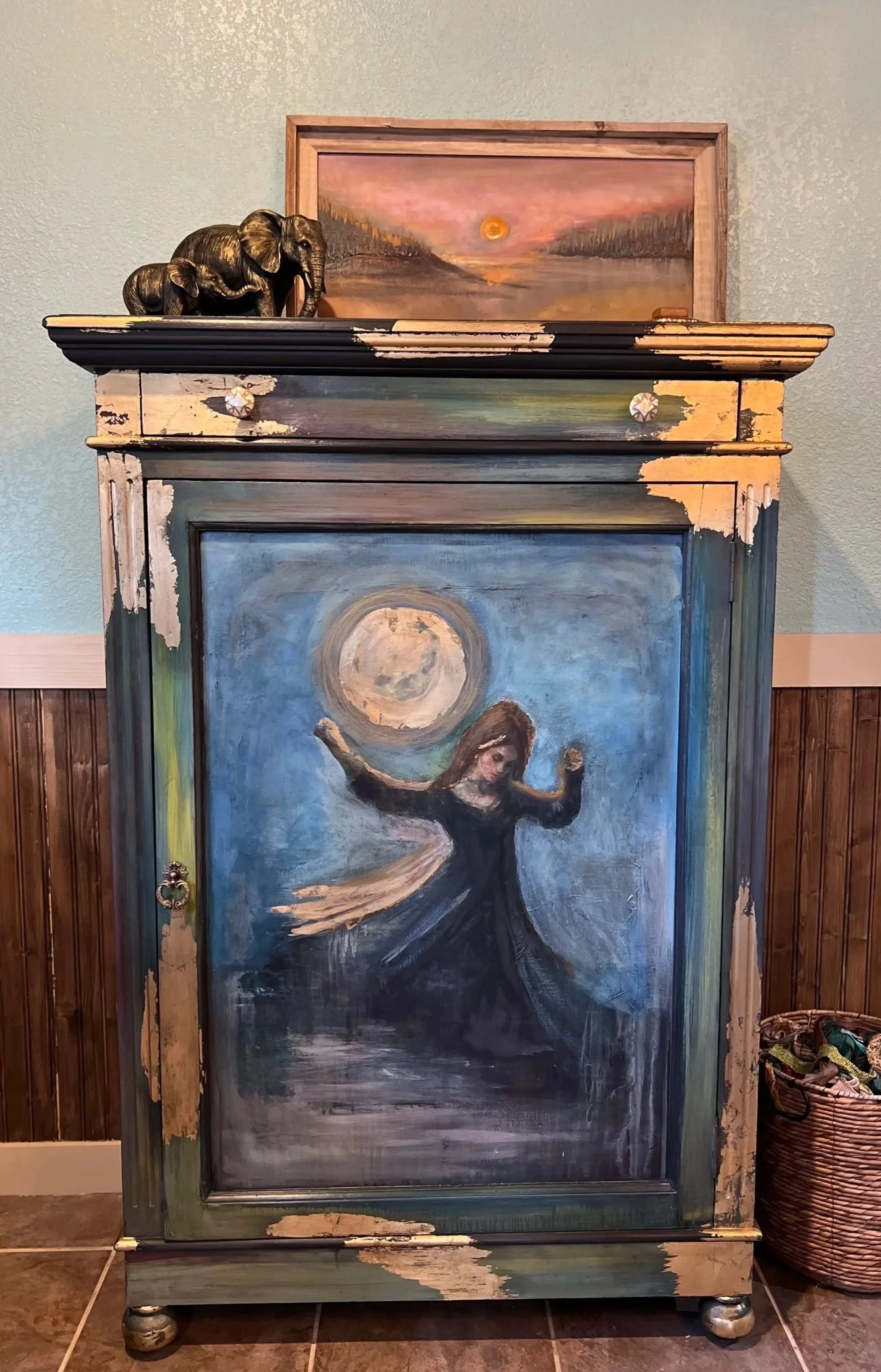
About eight years ago, I found a little tie wardrobe at a secondhand shop. She was humble, simple, and easy to overlook, but something about her shape, her bones, and her little door caught my eye. I didn’t know then how many lives she would live under my roof … how many times she would become exactly what I needed, before it was time for her to transform again.
When I first brought her home, the glass in the front door was the very first thing to go. I removed it and replaced it with a thin sheet of metal screen … tiny perforated holes that let air circulate but still kept her mysteries inside. I brushed the screen in a warm bronze so it felt aged, as though it had always belonged. You couldn’t see what was inside, but you could smell the soap curing on the shelves, and that was exactly the charm I wanted.
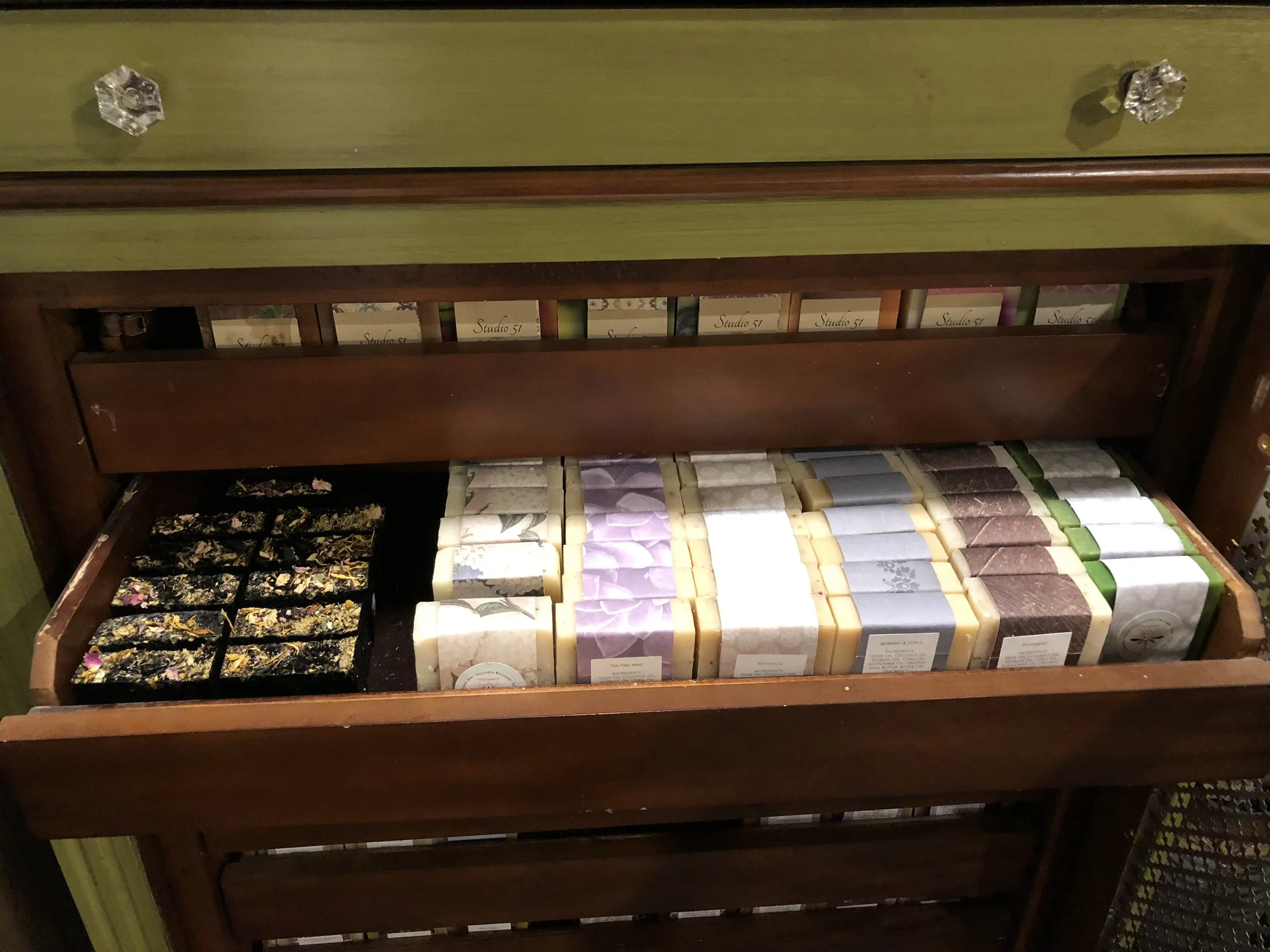
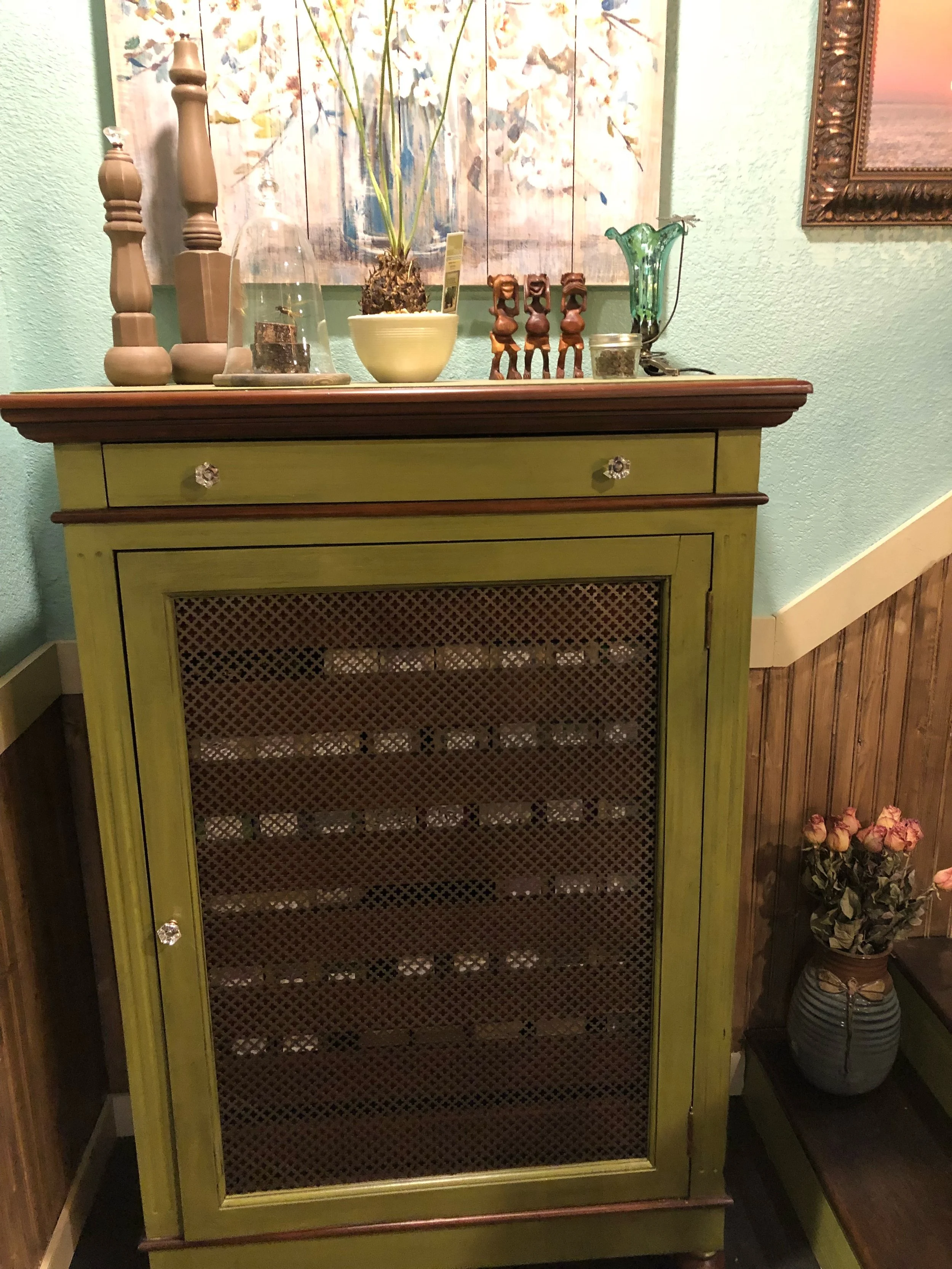
This was during my soap-making season … when my studio smelled like lavender buds, honey, eucalyptus, and oatmeal. She became my soap cupboard, the keeper of fragrance and simplicity.
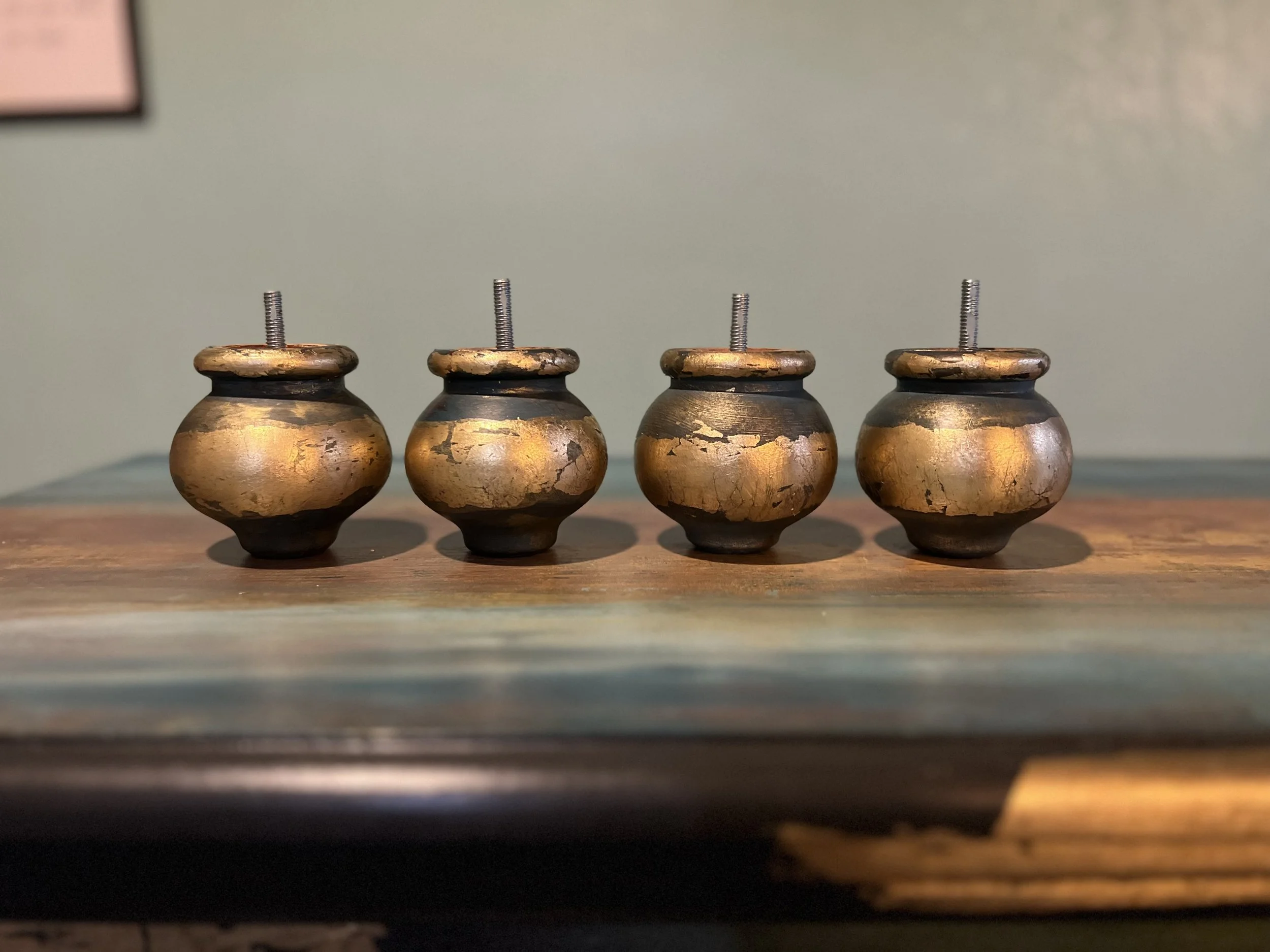
Around that same time, my father and brother helped me build a nine-foot farm table I had designed myself. She was painted a soft light green aged with glaze, like something from an old European cottage. I loved that look so much that I carried it over to the cabinet, adding a stenciled flourish to tie the pieces together. She didn’t have legs originally, so I found some that felt just right and added them, giving her height, presence, and a little confidence.
For years she served her purpose beautifully.
Then seasons shifted. I stopped making soap. The studio changed. And she moved quietly into storage … dusty, patient, waiting for her next chapter.
Fast Forward a Few Years
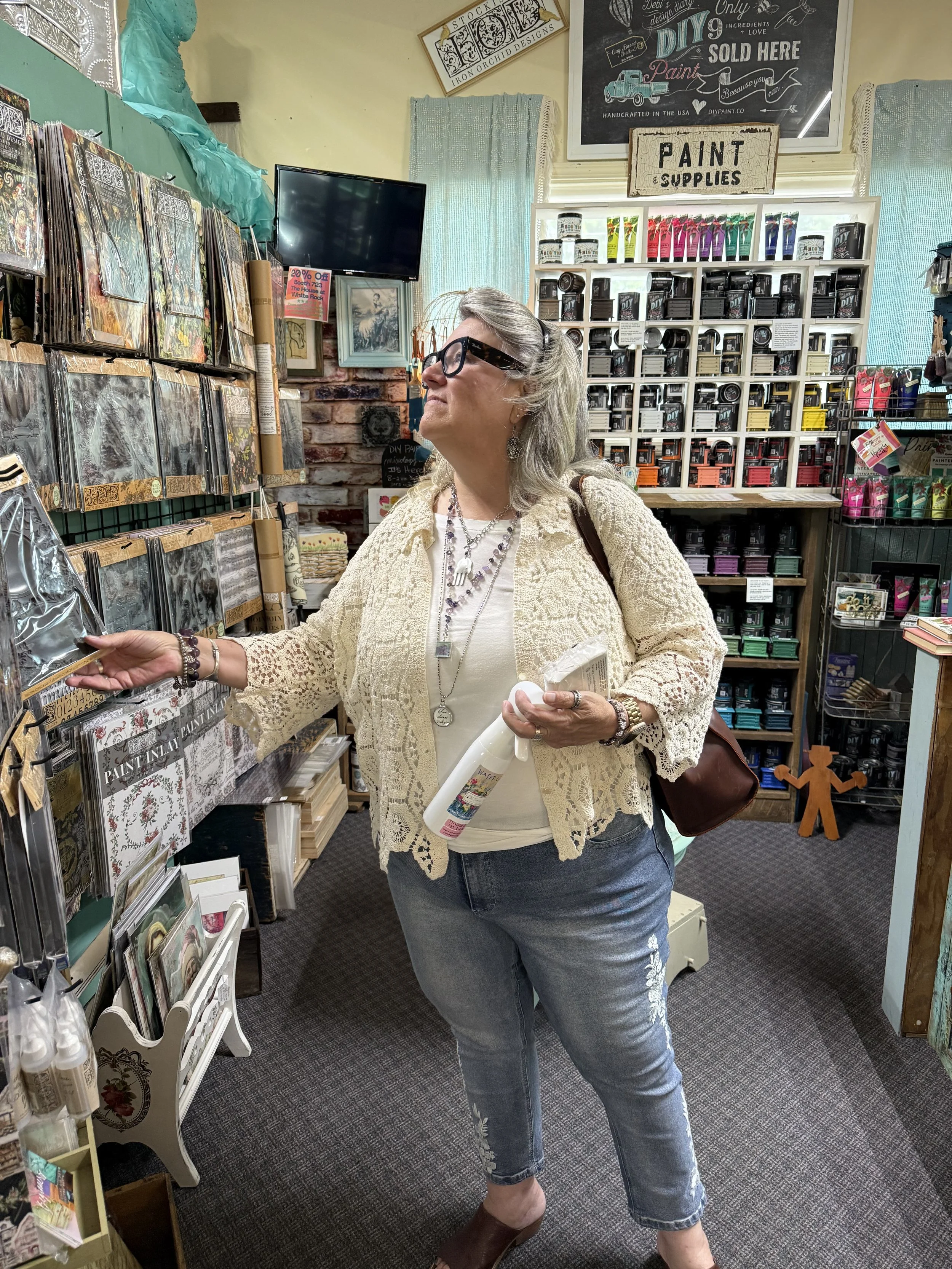
When I traveled to Madison, Indiana for a workshop, I wandered into River West Antiques … a place that feels like a wonderland for creatives and treasure hunters alike. My friend Sandy has a booth there, and if you ever visit, promise me you’ll go. Her space radiates that signature blend of spirituality and cowgirl humor she’s known for.
Sandy carries Debi Beard’s DIY Paint … my favorite clay-and-chalk paint in the world. It’s velvety, creamy, wildly pigmented, eco-friendly, and made from only nine simple ingredients. Zero VOCs, no harsh odors … safe enough to use in a closed room without worrying about my pets.
The first time I worked with clay-based paint, I had a learning curve. It behaves differently … softer, more organic, more alive. But once I learned how to work with it?
I started painting everything.
Sandy’s booth was full of temptation … stamps, transfers, clay molds, and an entire wall of decoupage papers.
And then I saw it … again.
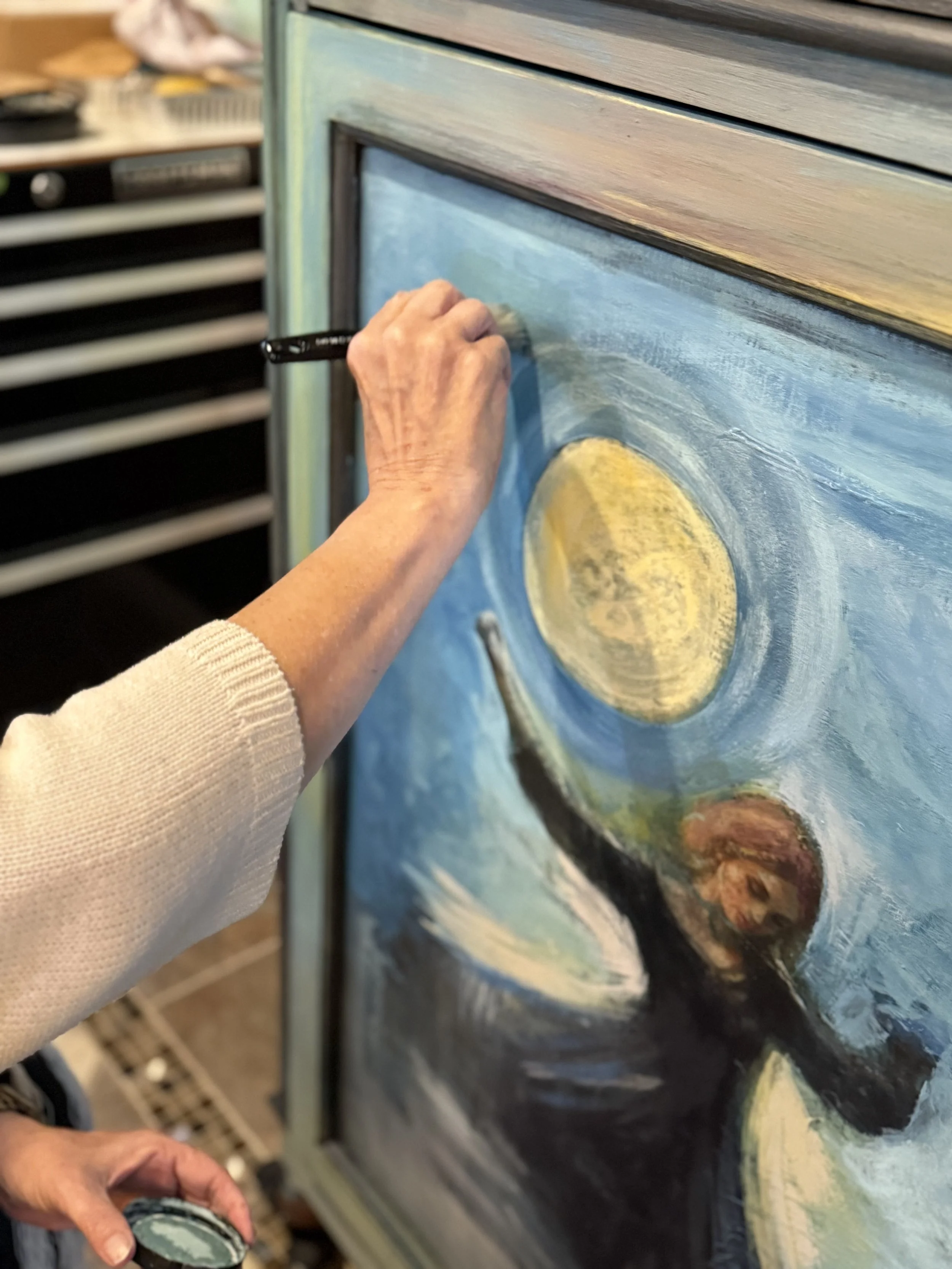
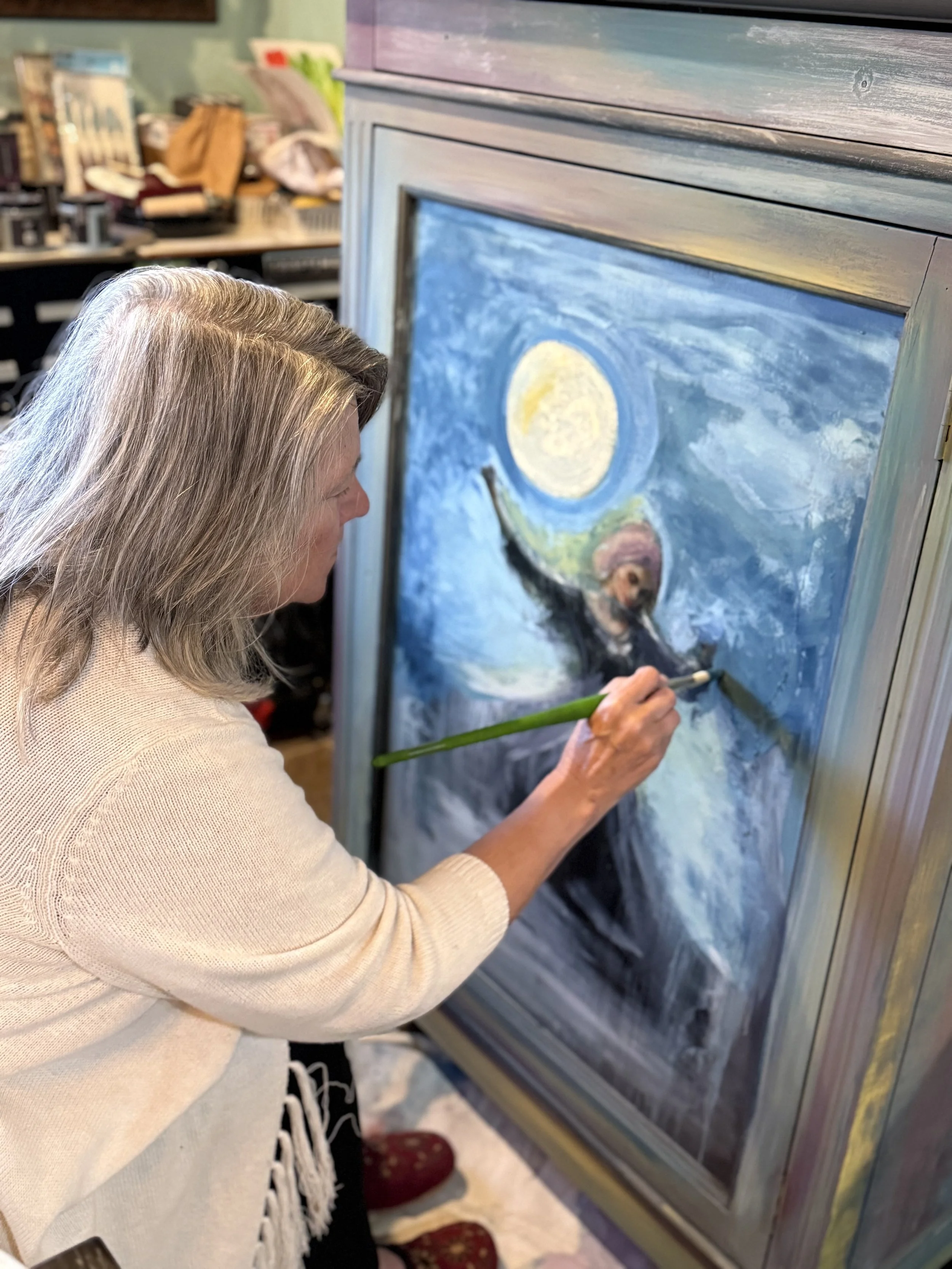
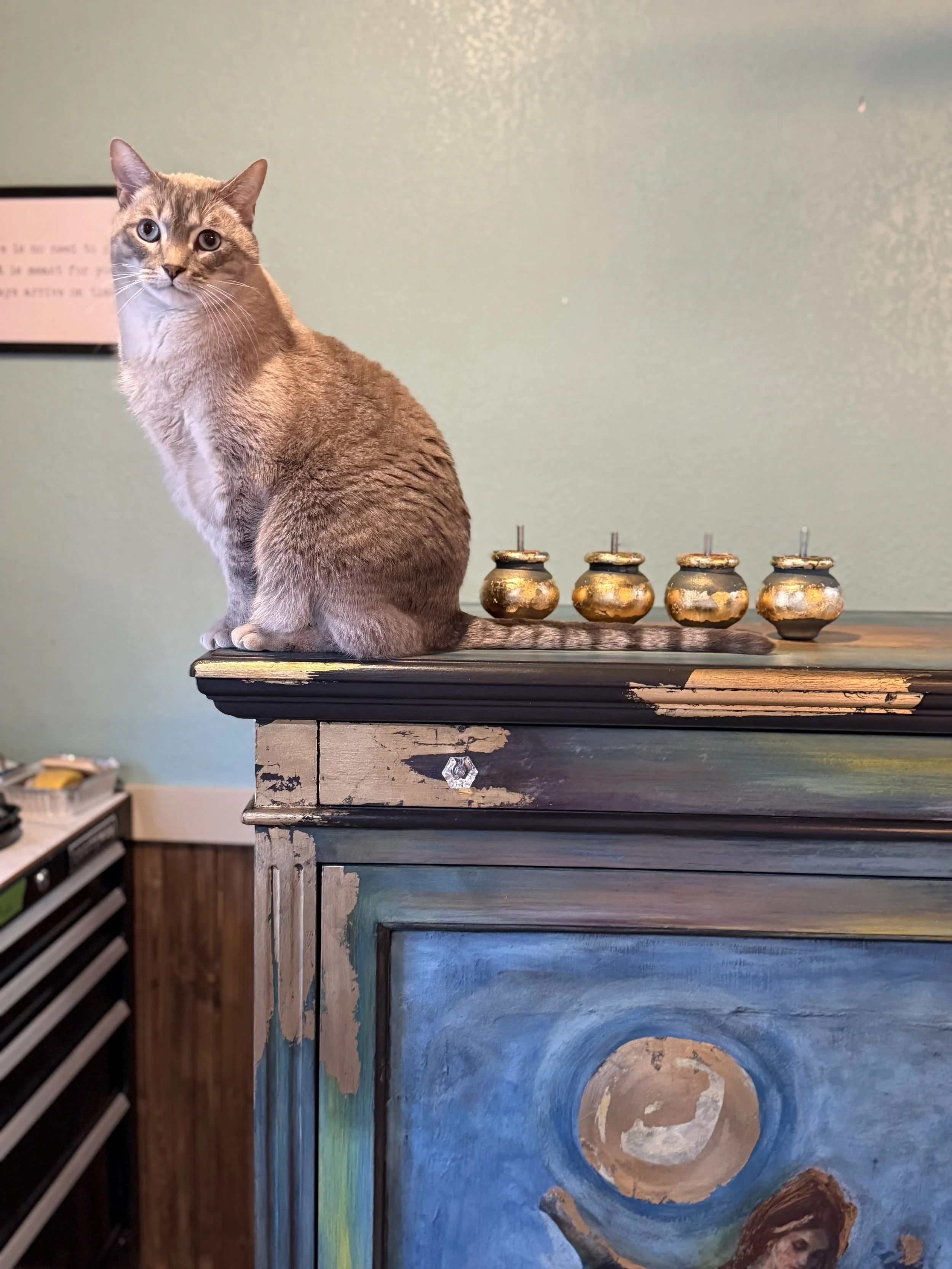
A decoupage paper called Moon Beam Rhapsody by Whimsikel Designs. A moody, enchanted image of a woman dancing in the moonlight. I had actually purchased it twice … both times from Sandy’s booth. The first one I bought earlier in the year and completely forgot about. (Anyone else ever done that? You fall in love with something, tuck it away, and later rediscover it like it’s brand new?)
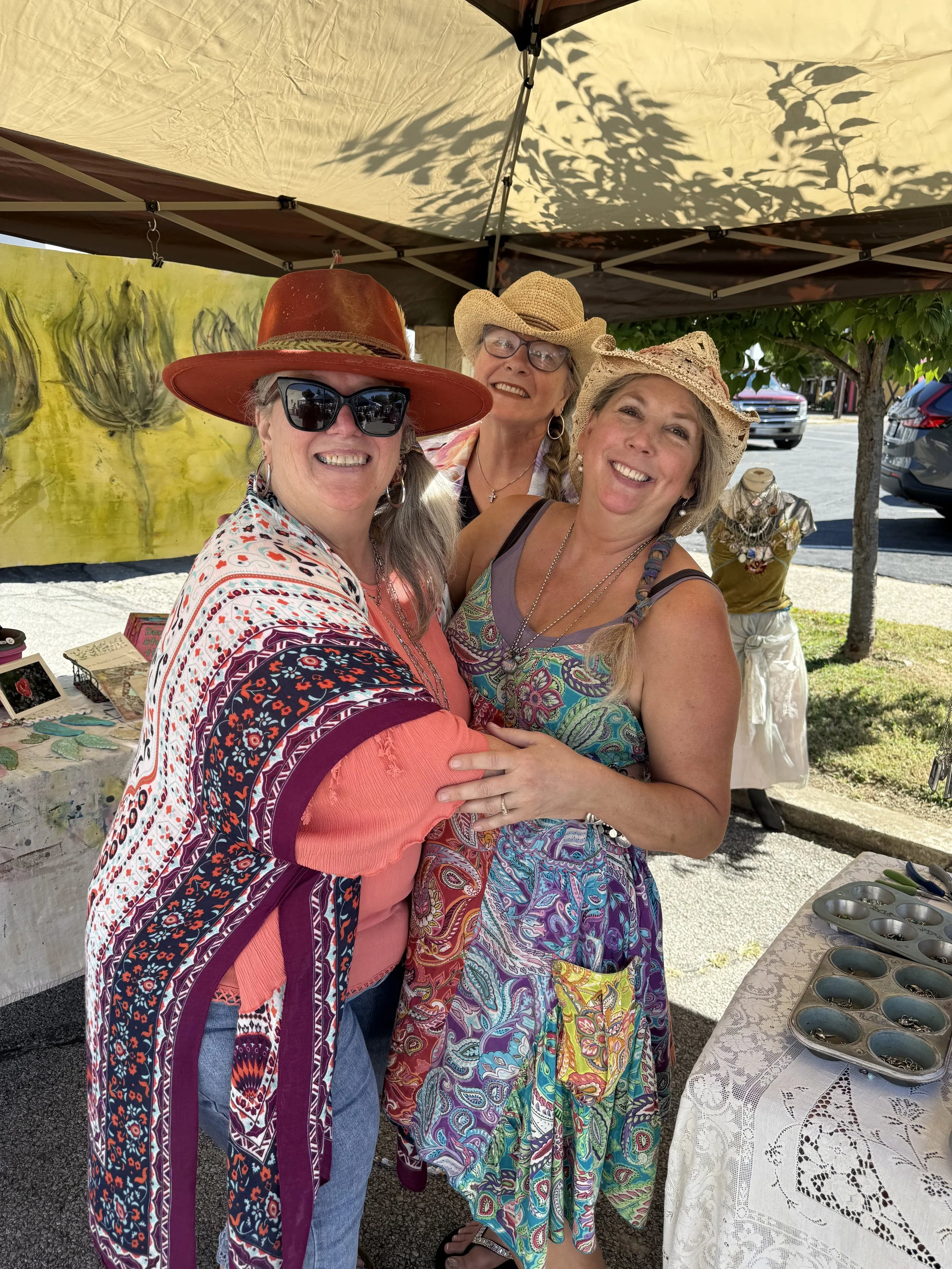
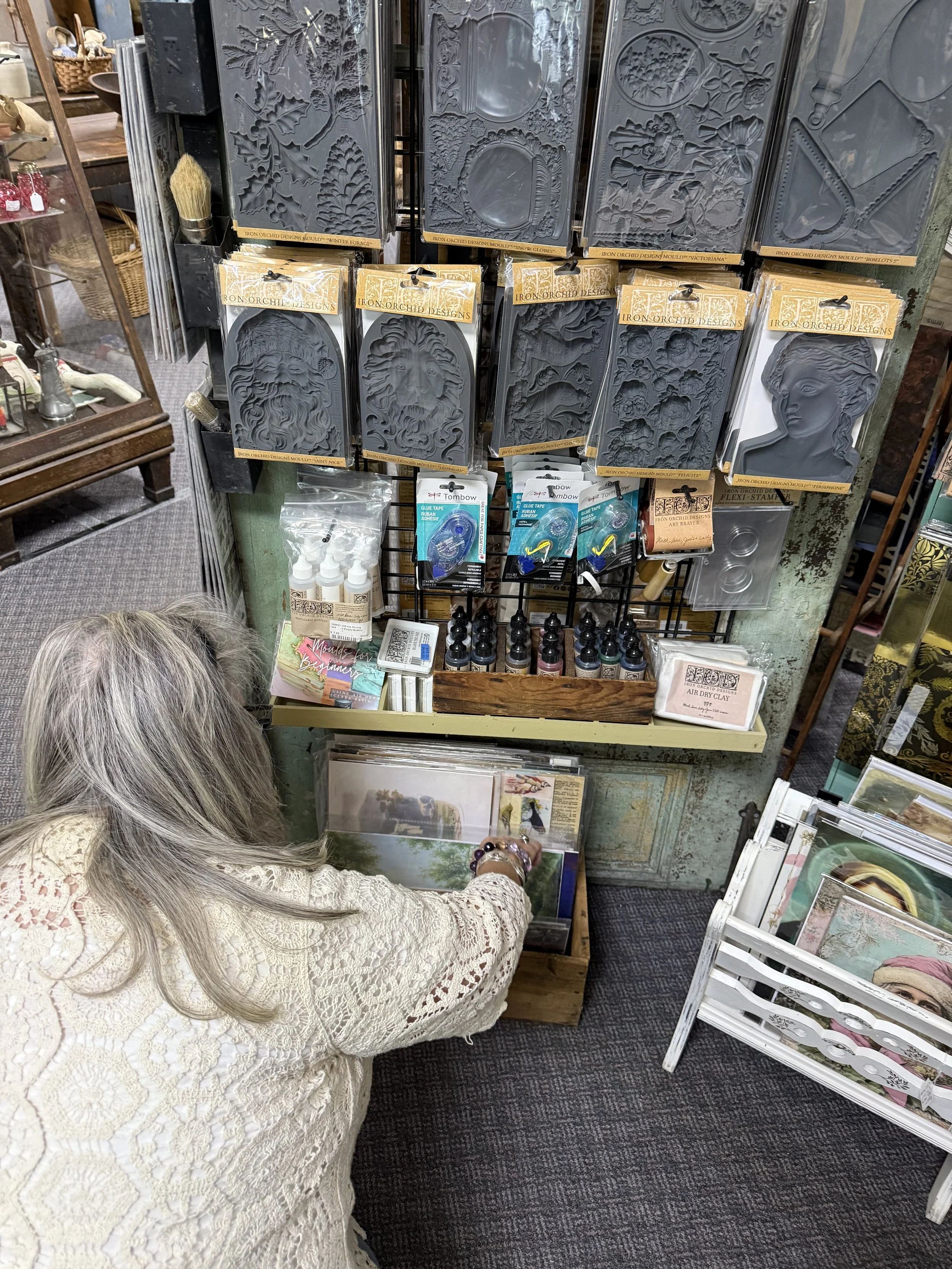
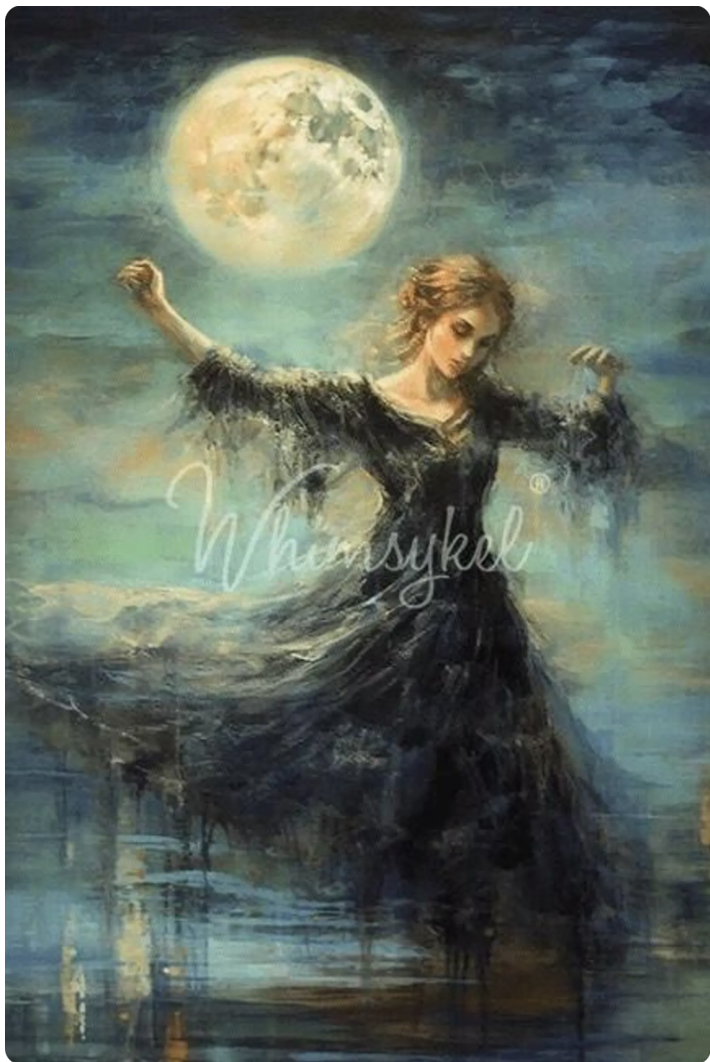
So when I saw it the second time, I didn’t hesitate.
Clearly she was meant for this piece … she found her way to me twice.
She became the undeniable anchor and soul of the entire design.
Beginning the Transformation
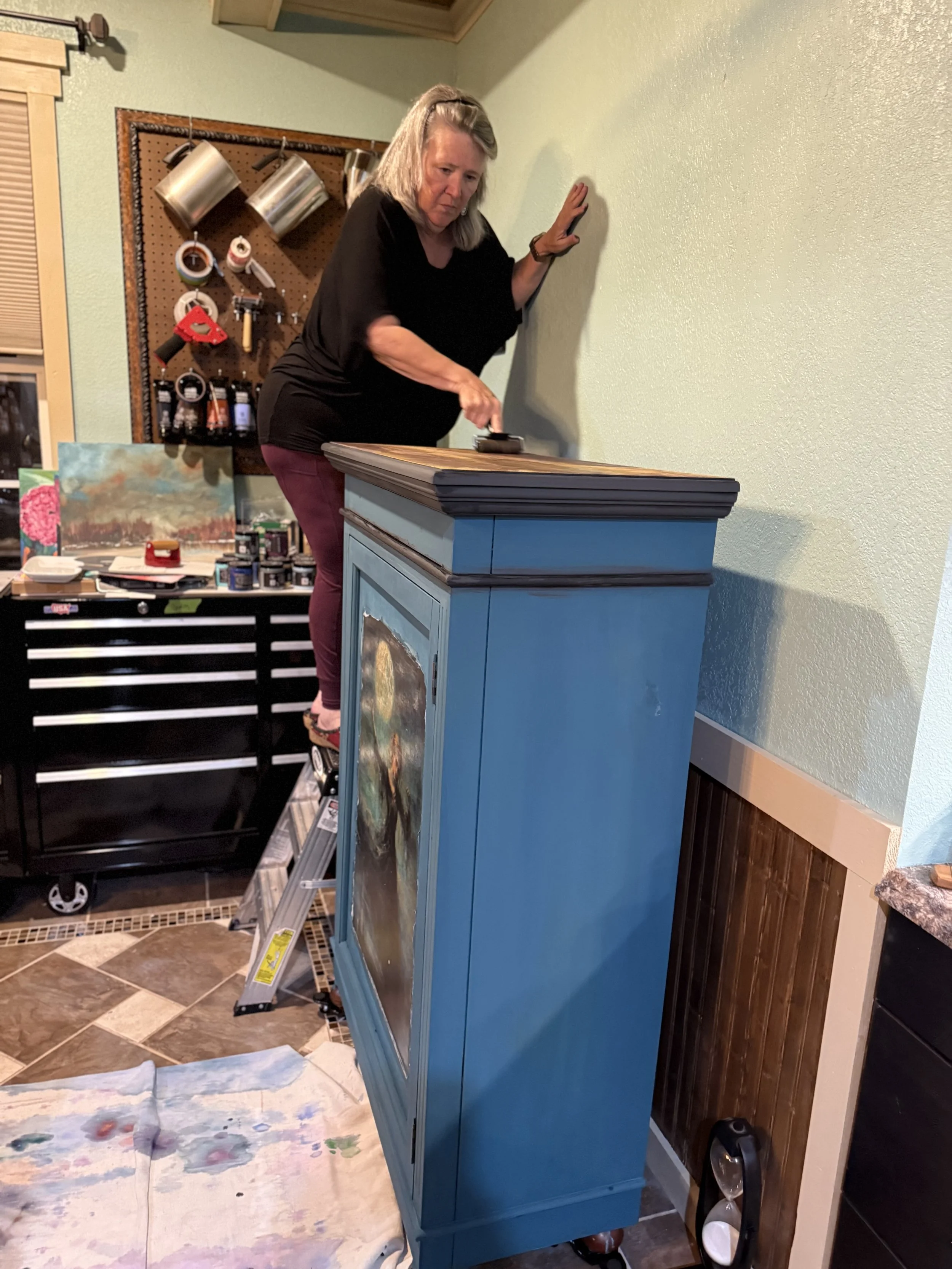
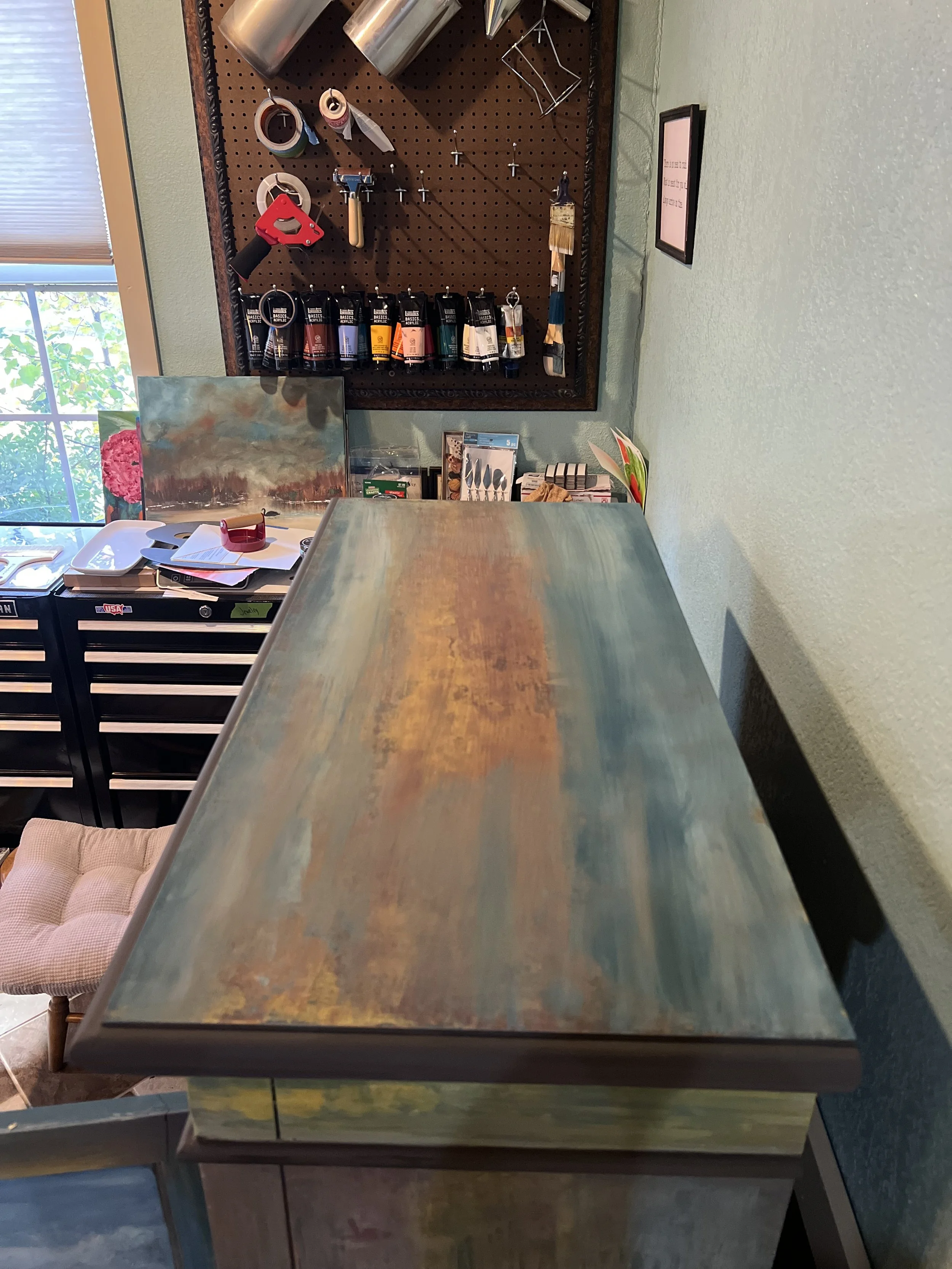
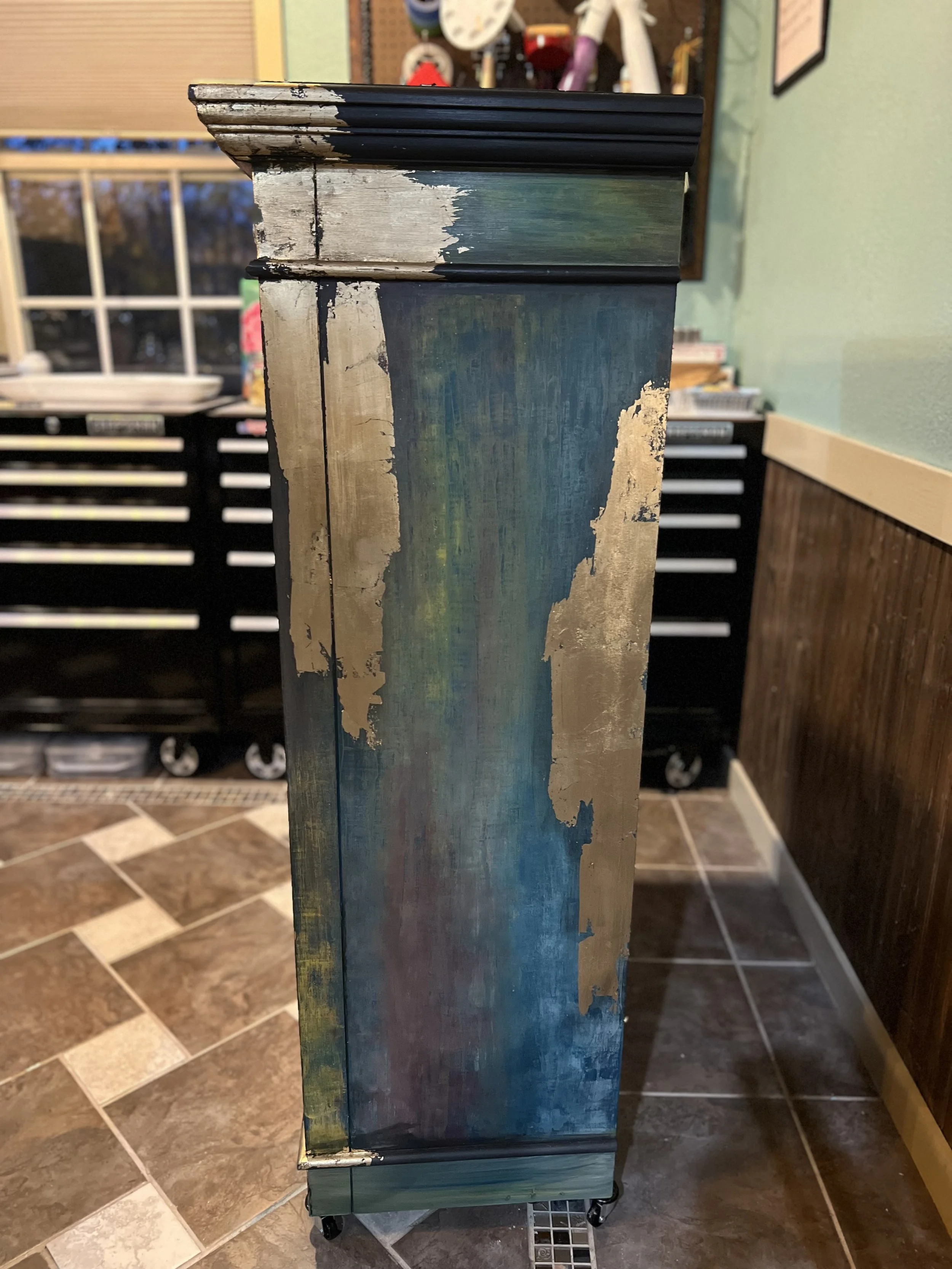
When I brought the cabinet out of storage, she was covered in dust and memories. Underneath was her original Sherwin Williams latex finish … the same shade I used on my farm table years ago. Thankfully, clay paint adheres beautifully over latex with very little prep. All she needed was a good wash and she was ready for her new life.
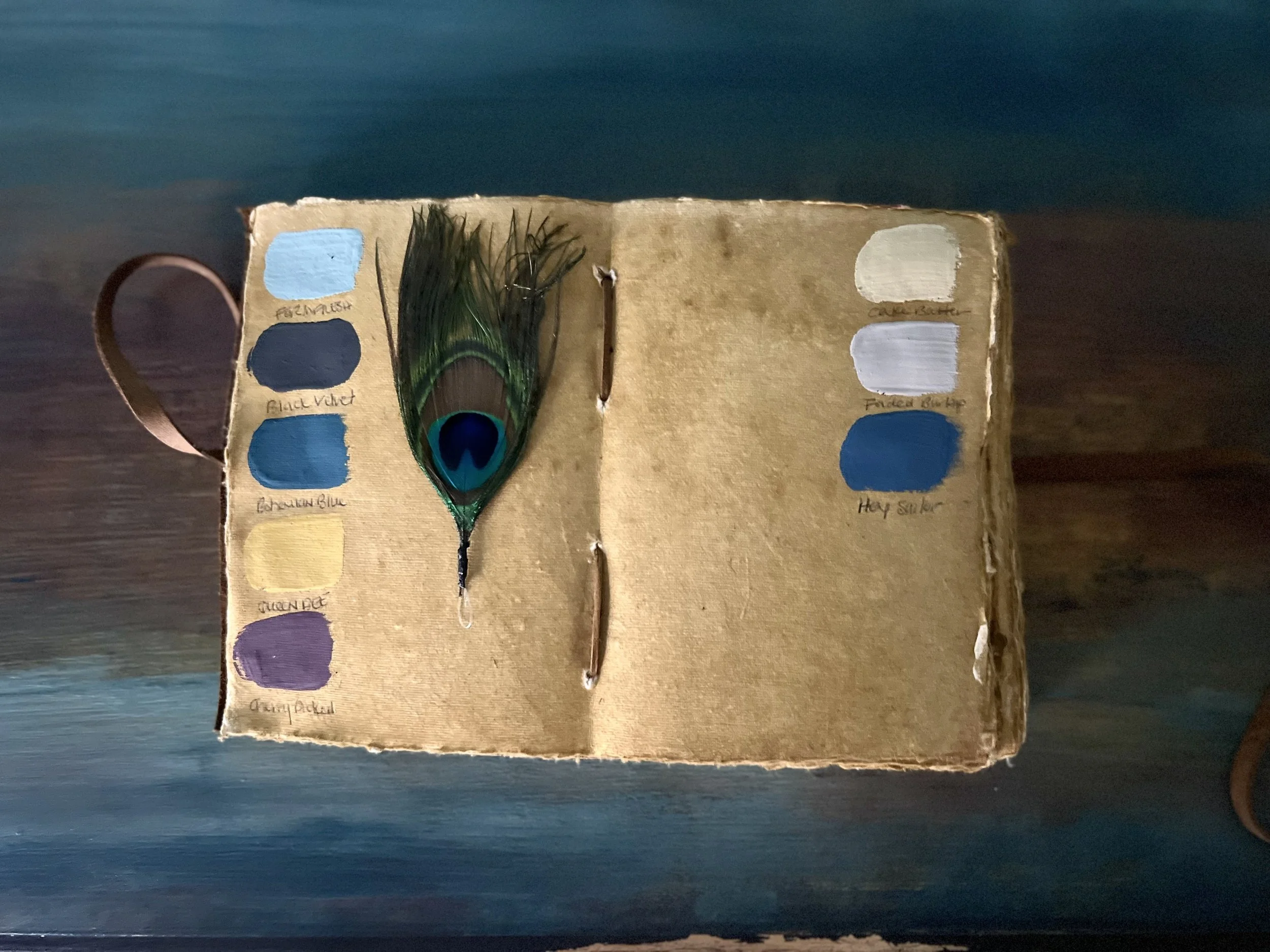
I laid Moon Beam Rhapsody on the door panel and everything fell into place. The color palette of the design spoke immediately.
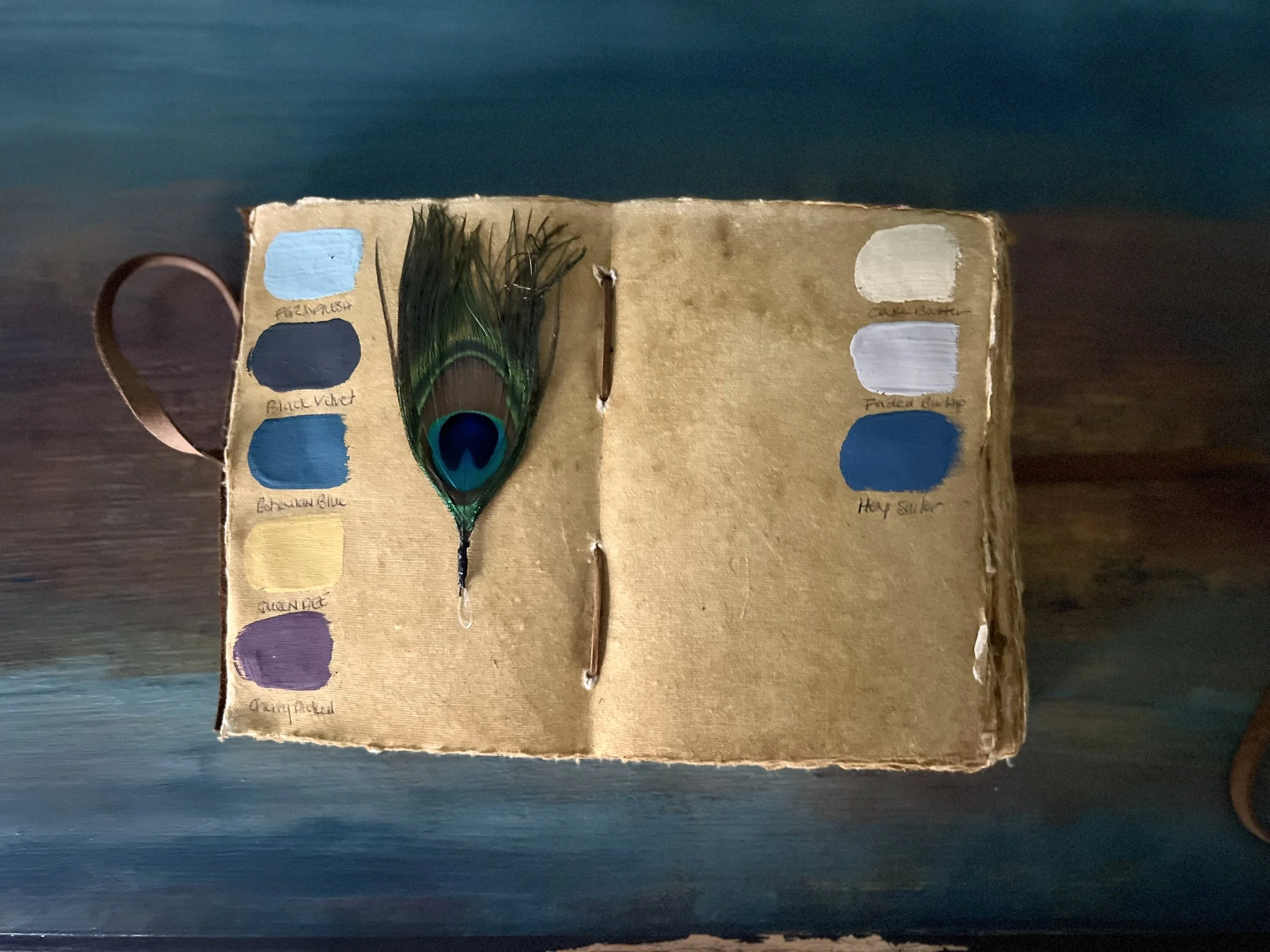
Bohemian Blue
was the obvious base … deep, moody, rich. The grounding tone for the entire piece.
Then came the layers:
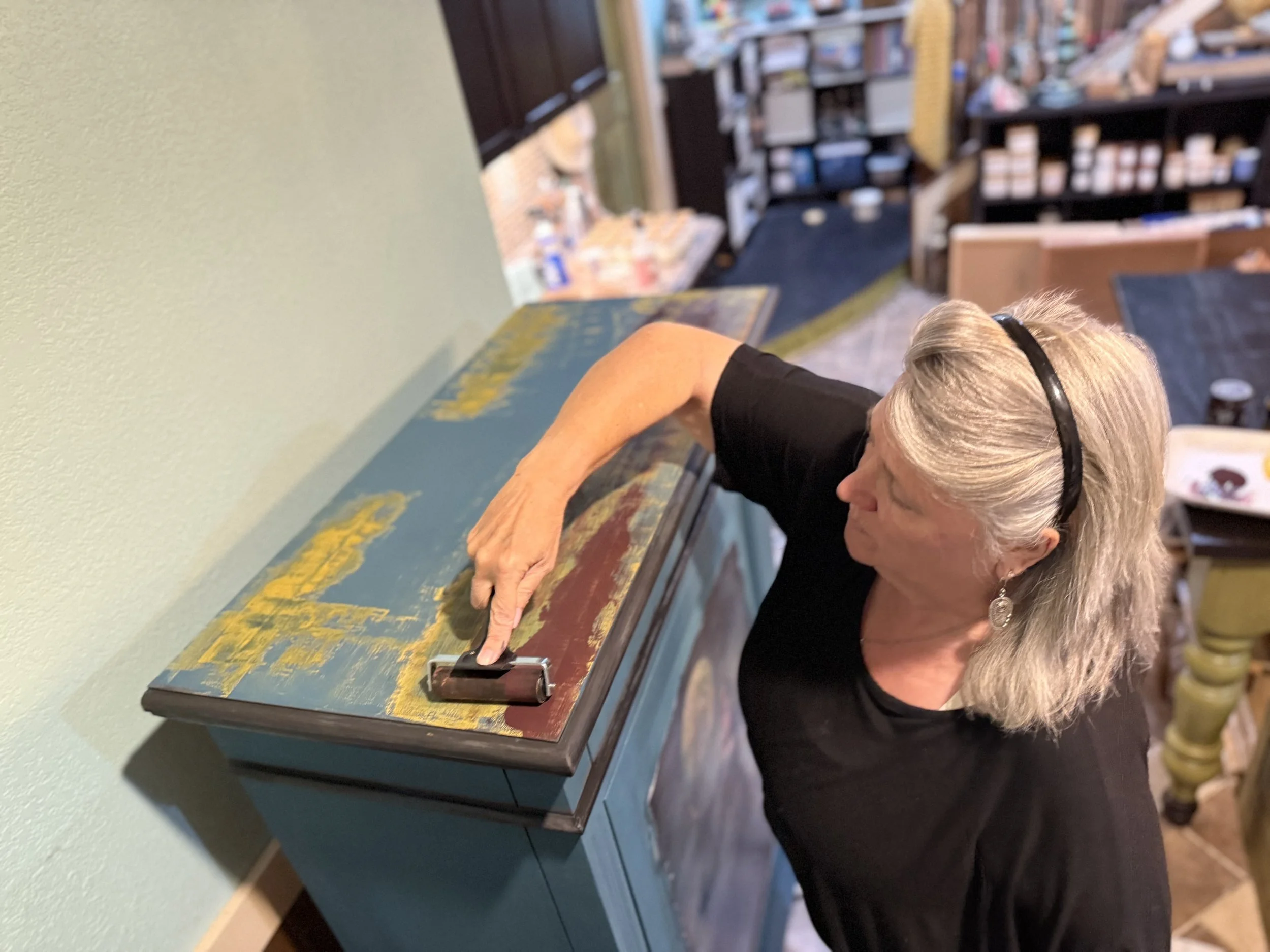
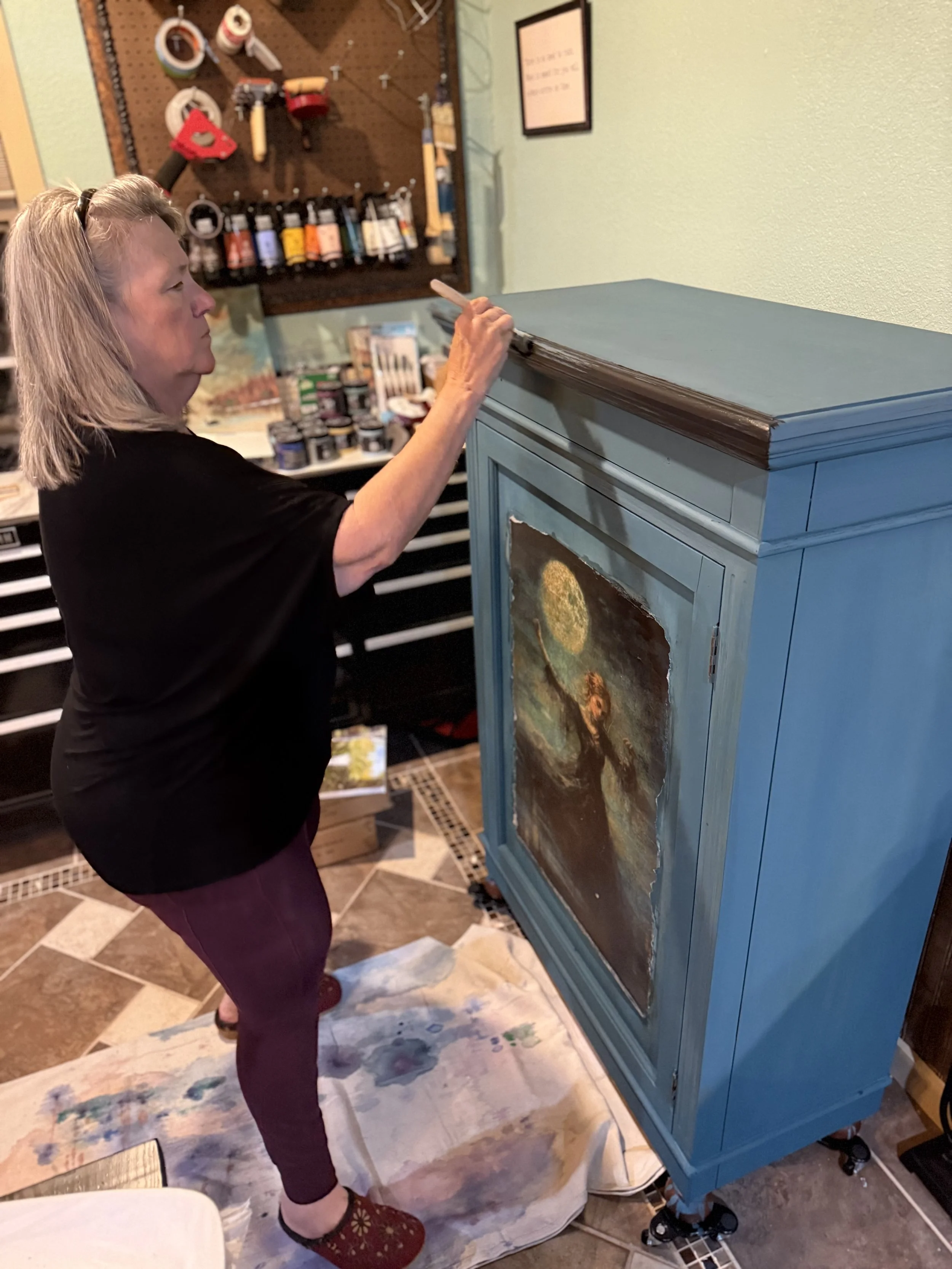
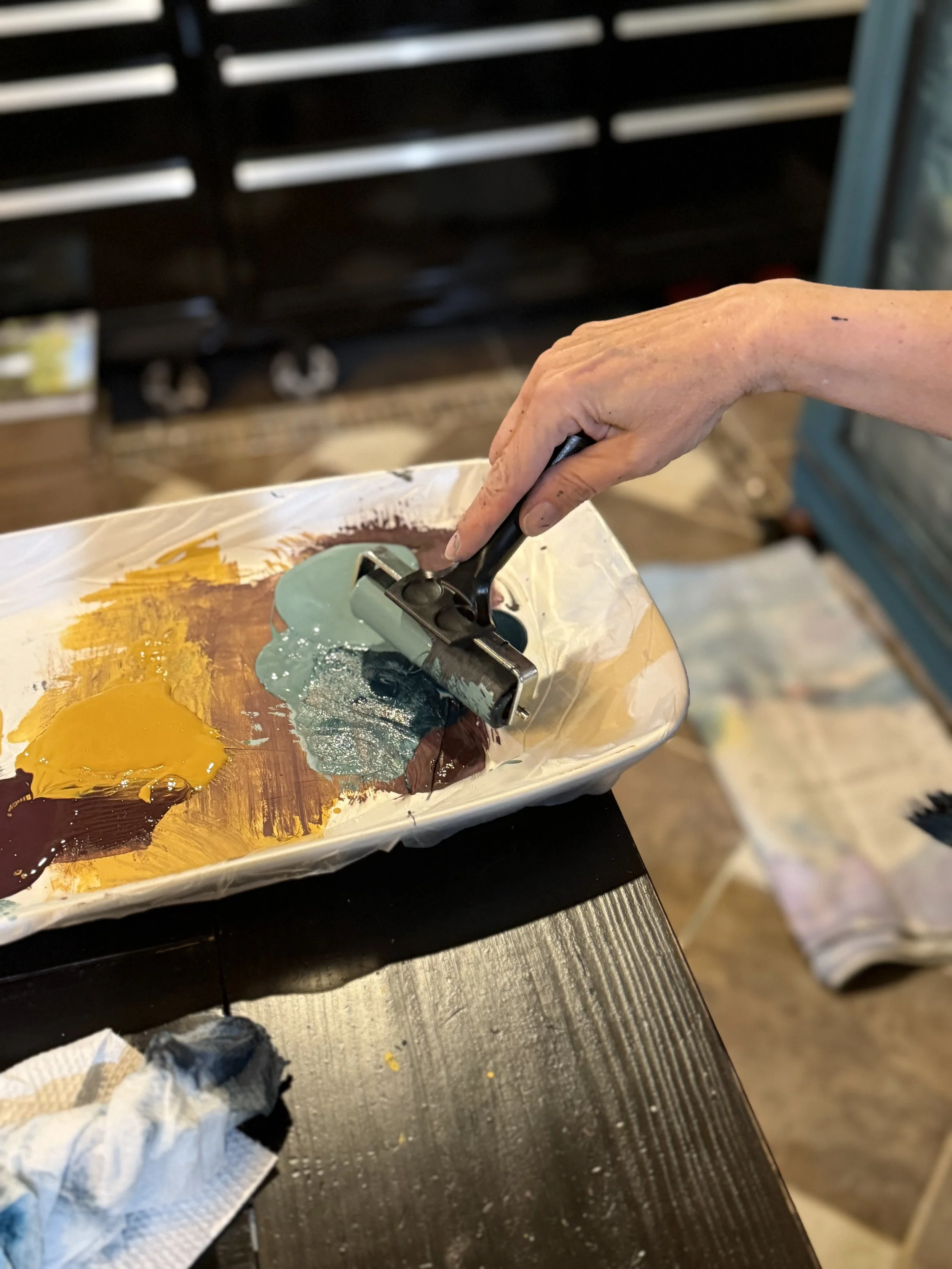
Farm Fresh – a minty soft green
Black Velvet – the shadow tone
Queen Bee – a golden yellow
Cherry Picked – a deep wine-brown
Hey Sailor – a muted royal blue
Faded Burlap – warm, soft neutral
Cake Batter – the perfect creamy highlight
Each color was chosen directly from the decoupage design’s palette.
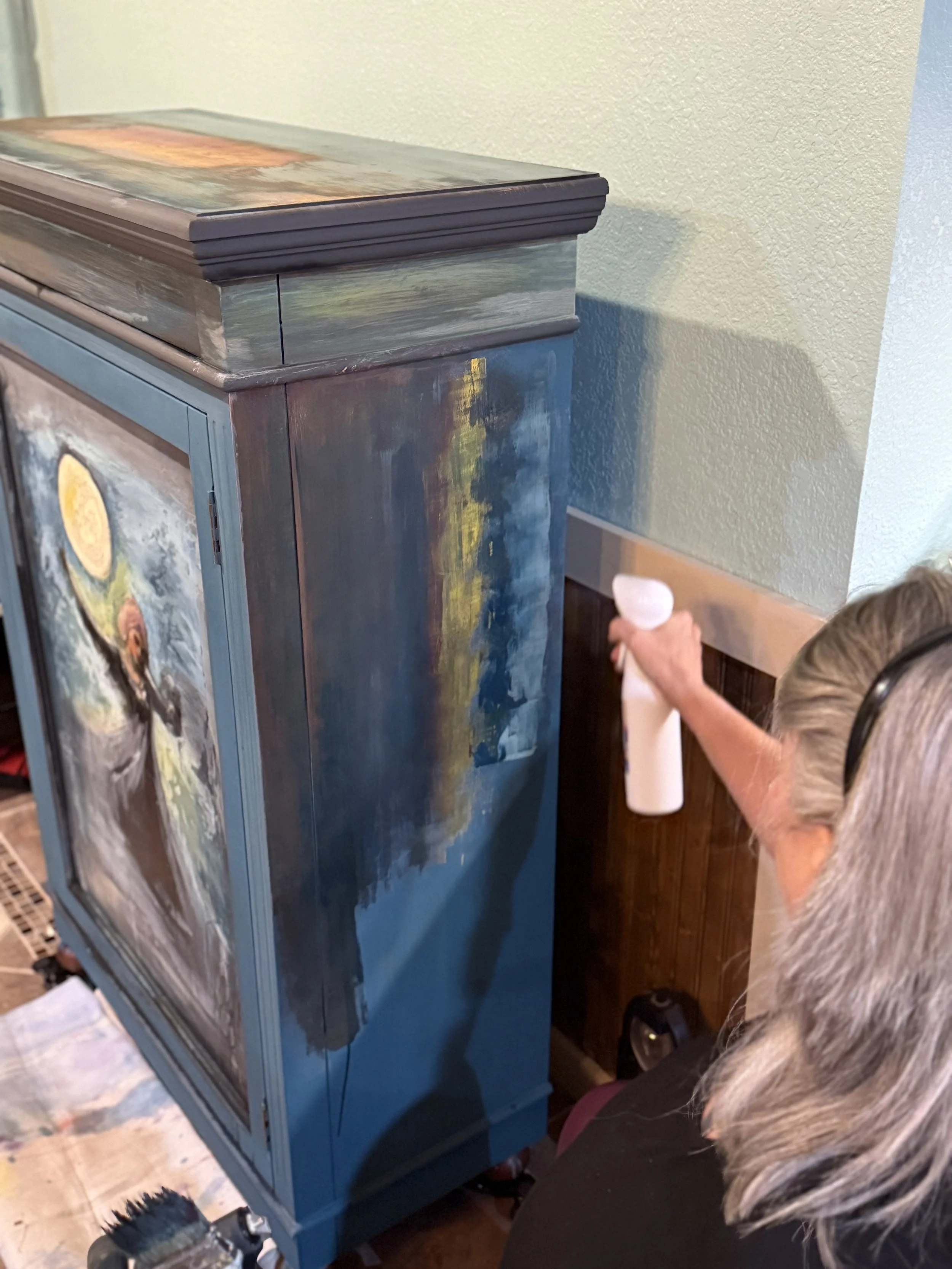
The secret to using this paint?
Water.
A lightly misted brush.
A misted palette.
Keeping everything just wet enough to dance together on the surface.
Painting her was like working in watercolor … fluid, emotional, intuitive.
I stretched the project over a couple of days, even though I wanted to finish it in one burst of inspiration. But patience paid off. Letting each layer rest created a depth, softness, and old-world charm I wouldn’t have achieved otherwise.
The Decoupage & The Gold Leaf
Truthfully, I had a few mishaps applying the decoupage design. Furniture decoupage is not my daily medium. But the imperfections became part of her charm. I wouldn’t change a thing.
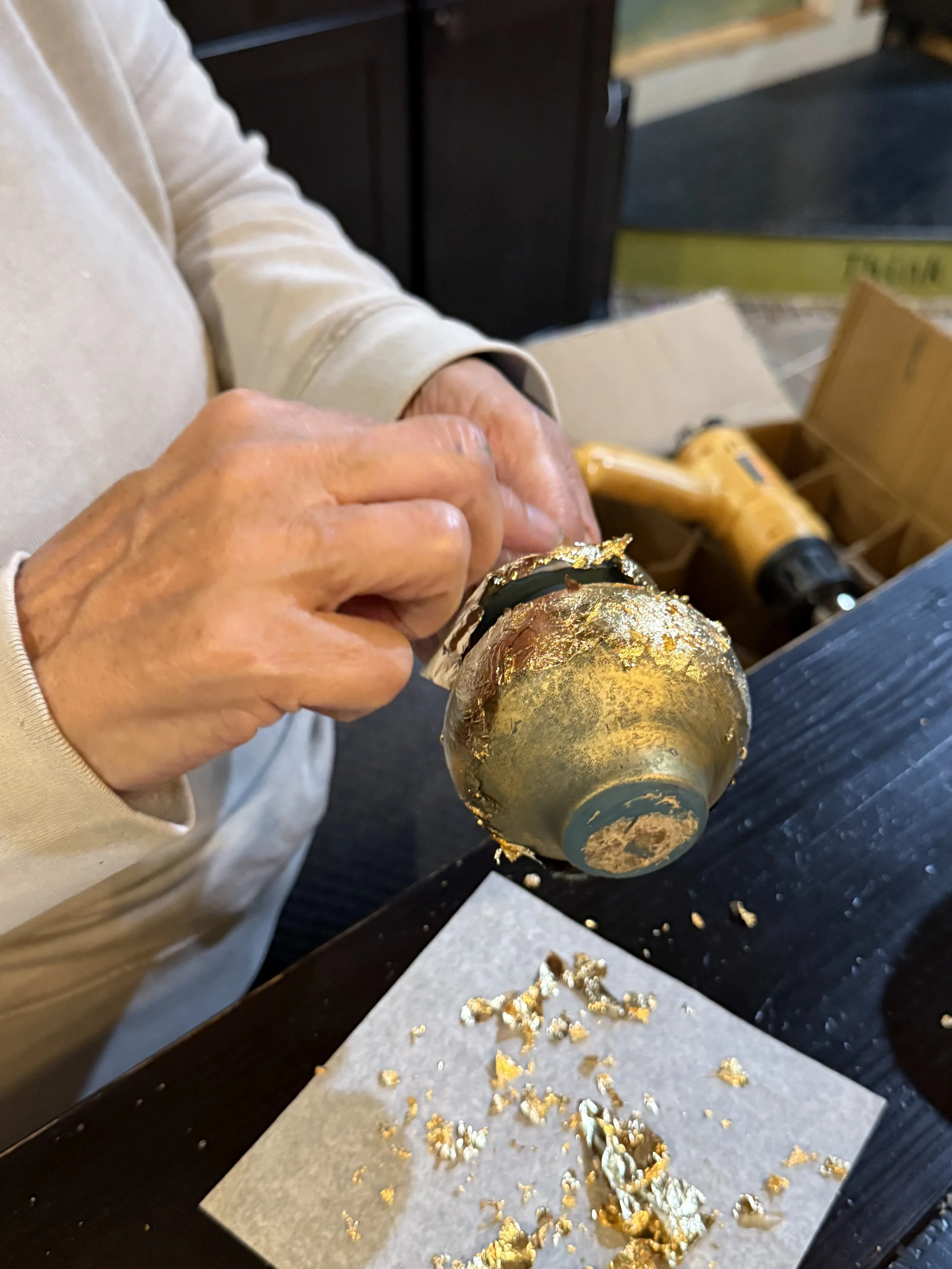
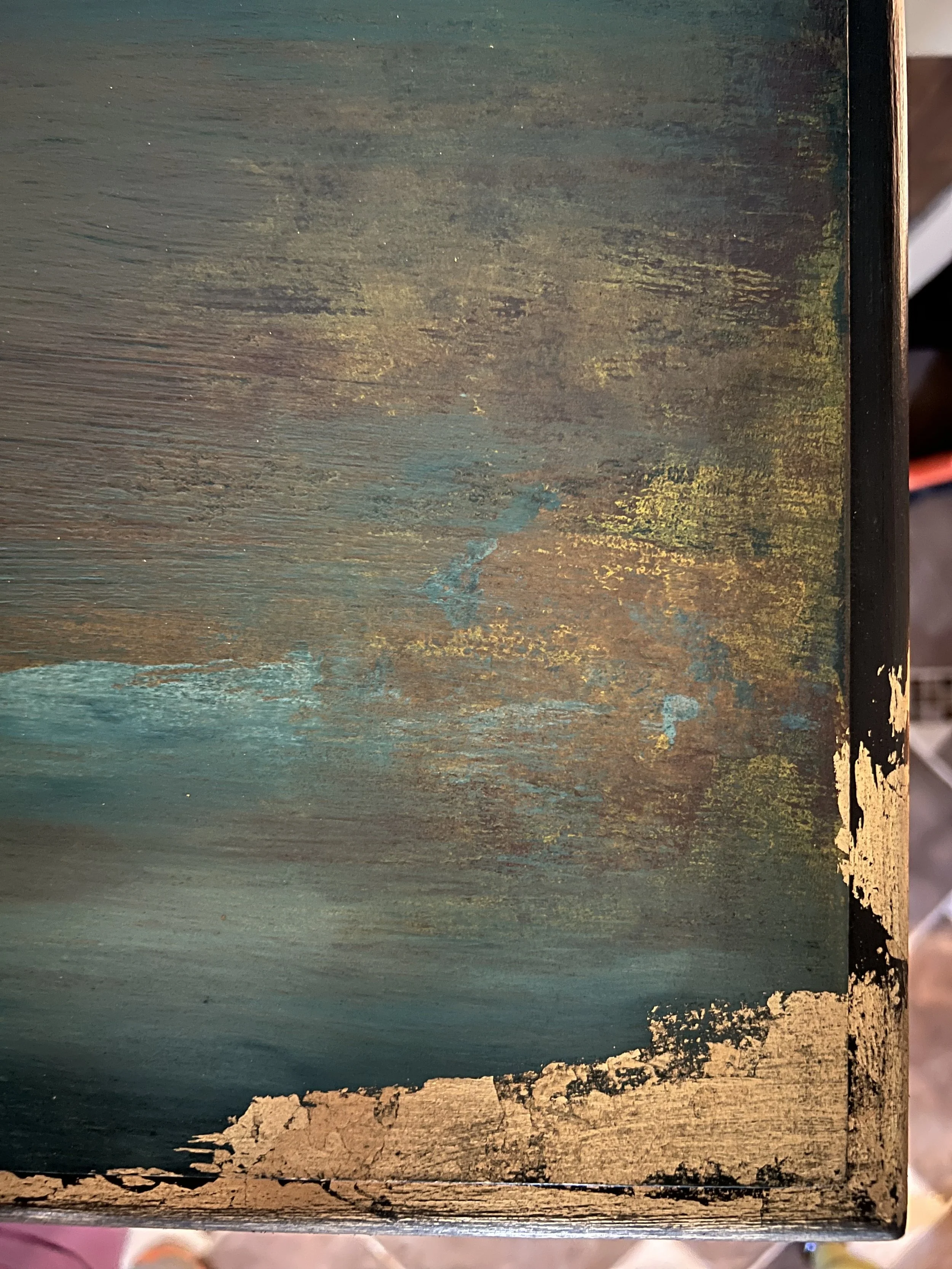
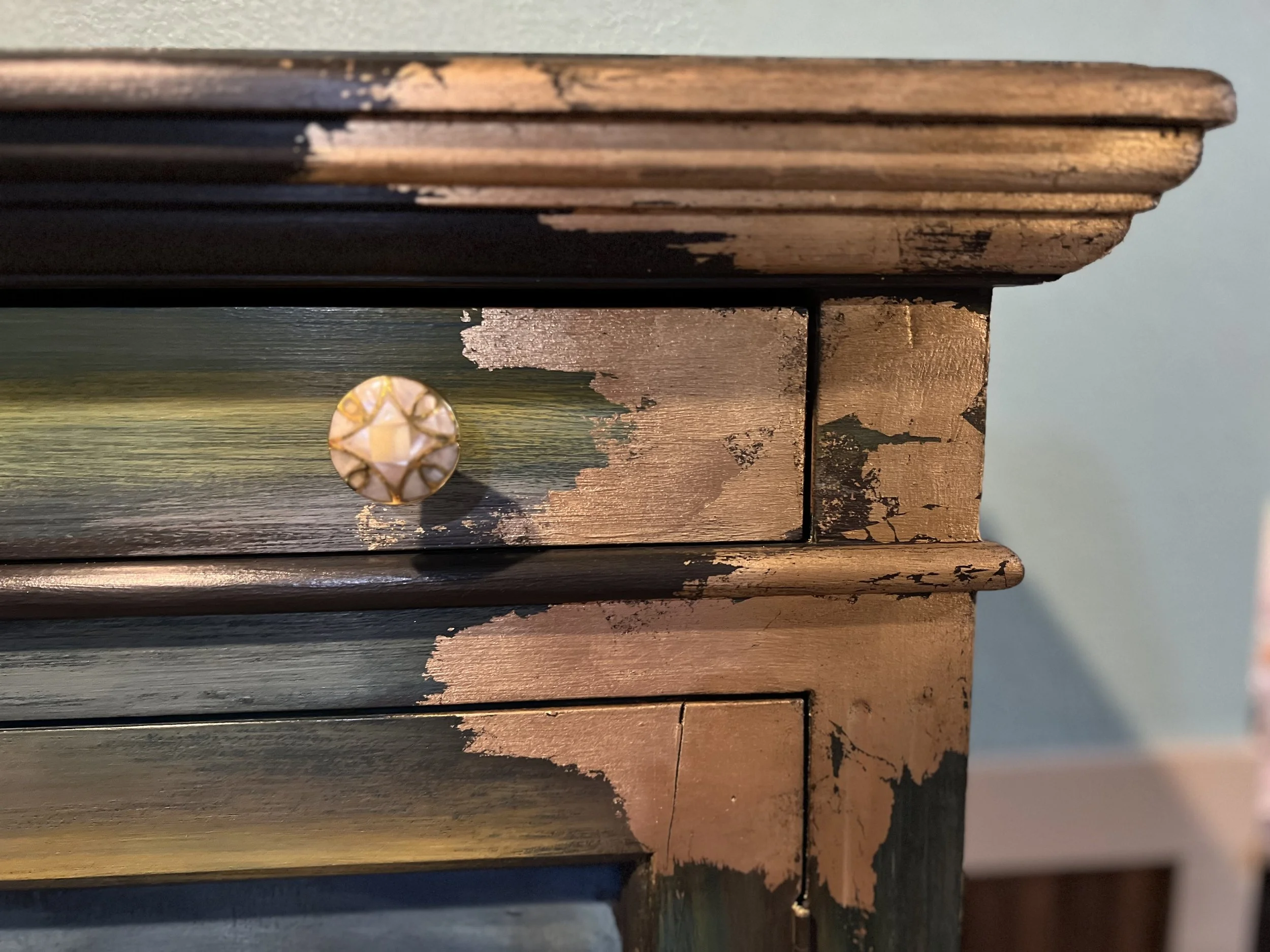
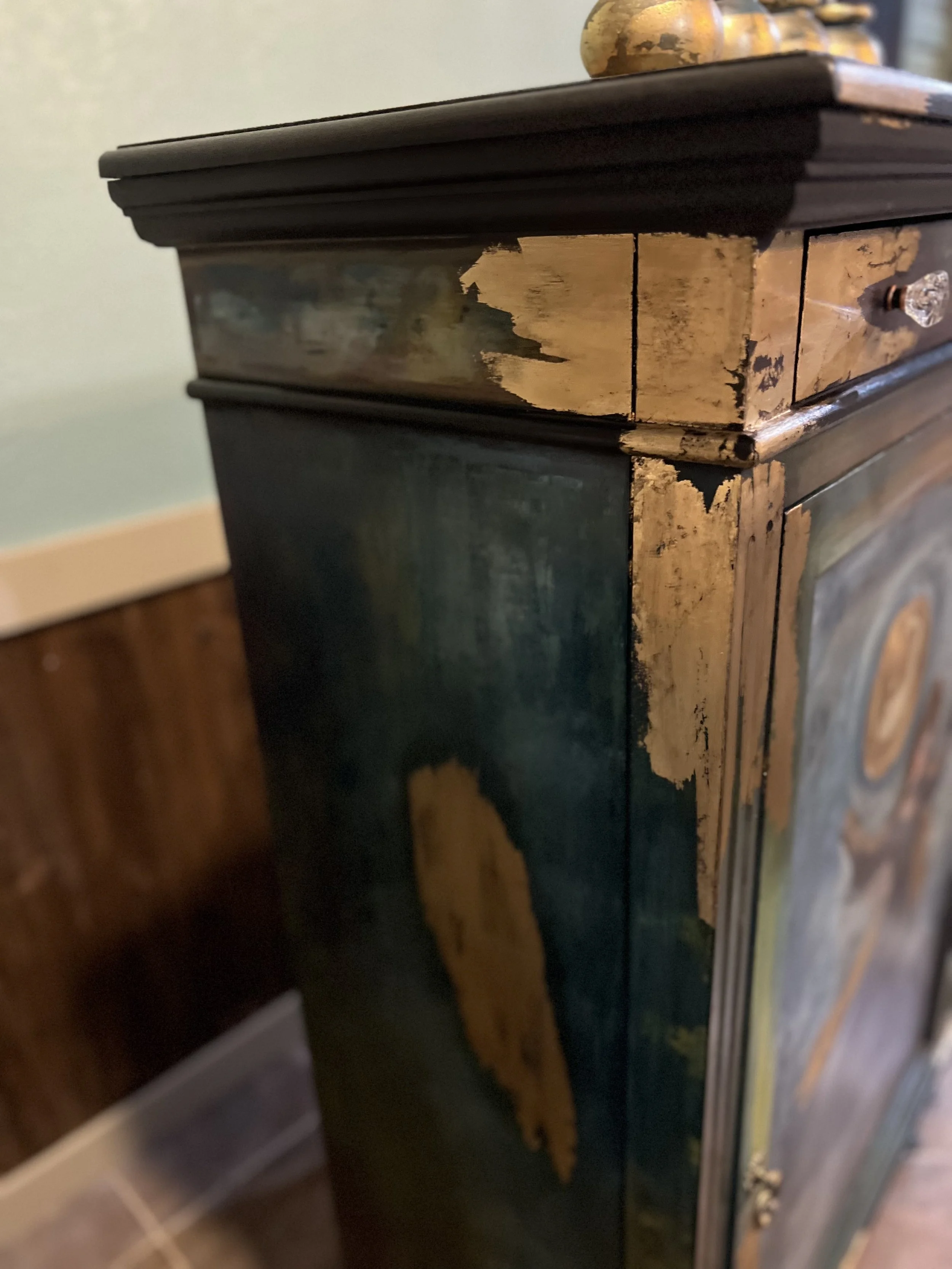
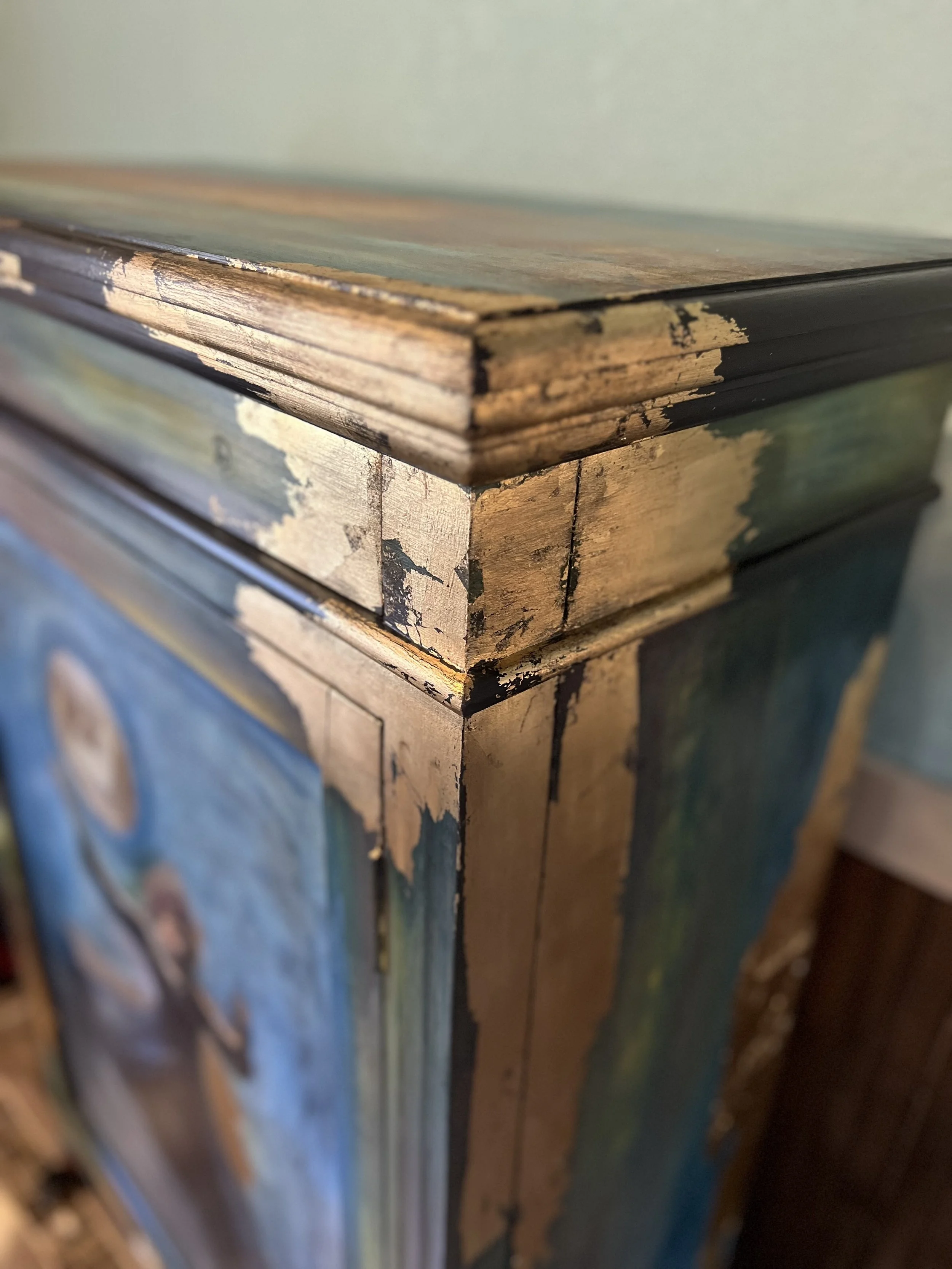
The gold leaf was a late addition … inspired by this month’s challenge inside The Creative Connection. I already had a stash of gold leaf from another project, and once I opened the sheets … the obsession began!
Gold leaf is addictive.
There, I said it.
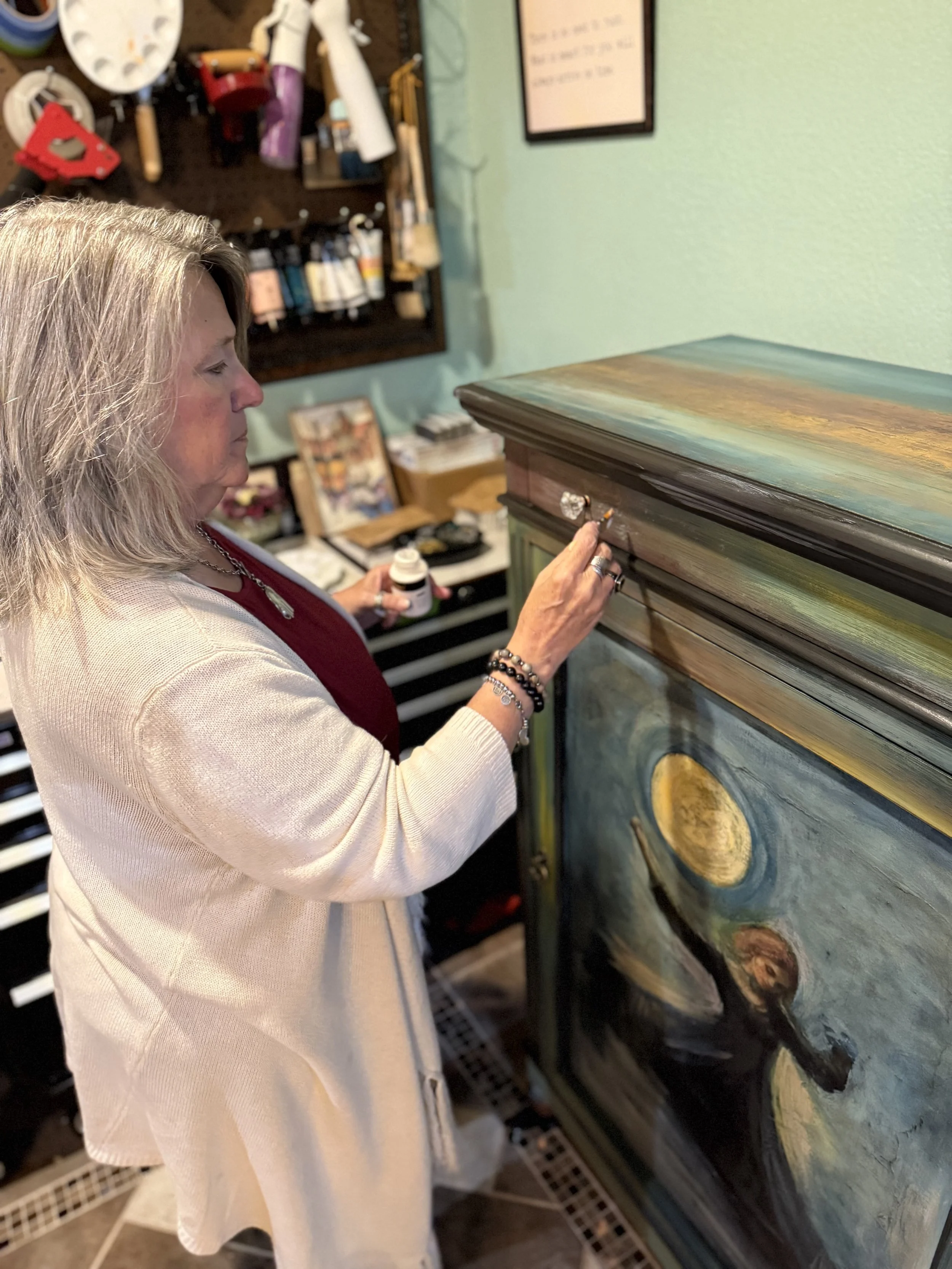
I showed restraint (mostly), but adding those fleeting touches of gold to the moon, the woman’s gown, and the edges of the cabinet felt like painting with light.
The final step was brushing on dark wax … buttery, rich, grounding … sealing everything with a soft, vintage glow. It was the last touch she needed.
Old world.
Soulful.
Mysterious.
Completely transformed.
Closing Thoughts
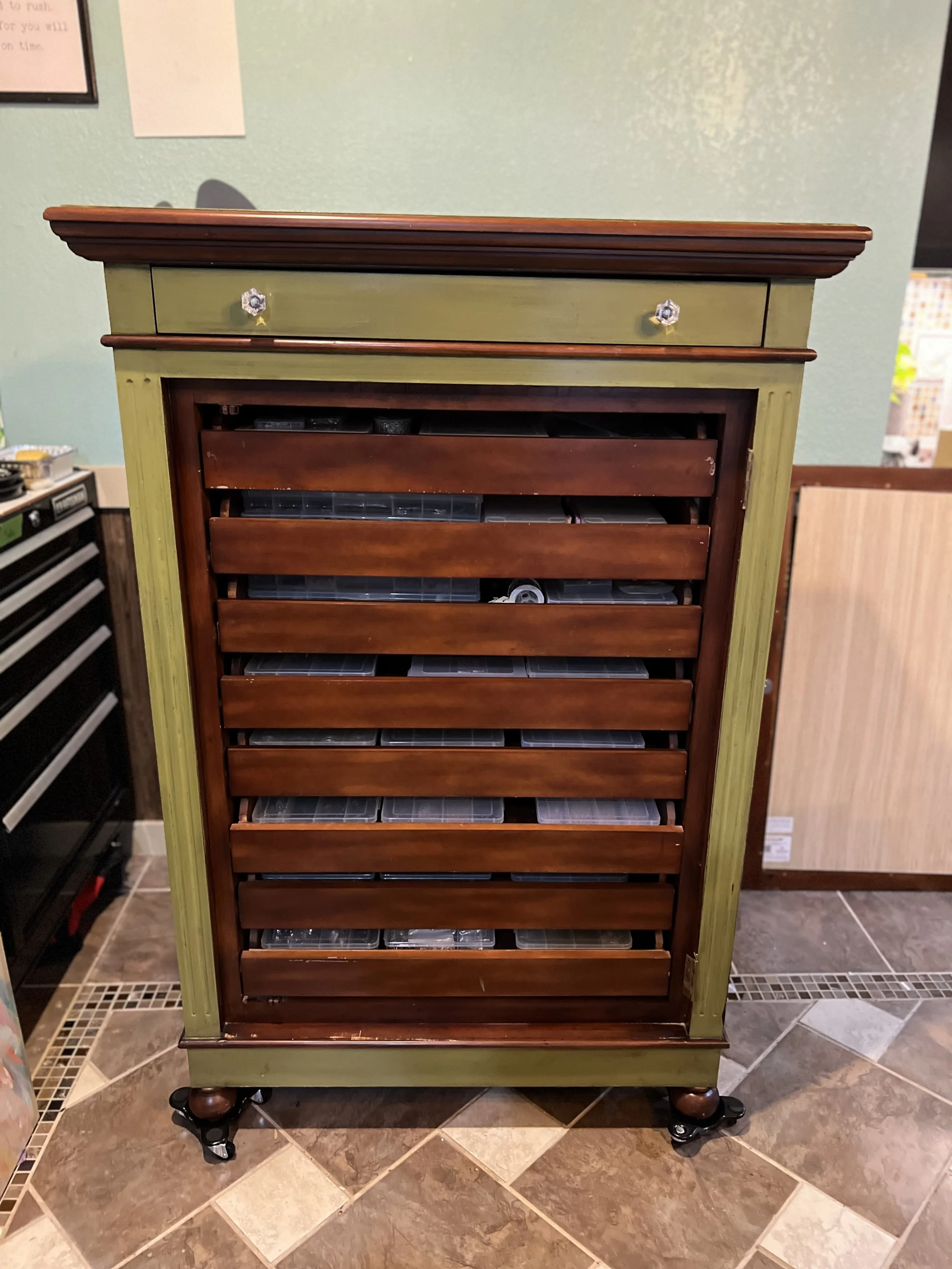
This little secondhand tie wardrobe has lived many lives since I brought her home … soap cupboard, studio accent, forgotten treasure, and now, she has stepped into her newest season:
She now houses my containers of beads and jewelry components.
It’s the perfect next chapter.
A cabinet that has always held the tools of whatever creative season I’m in … fragrance, supplies, inspiration … now holds the tiny treasures that become my tassels, charms, bracelets, and one-of-a-kind adornments.
She reminds me that beauty evolves.
Purpose evolves.
And sometimes the things we set aside are simply waiting for us to return with new eyes and a new vision.
I hope you enjoy seeing her steps and her finished transformation as much as I loved creating her.
Thought to Carry
“Sometimes the things we set aside are simply resting until we’re ready to see their magic again.”
A gentle reminder that nothing is wasted … not seasons, not ideas, not pieces of furniture, not parts of ourselves.
“What you seek is seeking you.” — Rumi
“He has made everything beautiful in its time.” — Ecclesiastes 3:11 (NKJV)
The Winds of Change
When Synchronicity Becomes Your Compass
There’s a moment in every season … creative, personal, or spiritual … when you can feel the shift before you can name it.
A soft stirring.
A subtle pulling.
A breeze that wasn’t there yesterday.
And sometimes … the winds of change arrive with such uncanny timing that you can’t help but laugh at the synchronicity of it all.
These past few weeks, I’ve watched the threads of my life, my business, and my story tug in directions I didn’t plan, but absolutely needed. Conversations at shows, unexpected opportunities, people crossing my path at exactly the right moment … it’s as if the wind carried them straight to my door.
And what I’m learning, again, is that synchronicity is often God’s gentle way of saying:
“Keep going. You’re aligned. I’m here. The next step is already unfolding.”
When Change Becomes Invitation
Sometimes change comes as a storm that rearranges everything.
Other times, it arrives as a whisper that asks you to listen before you leap.
Running an ever-evolving business … especially one built from soul work, creativity, healing, and intuition … requires a willingness to pivot, soften, grow, release, and become.
It means trusting the winds when they shift.
It means following the direction your spirit is being guided toward, even before the map appears.
It means honoring every nudge, every alignment, every “coincidental” encounter that feels too meaningful to ignore.
Synchronicity isn’t random.
It’s relational.
It’s the quiet evidence of a God who weaves our story with intention, bringing the right people, ideas, and opportunities at the exact moment we are ready to receive them.
Synchronicities in Business (That Don’t Feel Like Business at All)
As my own work expands … through candle launches, Soulful Saturdays, the book, the journals, workshops, retreats, and all the threads weaving into The Silver Bohemian … I’m noticing something:
Every new door appears when I decide to honor where I actually am, not where I think I “should” be.
And when I stop resisting what is changing, everything starts aligning.
People arrive who speak my language.
Ideas connect like constellations.
Old ways fall away without the grief they once carried.
New pathways shimmer with possibility.
These synchronicities feel like wind chimes at the edge of my awareness … delicate reminders that I am guided, supported, and never walking this path alone.
You Don’t Have to Be Ready. You Have to Be Open.
The winds of change don’t ask for perfection.
They ask for openness.
To let go.
To lean in.
To trust what’s unfolding.
To follow the subtle breeze where it’s leading.
To believe that God is bringing you toward the very thing you’ve been preparing for, often without realizing it.
The business you started years ago isn’t the business you’re meant to carry forever.
It evolves because you evolve.
And when you shift, everything connected to your calling shifts, too.
Synchronicity simply helps you keep pace with your own becoming.
A Thought to Carry
Pay attention to the breeze, not the storm.
Synchronicity is often found in the smallest shifts, the quietest invitations, and the unexpected conversations that feel like home.
Follow what moves.
Trust what aligns.
Let the winds of change carry you where you’re growing next.
“When the winds of change blow, some build walls; others build windmills.”
— Chinese Proverb
“The wind blows where it wishes, and you hear the sound of it,
but cannot tell where it comes from and where it goes.
So is everyone who is born of the Spirit.”
— John 3:8, NKJV
Doing & Being
When Your Life Becomes the Work of Wholeness
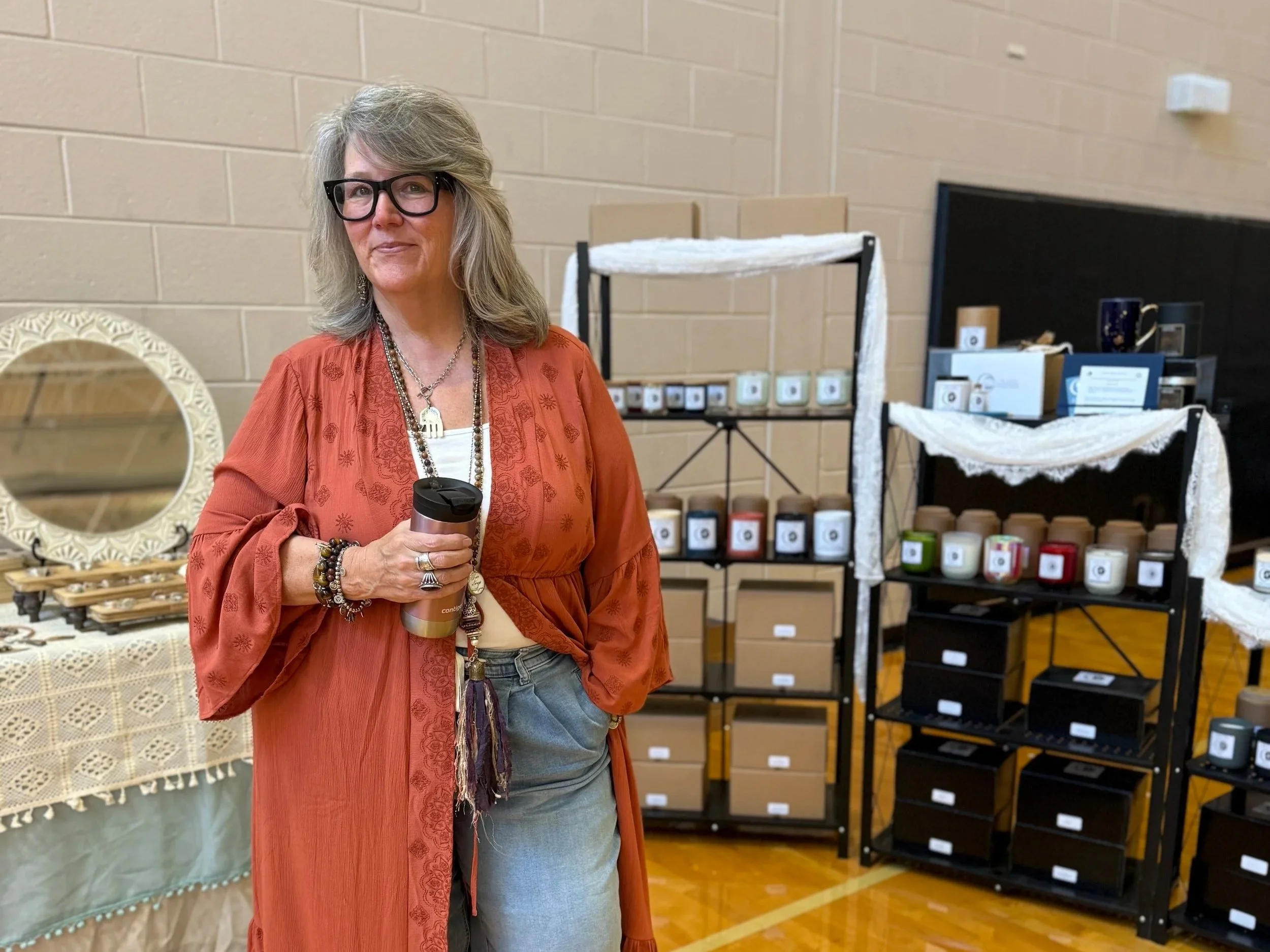
This weekend reminded me that the most beautiful conversations rarely happen in planned spaces. They happen between the booths, between the breaths, between strangers who feel like they’ve known each other longer than a few minutes.

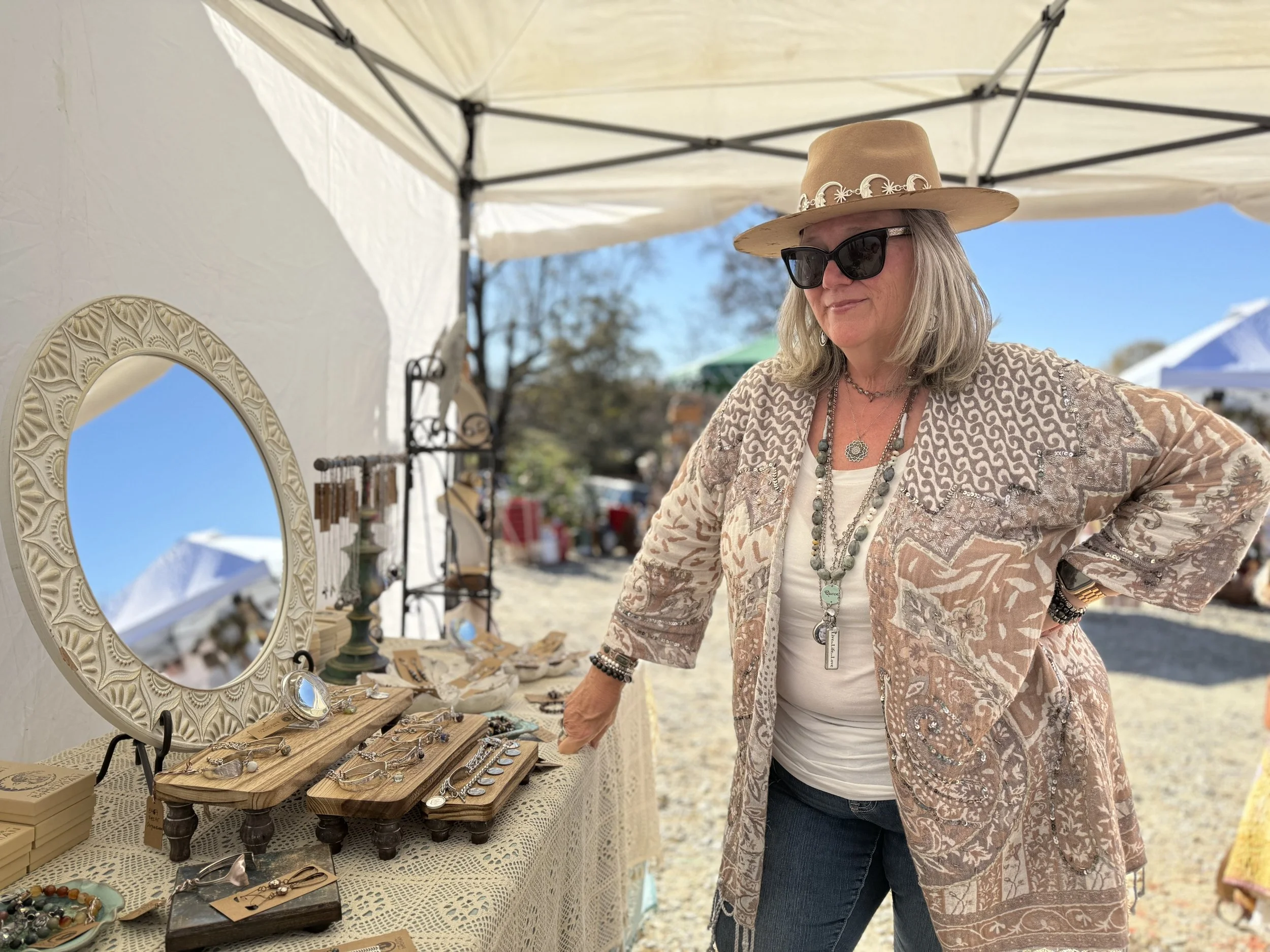
I met some incredible souls … mothers, caregivers, teachers, and travelers … all of us doing the work in our own way. One woman told me she had walked the entire Camino de Santiago with her husband, step by step across the miles of Spain. Her story carried her grit, she shared her reluctance about the accommodations … how she thought she couldn't finish and almost quit … then she found the courage that she could, and she did!!! That makes three people I know that have completed this pilgrimage. If you don’t know what it is, I encourage you to look it up.
These conversations are the kind that linger long after the telling. Others spoke of raising children, caring for aging parents, involvement in the community with their restaurants that I had frequented, or teaching generations of students to find their voice. Each story held its own quiet reverence. Some conversations began with talk of upcoming shows or creative projects, but as it often does, the dialogue drifted toward the deeper why … the heart work.
When someone asked what I do for a living, I smiled and said, “I help people remember it is okay to allow time for themselves, and to get reacquainted with who they are through art, story, and stillness.”
That’s the simplest way I can describe it. Because what began years ago as crafting candles and sewing denim has grown into something much larger: a practice of wholeness.
There was a time I thought “doing the work” meant long hours and steady output, always striving toward the next goal. But over the years, I’ve learned that being the work means letting your life become the message … that how you show up, listen, and create carries as much weight as the finished piece itself.
Wholeness work isn’t a business plan or a product line. It’s a way of living, one that honors the rhythms of rest and renewal, creativity and contemplation. It’s in the quiet act of pouring wax with intention. It’s in the conversations that turn into prayers without ever saying “amen.” It’s in the art that speaks what words can’t.
Each time I attend an event, I notice how the exchange has shifted. I may start by talking about a candle or a piece of jewelry, but somehow, we always end up talking about life … grief, growth, faith, the search for meaning. That’s when I know the work is working through me.
Maybe that’s what it means to truly live your purpose: not to separate your calling from your daily life, but to weave it into everything you touch.
When I listen to others share their stories, I see reflections of my own … the healing that happens when we give ourselves permission to be real, to be seen, to be unfinished and radiant all at once.
So yes, I’m doing the work.
But more than that, I’m learning to be the work.
To live the peace I speak of. To embody the creativity I encourage.
To show up to the table … or the market … as a whole and human being, not a finished product.
Because in the end, that’s what draws us together: the willingness to be present, to listen, and to let our light spill into the world one conversation, one creation, one encounter at a time.
A Thought to Carry
So here’s a realization I am having in this season … maybe “doing the work” isn’t about adding more to your list. Maybe it’s about allowing who you are to pour into everything you already do.
Show up. Create with love. Be present.
Let your life be the work.
“The measure of a life, after all, is not its duration, but its donation.”
— Corrie ten Boom“And whatever you do, do it heartily, as to the Lord and not to men.”
— Colossians 3:23 (NKJV)
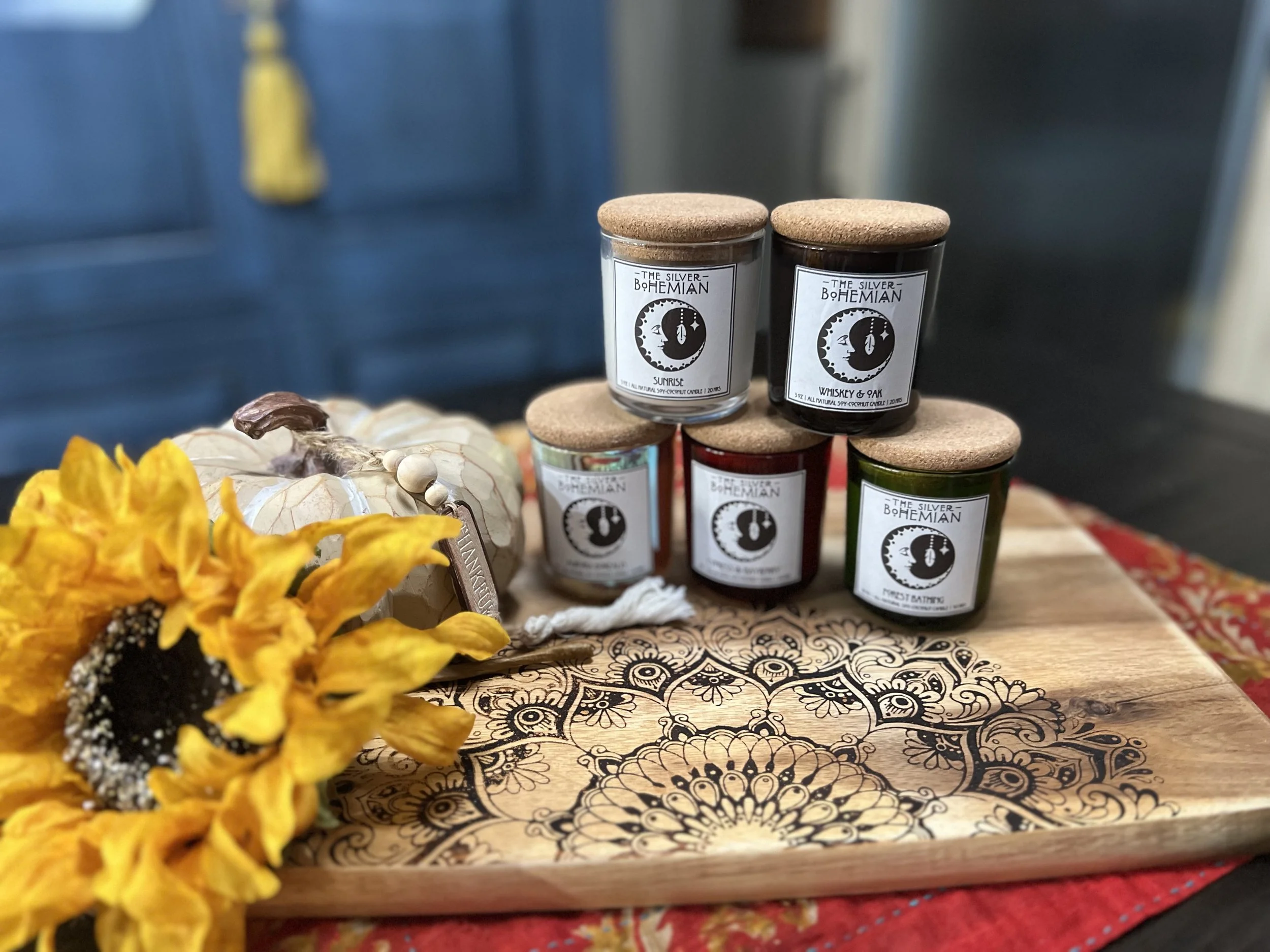
The Light We Give: A Candle Maker’s Journey of Healing, Faith & Everyday Gifting
Discover the story behind The Silver Bohemian — from humble jelly jars and bayberry inspiration to clean, handcrafted candles made with intention. Learn how candle making became a ritual of healing, gratitude, and everyday giving.
There’s something sacred about lighting a candle: the quiet flicker, the soft scent that fills the room, the way one small flame can turn an ordinary space into a sanctuary.
Long before I ever poured my first candle, I was in love with them. Years ago, I worked for a company called PartyLite, and that’s where I first discovered the art of quality … how fragrance and wax could hold memory and emotion. It was also there that I fell in love with the story of Mabel Baker, the woman whose legacy began it all on the shores of Cape Cod. I was drawn to the purity of her ingredients, her integrity, and her pioneering spirit. Her famous bayberry candles carried not just fragrance, but meaning … a symbol of good fortune and heartfelt tradition.
Those early days planted something in me: an appreciation for craftsmanship and a respect for the stories that live within what we create. The pride I take in my candles today was born in that season, as a young stay-at-home mom, learning, growing, and finding purpose in small acts of making.
When my first husband became terminally ill, everything changed. Clean ingredients became more than a preference; they became a form of care. I wanted to know what was in the air we breathed, the products I used, and what I brought into our home. So, I taught myself how to make candles, not just for beauty, but for peace of mind. Every pour became a quiet prayer, each scent a whisper of healing and hope.
That season also deepened my appreciation for essential oils … how they support the body’s ability to restore balance and harmony. I’m not opposed to medicine, but I do believe that we often reach for quick fixes when our bodies are really asking for rest, nourishment, and stillness. I’ve learned that the body has a remarkable design, one created by God to heal, adapt, and renew when we honor it.
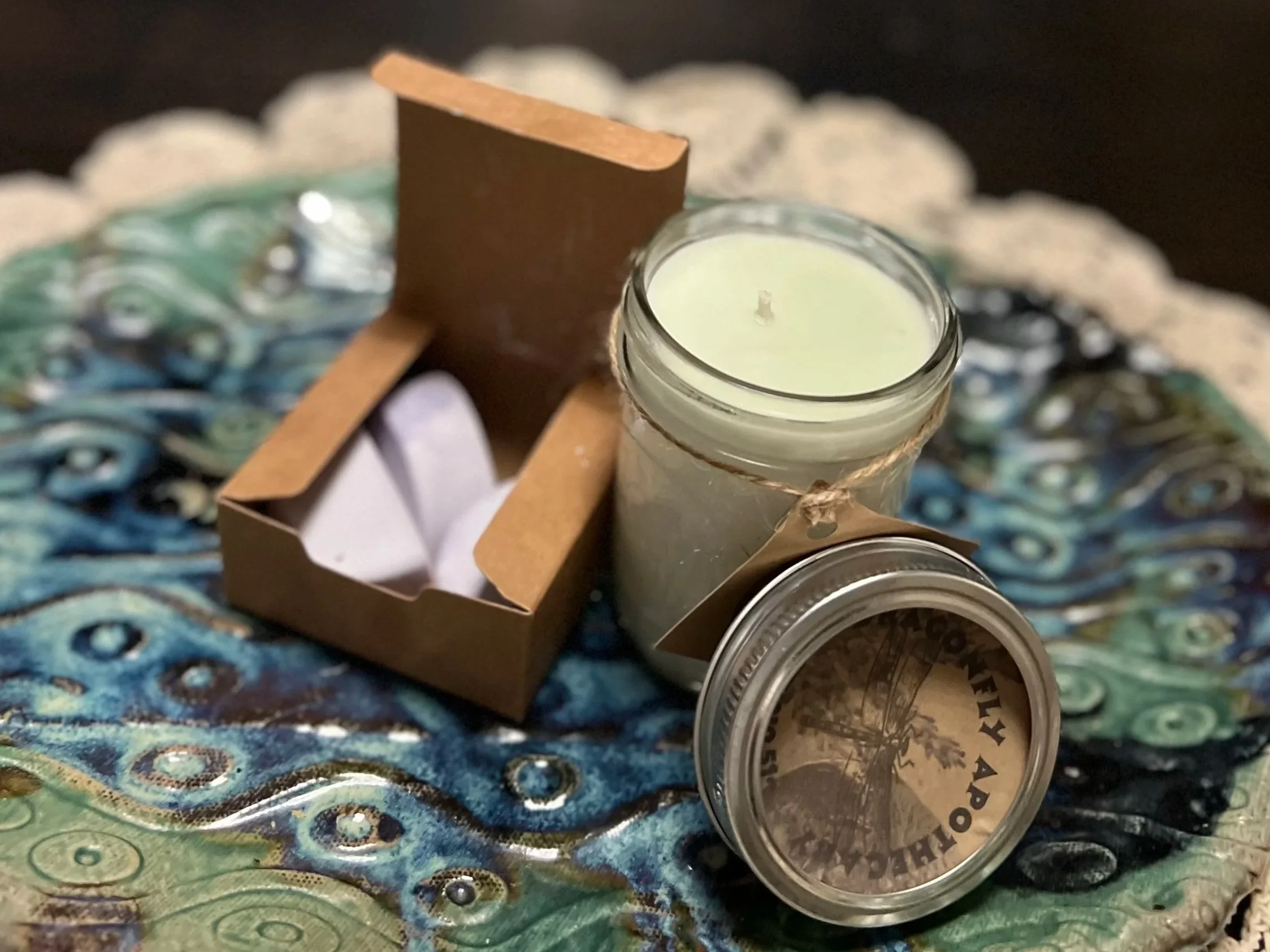
As I began to pour, I had no fancy tools or custom packaging. My first candles were made in small jelly jars, and my first wax melts were poured into an ice tray mold from my kitchen. They weren’t perfect, but they were honest, useful, and made with love. Those early creations taught me something important: simplicity can still carry soul. What mattered most wasn’t the jar or the label; it was the intention behind the light.
Over time, my candle-making evolved from humble beginnings at my kitchen table to what has now become The Silver Bohemian. But at its heart, the mission remains the same: to offer meaningful, mindful gifts that speak love in ordinary moments.
After losing several people I loved, many of them around the holidays, I began to see giving differently. I realized how precious the now really is, and how love shouldn’t have to wait for a special occasion. I no longer wanted to give because the calendar told me to; I wanted to give because my heart did.
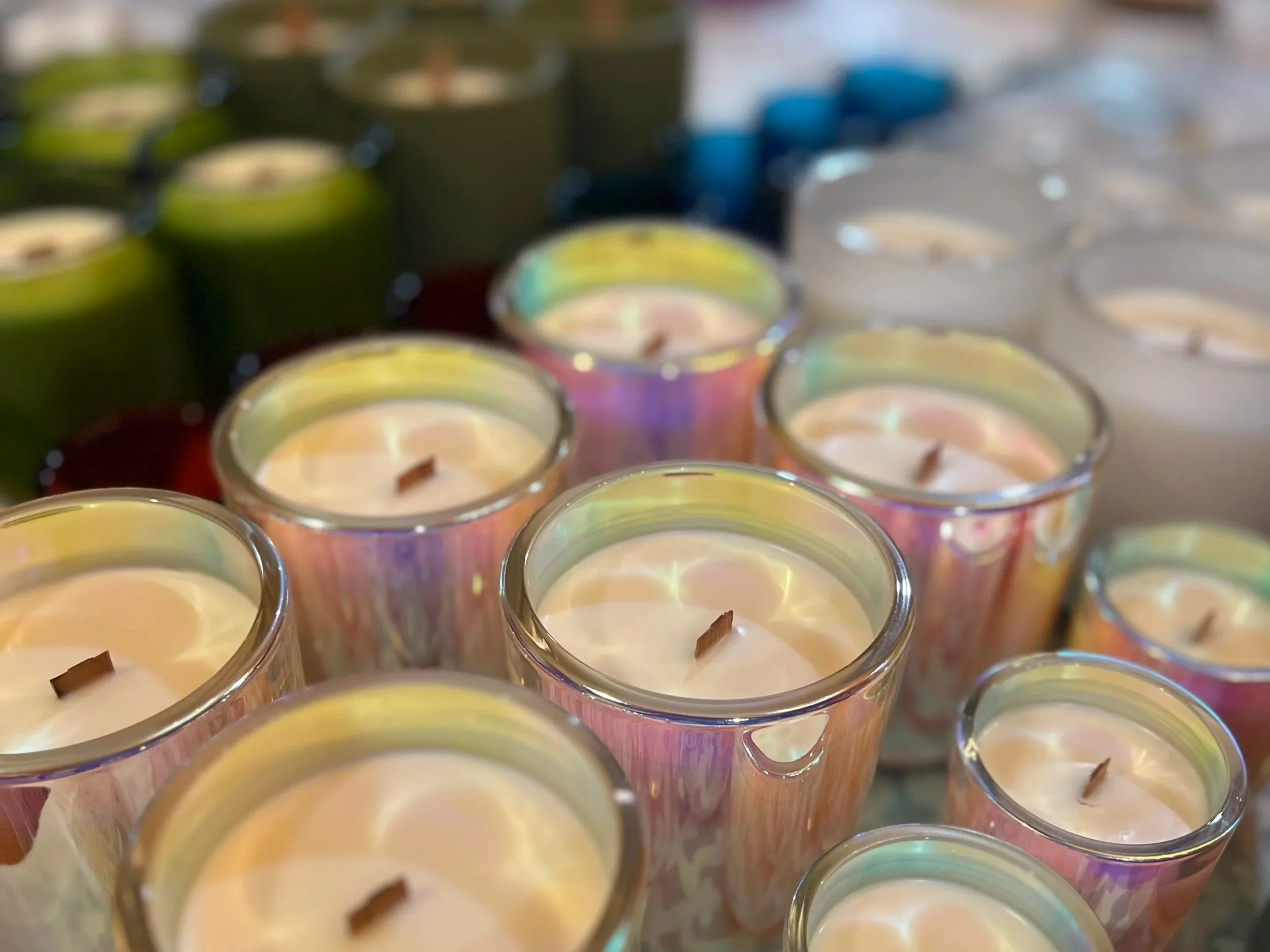
So I began to send small tokens of light … a candle for a friend who’d had a hard week, a simple note tucked inside, “I thought of you.” That became my quiet mission: to make thoughtful, handcrafted gifts available not only for myself, but for others who wanted to share love in the same way … just because.
As my wellness practice deepened, my candles found a new rhythm, woven into the rituals of my day.
In the morning, I light one before journaling, a gentle cue to breathe and invite clarity before the day begins.
In the evening, another candle marks the slowing down, softening the edges of the day with peace and gratitude.
In my studio, I light them while I paint, write, or sew. Each flame anchors me in presence as scent mingles with inspiration.
And in client sessions, my candles add another layer of comfort, transforming the room into a sanctuary of calm, where the body and spirit can rest, release, and restore.
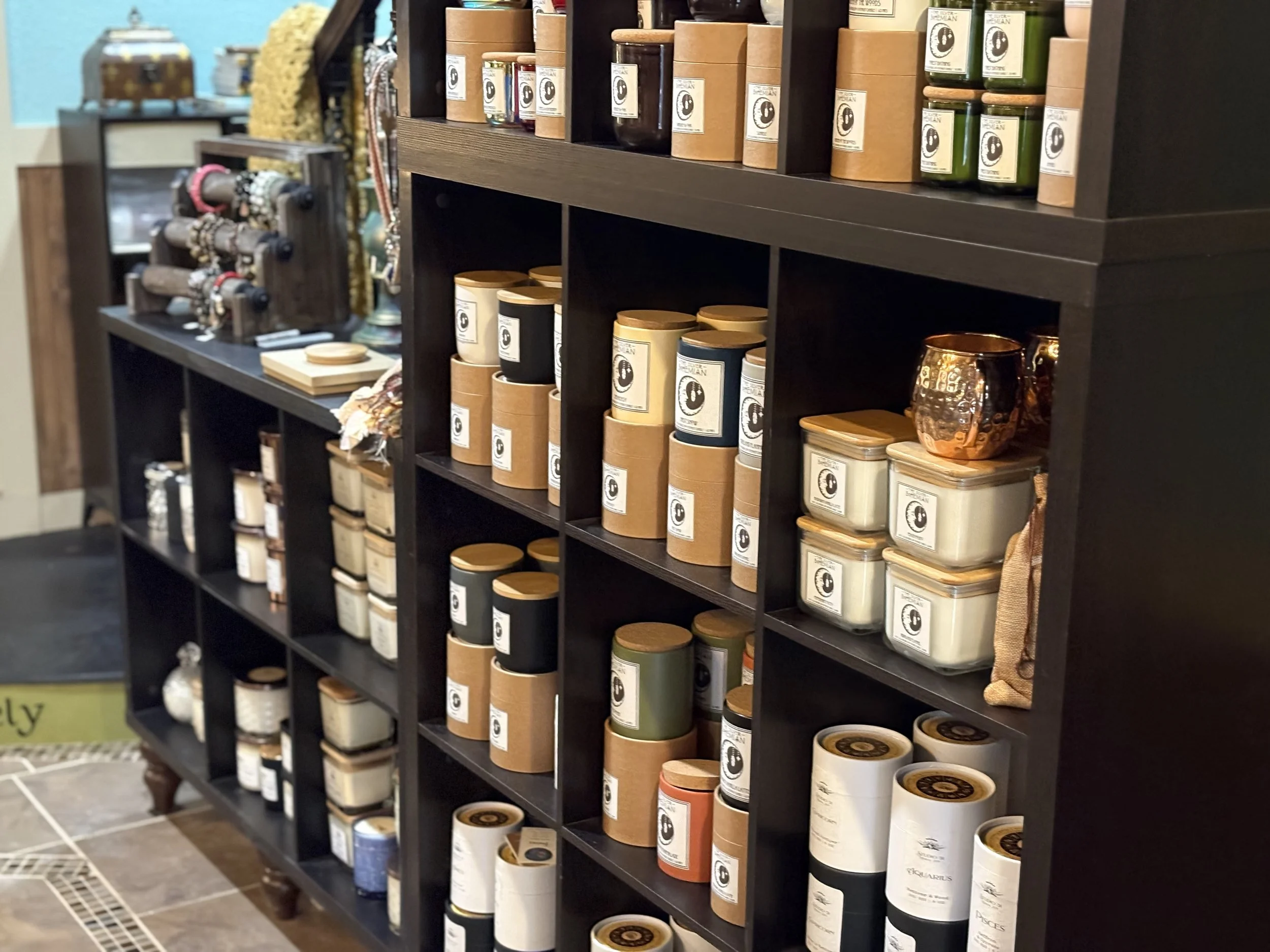
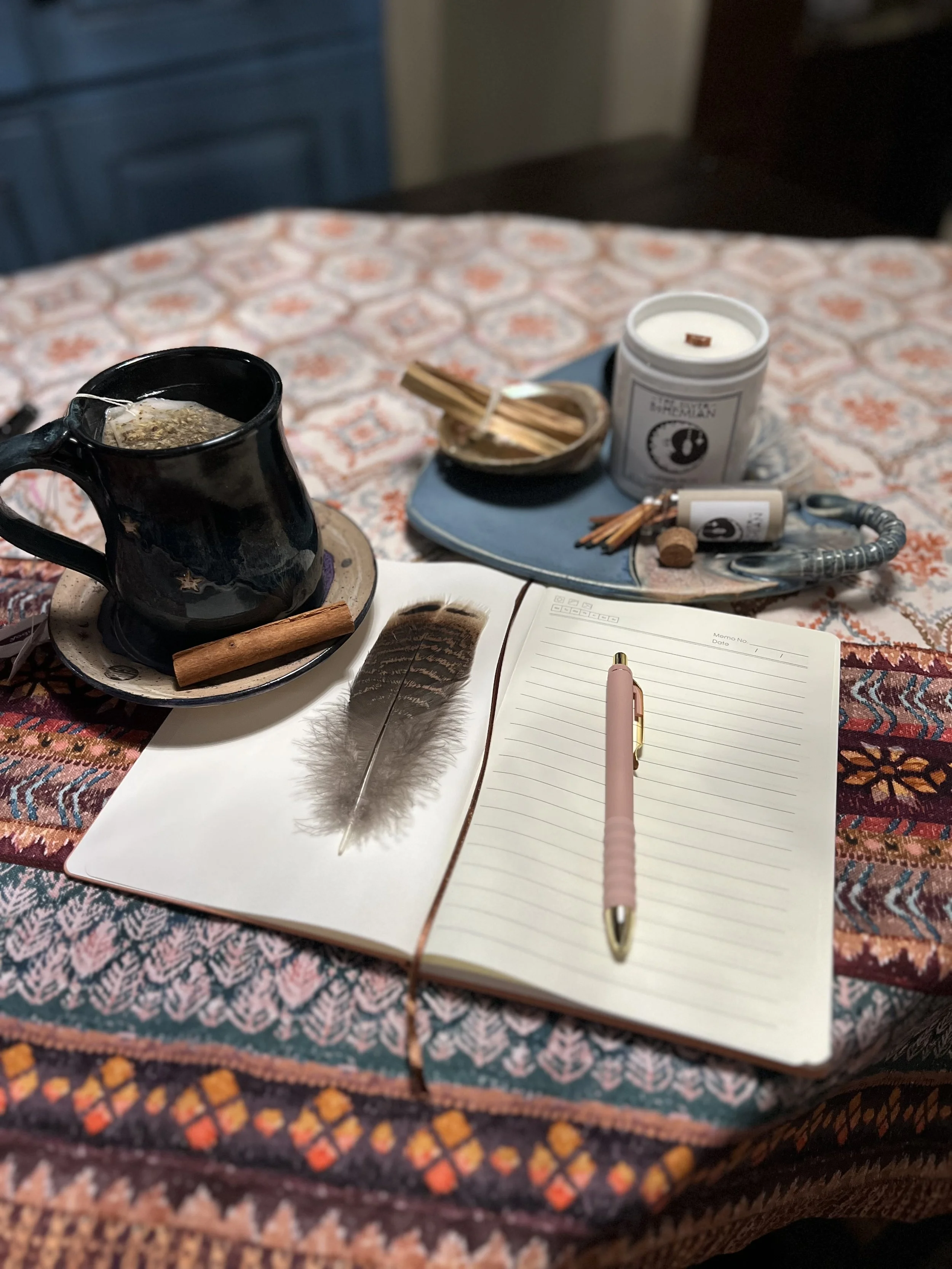
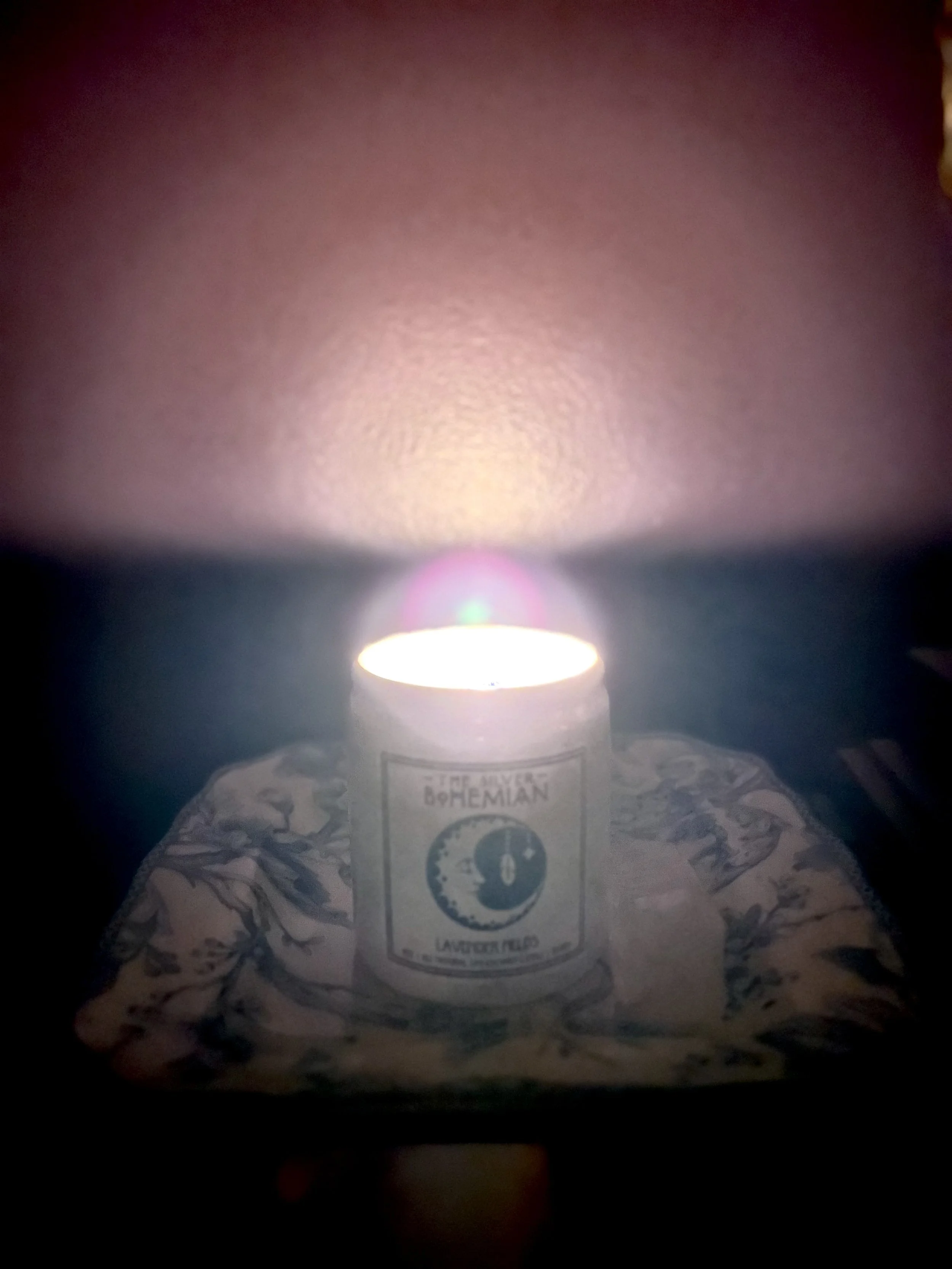
Light became both my creative language and my healing one, an alchemy that connects craft, care, and spirit in every space I enter.
Every time I make a batch of candles, I think of the love I’m sending out … the people who will receive them, the warmth they’ll bring, and the reason I began making them in the first place. Each candle carries that same intention: that whoever lights it will feel loved, remembered, and wrapped in peace.
Each candle I make is more than wax and wick. It’s a vessel of memory and message.
Some are poured with peace in mind. Others with comfort, joy, or clarity. Each one carries intention: a reflection of how even in dark seasons, light still finds a way to shine through.
I suppose that’s the real alchemy of this work … not just transforming raw ingredients into fragrance and flame, but transforming moments into meaning.
What began as a spark, a young woman inspired by Mabel Baker’s story and her own love of candles, has grown into something far deeper. From those first jelly jars on my kitchen counter to the curated gift sets I pour today, every candle still begins with the same heart: a love for craft, a reverence for light, and a desire to share it.
A Thought to Carry
When we give light, whether it’s a candle, a word, or a small act of kindness, we’re participating in something sacred. We’re reminding one another that love doesn’t wait for a reason. It simply moves when it feels called.
“Every good gift and every perfect gift is from above, and comes down from the Father of lights, with whom there is no variation or shadow of turning.”
— James 1:17 (NKJV)
“Try to be a rainbow in someone’s cloud.” — Maya Angelou
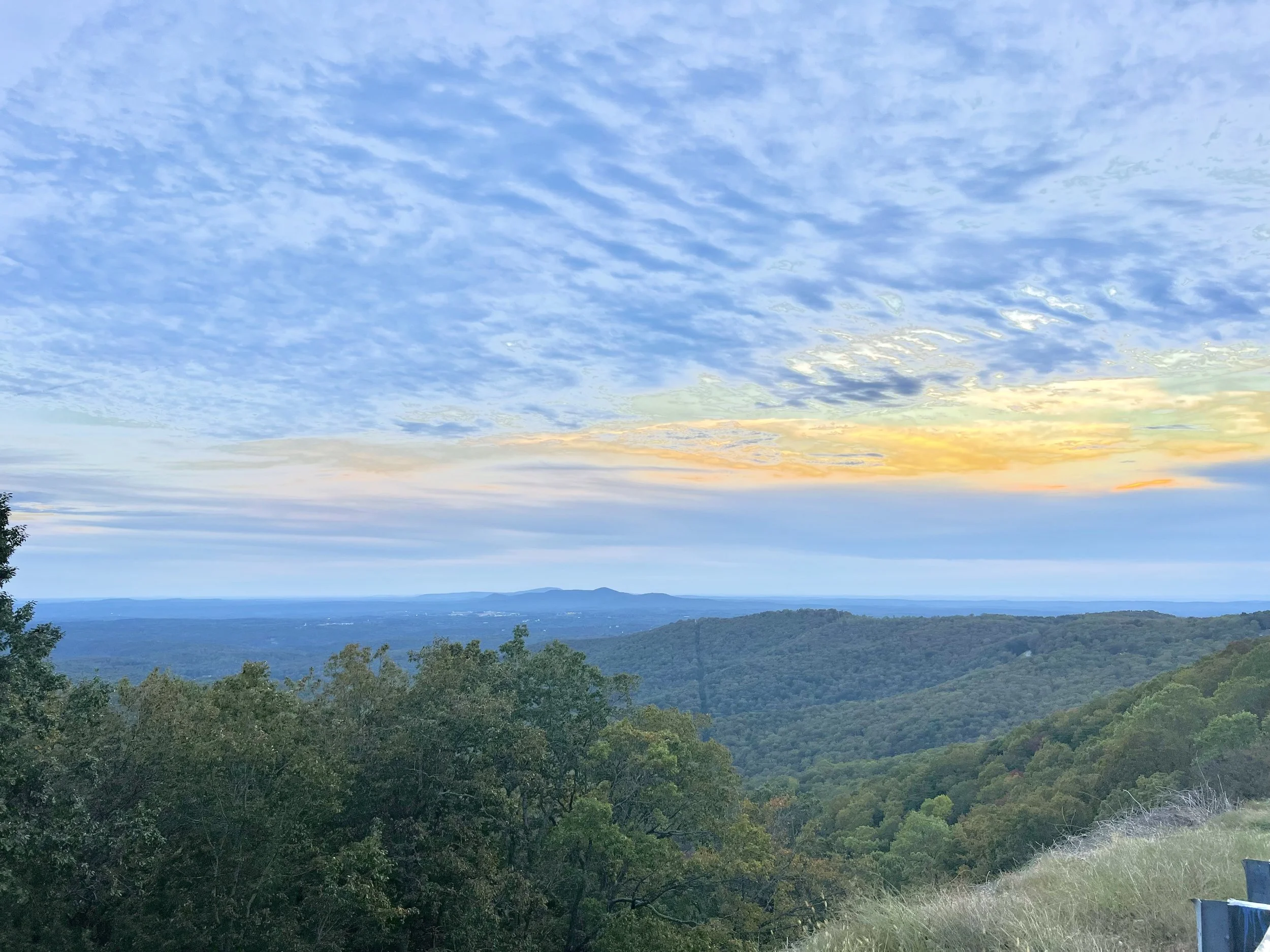
When Nature Becomes the Medicine
When Nature Becomes the Medicine: Finding Rest in Creation
This past weekend, I gave myself permission to pause.
Not because I had everything done … I didn’t.
Not because the calendar said “vacation” … it didn’t.
But because my spirit said, “It’s time.”
I’ve learned that when my soul whispers like that, I need to listen.
The final quarter of the year always carries a certain hum … the busyness of creating, preparing, and sharing the work of my hands. It’s the season when my studio lights glow late into the night and the scent of wax, wood, and essential oils fills the air. I love this rhythm of production … the beauty of bringing ideas into form … yet I also know how easily the pace can shift from sacred to hurried if I’m not grounded.
So I stepped outside.
I traded my planner for a trail and my to-do list for open sky.
I let the quiet rearrange me.
And somewhere between the rustle of the leaves and the sound of water moving over stone, I felt myself exhale.
Nature has always been my medicine.
She doesn’t rush. She doesn’t strive.
She simply becomes … revealing that creation is both an act of stillness and motion, of surrender and becoming.
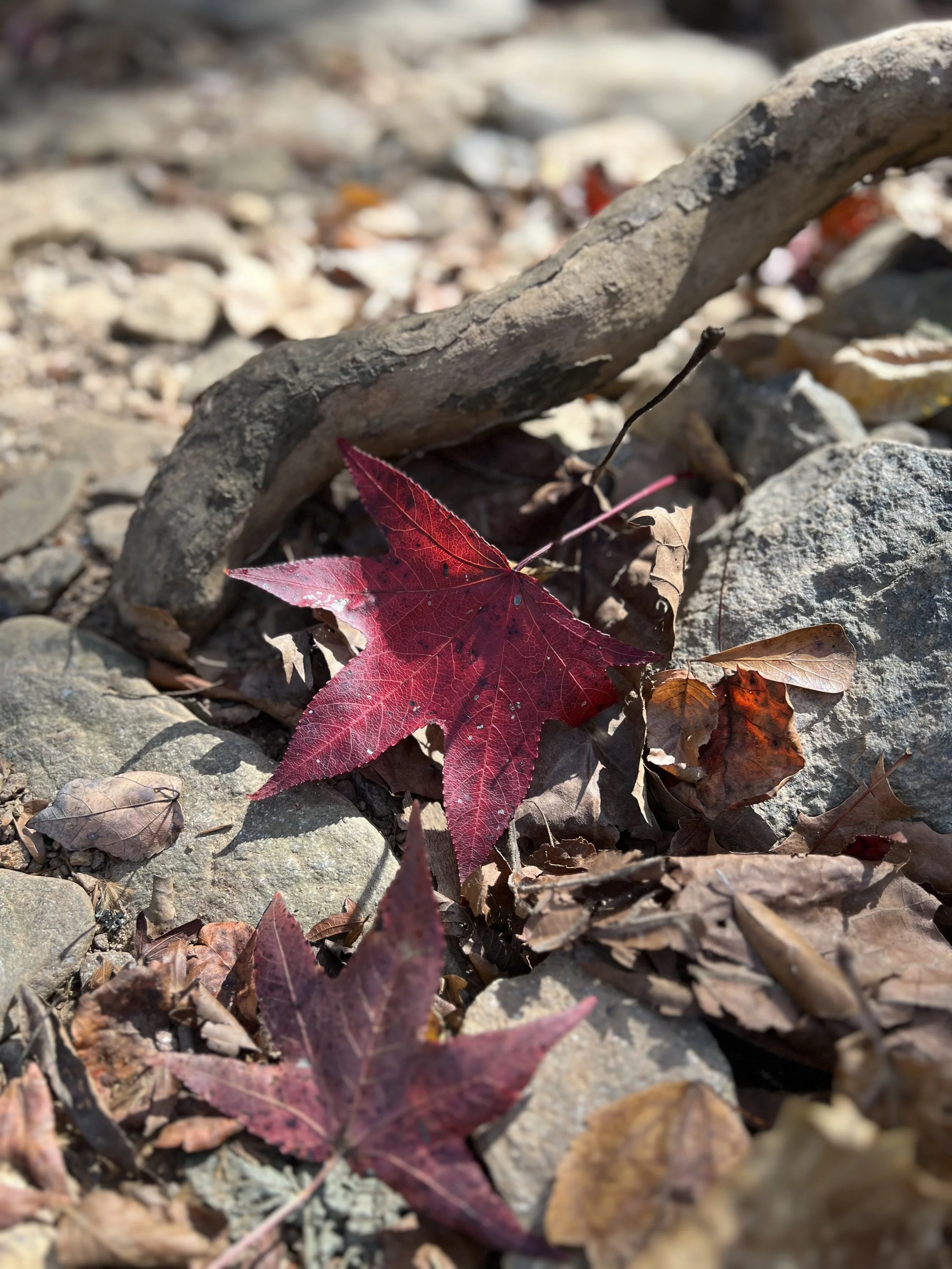
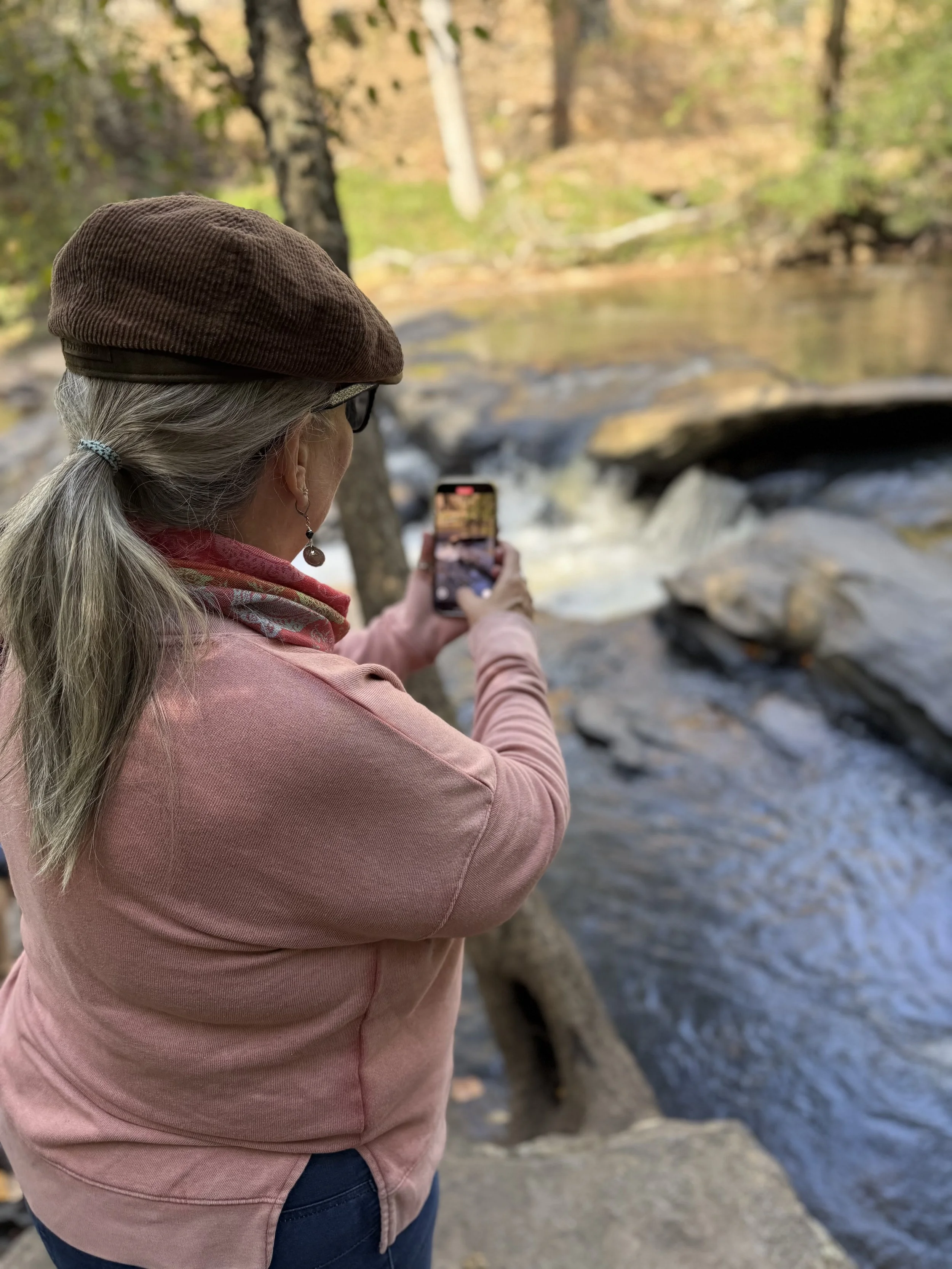

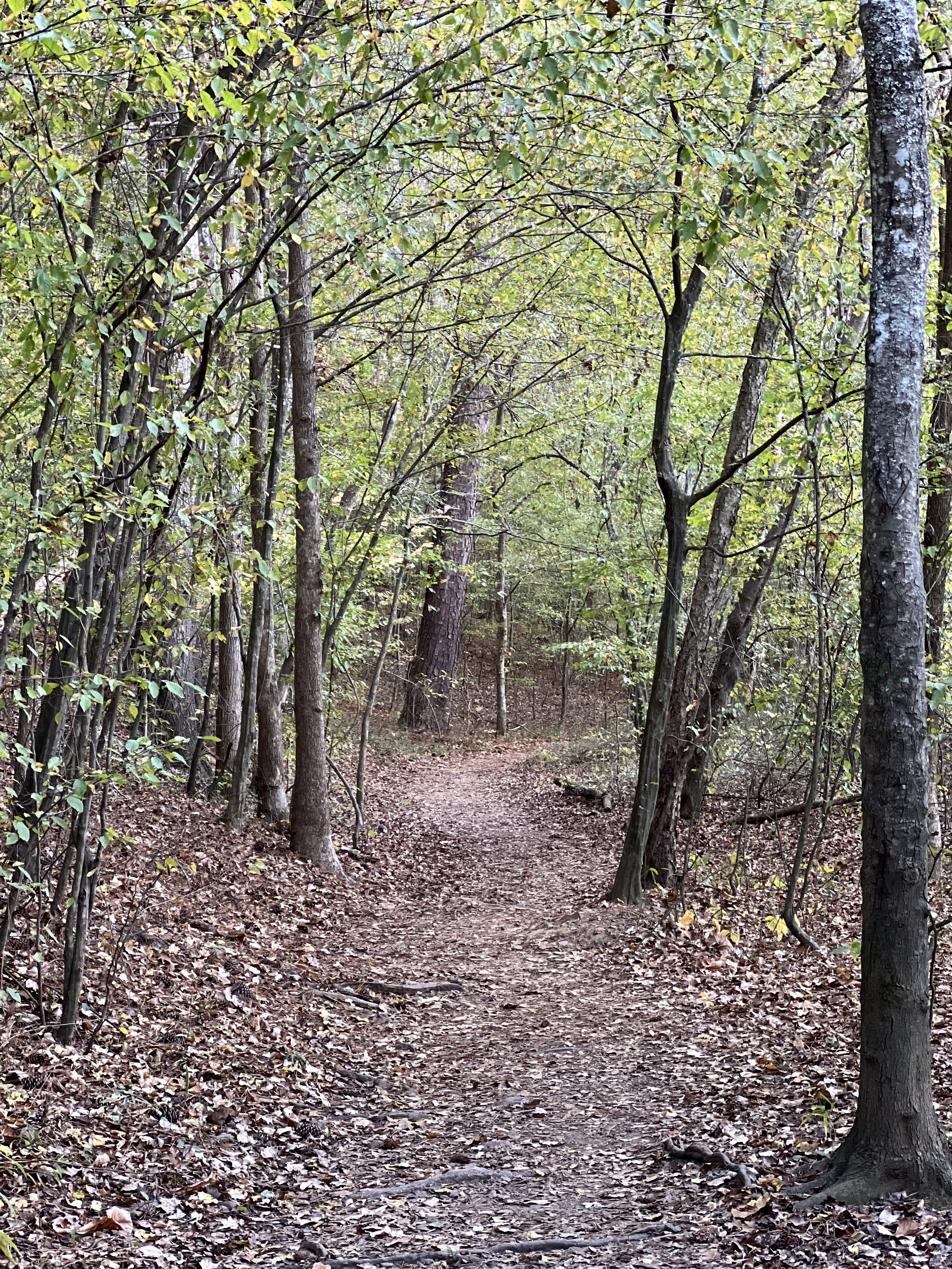
As I walked, I realized how much this mirrored my own creative process.
Every idea needs its wintering … its quiet unseen time … before it can bloom.
Every season of making begins with a season of listening.
I returned home lighter.
Not because my to-do list had vanished, but because I had remembered who I am beneath the doing … an artist, a vessel, a witness to grace unfolding through the ordinary.
Now, as I continue this last quarter of the year, I do so with fresh eyes and an open heart. I want my work to flow from the same ease I felt under the trees … intentional, unforced, rooted in gratitude.
A Thought to Carry
When you feel the pull to keep producing, remember that rest is not a reward … it’s part of creation. Let stillness refill your cup so what you pour out carries the sweetness of peace.
“He makes me to lie down in green pastures;
He leads me beside the still waters.
He restores my soul.”
— Psalm 23:2–3 (NKJV)“The earth has music for those who listen.”
— George Santayana
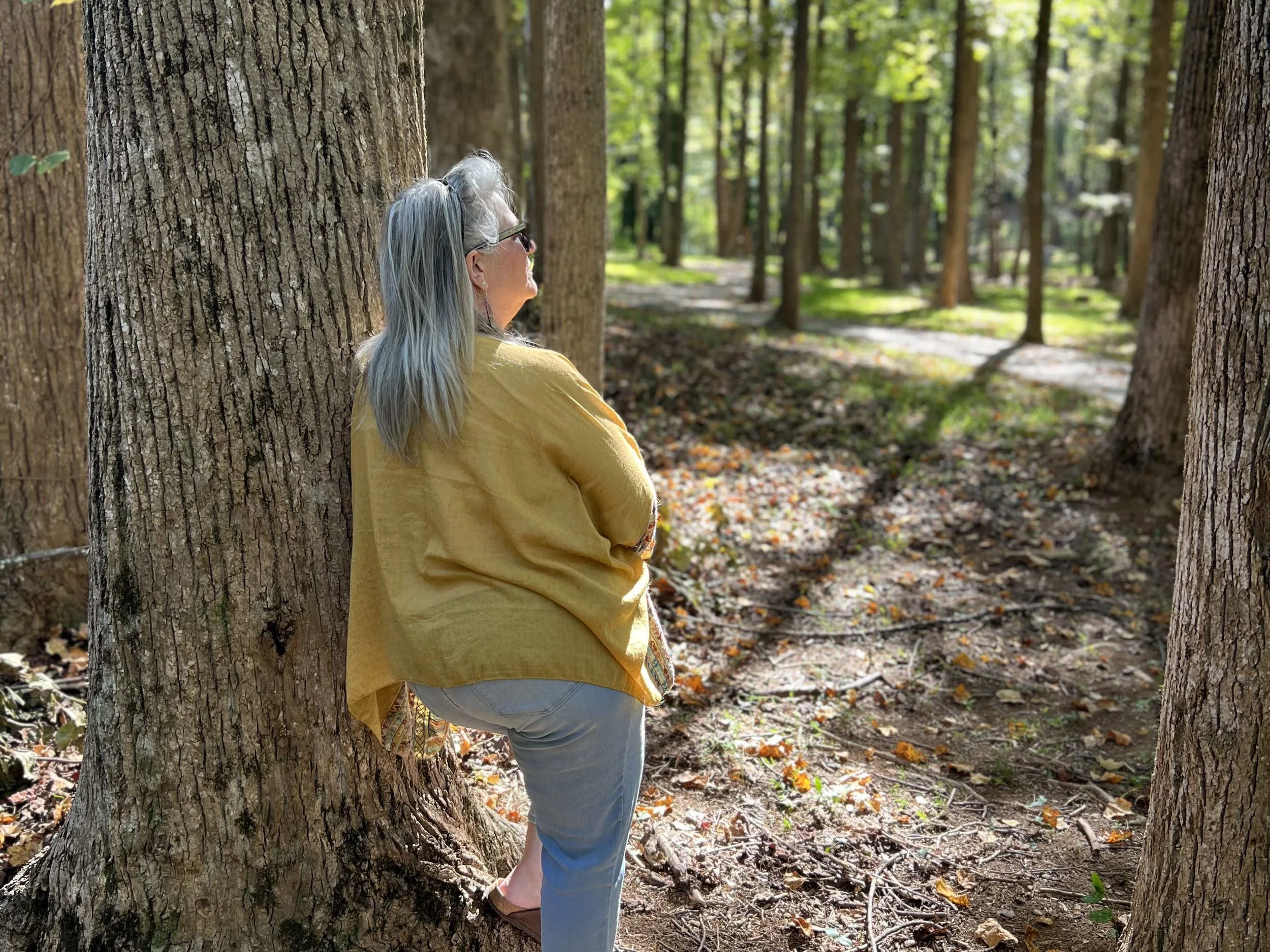
When Timing Meets Alignment
When Timing meets alignment — Sometimes being in perfect alignment doesn’t mean moving forward right now. It means trusting God’s rhythm, allowing space for rest, and believing that in the waiting, what’s meant for you will bloom even more beautifully than you imagined.
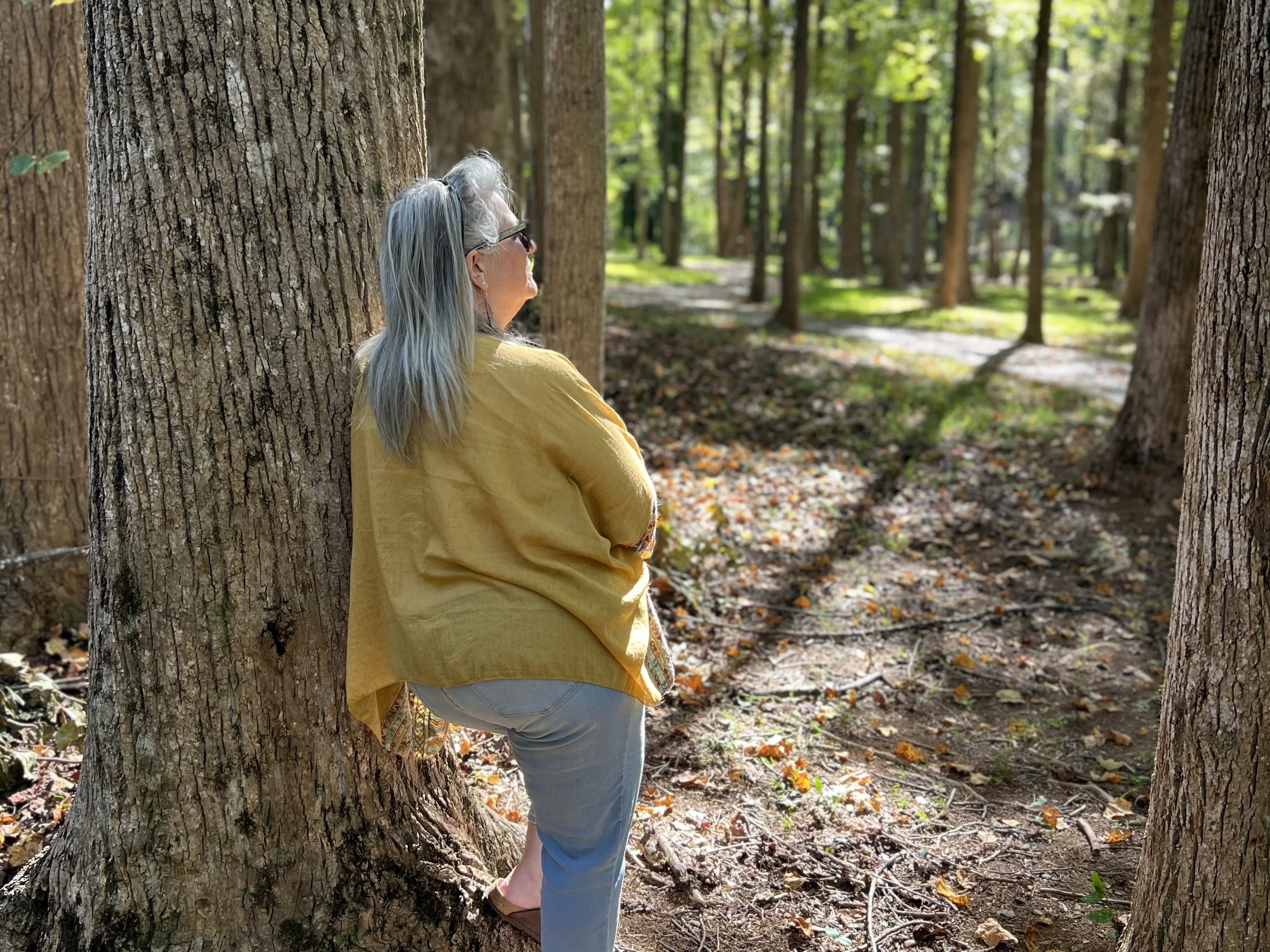
There’s a quiet kind of wisdom that comes with pausing.
It’s not about giving up … it’s about stepping back far enough to see the whole picture.
Recently, I had to make two big decisions: to reschedule my retreat and to realign my book launch. Both were rooted in faith and fueled by purpose. Every detail had been carefully crafted … the vision clear, the energy behind it on fire. And yet, there was this still, unmistakable sense that something was off … not in spirit, but in timing.
I’ve learned to pay attention to those whispers. They don’t roar; they hum softly beneath the surface, a sacred nudge from the One who sees the path from beginning to end. Sometimes, even when we’re walking in full alignment, God asks us to pause … not because we’re on the wrong road, but because He’s preparing something better up ahead.
For years, I’ve believed that alignment meant momentum … that once you found your path, things would naturally fall into place. But what I’m learning in this season is that alignment also invites stillness. It asks for the courage to wait when every part of you wants to sprint. It asks for the faith to trust divine rhythm when your plans seem to unravel.
The truth is, you can be in alignment and still be asked to wait.
That realization is both humbling and freeing.
The retreat I planned was meant to be a gathering of hearts … a sanctuary for rest, creativity, and soulful reconnection. The book, Tattered and Mended, has been a labor of love for over a year, a weaving together of stories about loss, legacy, and renewal. Both hold deep meaning for me. And yet, when the time came to move forward, I sensed a resistance that didn’t come from fear; it came from wisdom.
The kind that says: “Wait. The soil isn’t ready. The hearts meant to receive this haven’t yet arrived.”
That’s not an easy message to hear when you’ve invested your time, heart, and hope. But I’ve been reminded that there is a difference between doing good work and doing it in God’s time. Timing shapes everything … how the message is received, how energy flows, how transformation happens.
I’ve seen it in my creative process over and over again.
A painting that felt stuck suddenly comes alive when I return days later with fresh eyes.
A design idea that seemed uncertain blossoms after a quiet walk or a prayerful pause.
A plan that once felt urgent finds its natural unfolding when I surrender it.
These moments remind me that divine timing isn’t about delay; it’s about alignment on a higher level. It’s the unseen orchestration that ensures we’re not just doing the right thing, but doing it at the right time, with the right people, in the right way.
So, I’ve given myself permission to pause.
To not rush what God is still refining.
To trust that sometimes, slowing down is the most faithful step you can take.
This space between “now” and “not yet” is tender. It can feel like standing in the doorway between what was and what will be … one foot in purpose, the other in patience. But it’s also sacred ground. It’s where faith deepens, clarity returns, and creativity renews itself.
Waiting doesn’t mean nothing is happening. It means unseen things are being set in motion.
It means God is weaving threads we can’t see, preparing connections, opportunities, and outcomes beyond our imagination.
I’ve come to understand that the pause protects the promise.
It gives your vision time to grow its roots before it blooms. It protects your heart from launching too soon out of pressure or perfectionism. It prepares you for the fullness of what’s next, so when it arrives, you can hold it with grace instead of exhaustion.
The older I get, the more I see that waiting is not wasted time. It’s sacred time.
It’s the quiet conversation between you and God that shapes the next chapter.
It’s where your trust muscles strengthen and your creative voice refines.
And maybe that’s the real invitation: to stop equating productivity with progress, and instead see patience as a form of devotion.
When I pray and set my intention, I always pray for this … or something better.
It’s my way of saying, “God, I trust You with what I cannot yet see. If my plan isn’t the best plan, I surrender it so You can make it so.” That prayer has carried me through so many transitions and tender pauses. It’s a reminder that even when I’m uncertain, God’s view is wider than mine: His pace wiser, His plan kinder.
So for now, I wait. I revisit the pages of my book with gentler eyes. I listen for what the retreat wants to become rather than forcing it into what I thought it should be. I let the stillness teach me.
Because in the pause, I find peace again.
In the waiting, I find clarity.
And in both, I find a deeper trust that God’s “not yet” is still a “yes” … just one that’s being shaped for something better.
Maybe the timing wasn’t off at all. Maybe it’s being fine-tuned for something divine.
And I know, when the moment arrives, it will unfold exactly as it was always meant to … gracefully, beautifully, right on time.
Because in the waiting, and in the pause, I know it will be even better than I could imagine.
A Thought to Carry
“Faithfulness isn’t a feeling. It’s a steady movement in the same direction, even when the outcome is still unseen.”
— Ruth Chou Simons“To everything there is a season,
A time for every purpose under heaven.”— Ecclesiastes 3:1 (NKJV)
Want to be notified when the next blog is posted? Sign up here so you don’t miss a thing!
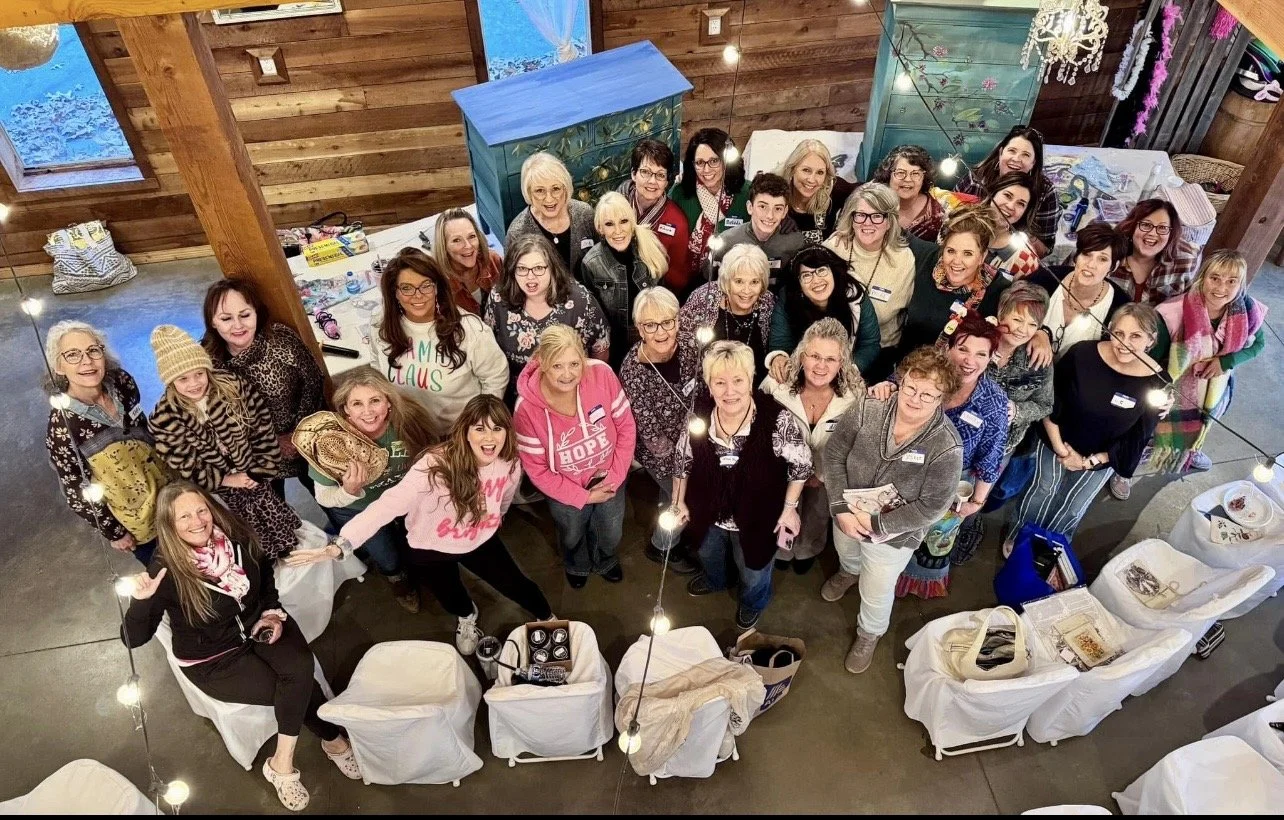
What Happens When Women Gather
“Sometimes the soul doesn’t need to be fixed.
It just needs to be witnessed in a softer light.”
— P.C.
There are seasons in life when we don’t even realize how quiet we’ve become.
Not the kind of quiet that brings peace … but the kind that comes when our creative voice, our spark, or our sense of belonging fades beneath the noise of doing and caretaking.
That’s where I found myself a two years ago.
I was still creating, still showing up … but not fully alive in the process. My work was meaningful, but my soul was tired. Then one day, I said yes to something that would change everything: a creative retreat.
I didn’t go as a teacher, a curator, or a leader.
I went simply as a woman who needed to breathe again.
Something happened there.
Surrounded by others who were showing up messy and brave, I found my own reflection in their stories.
There was laughter that rose like light, art that flowed without agenda, and moments of silence that felt holy.


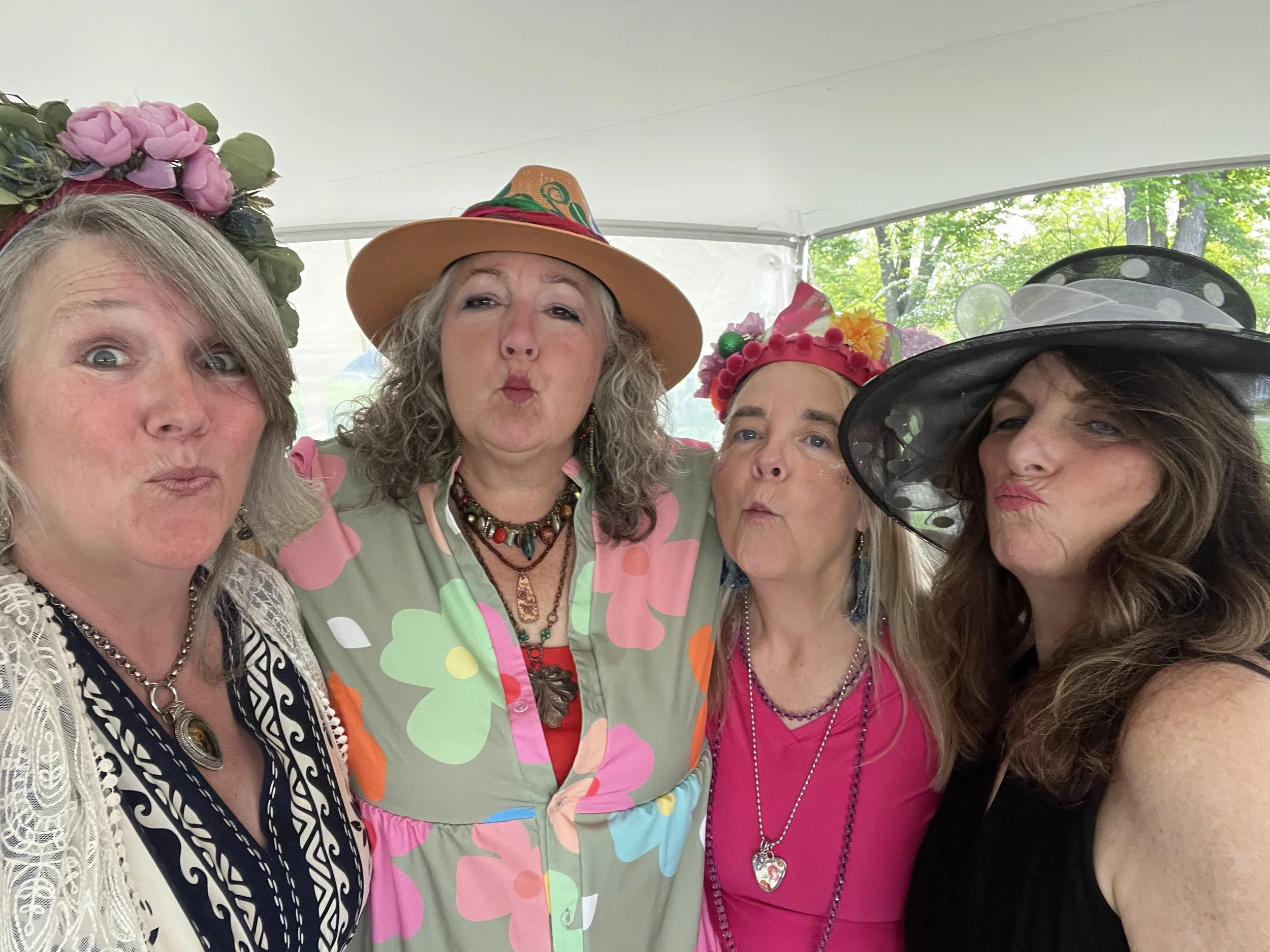
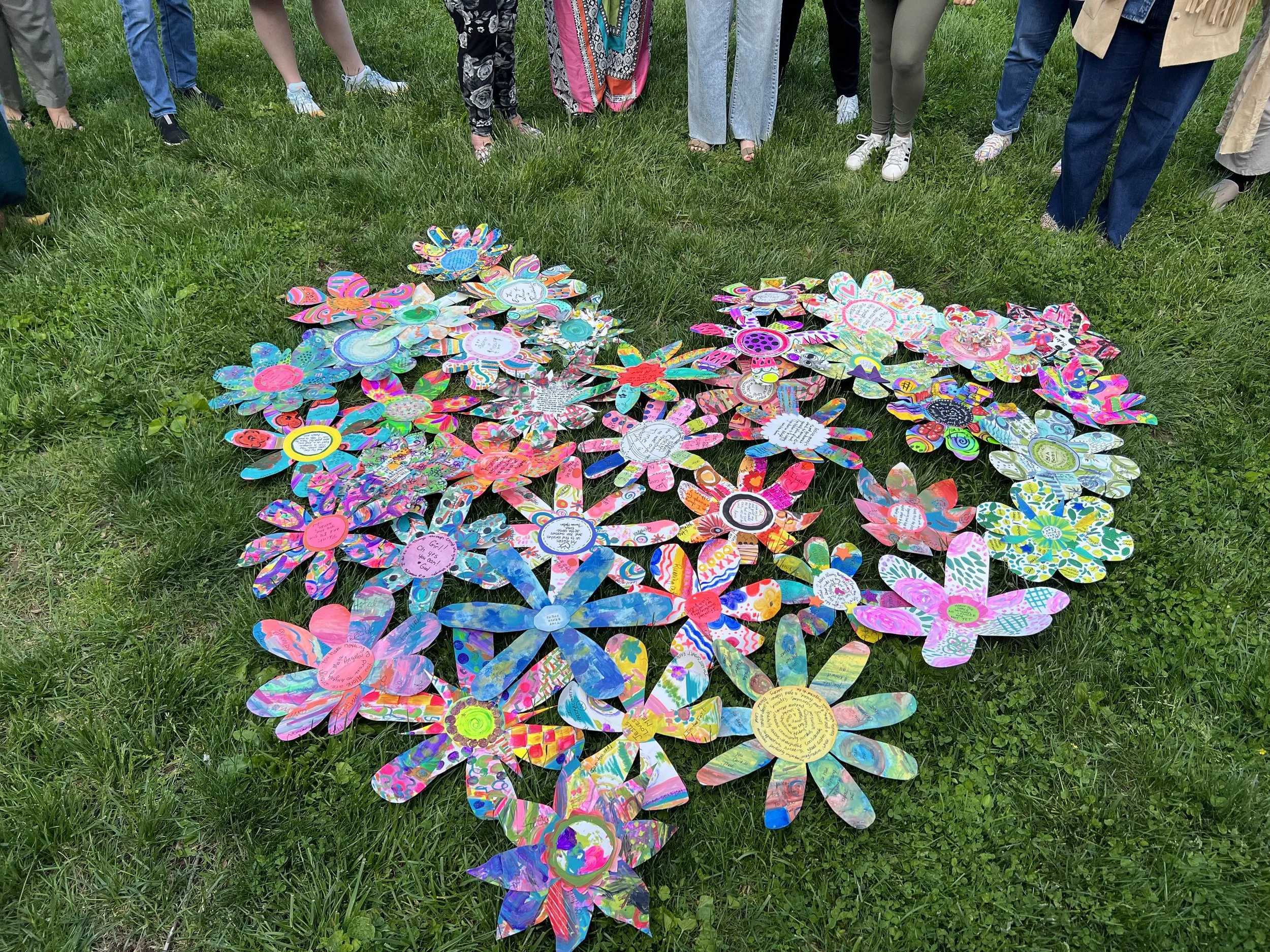
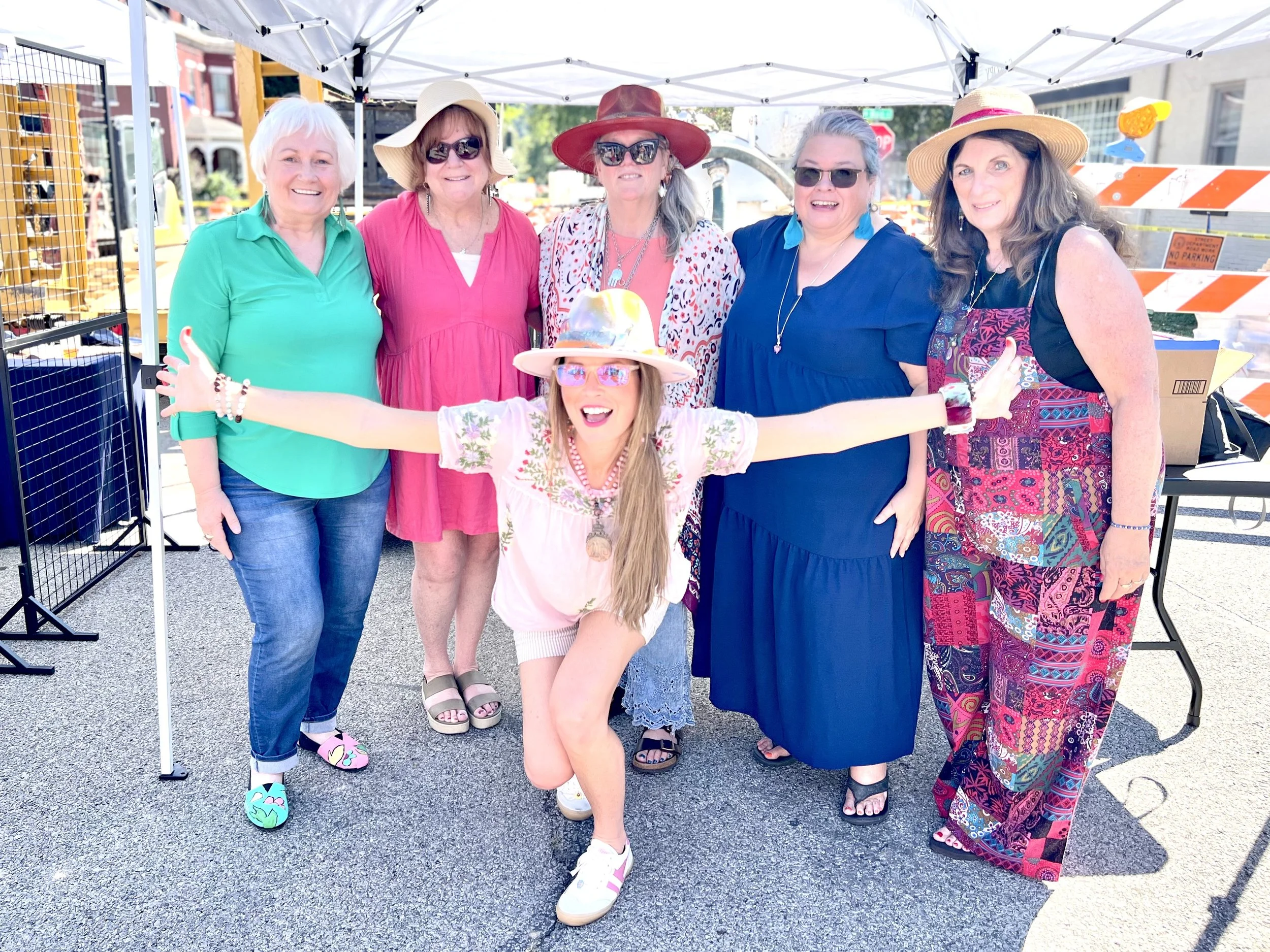

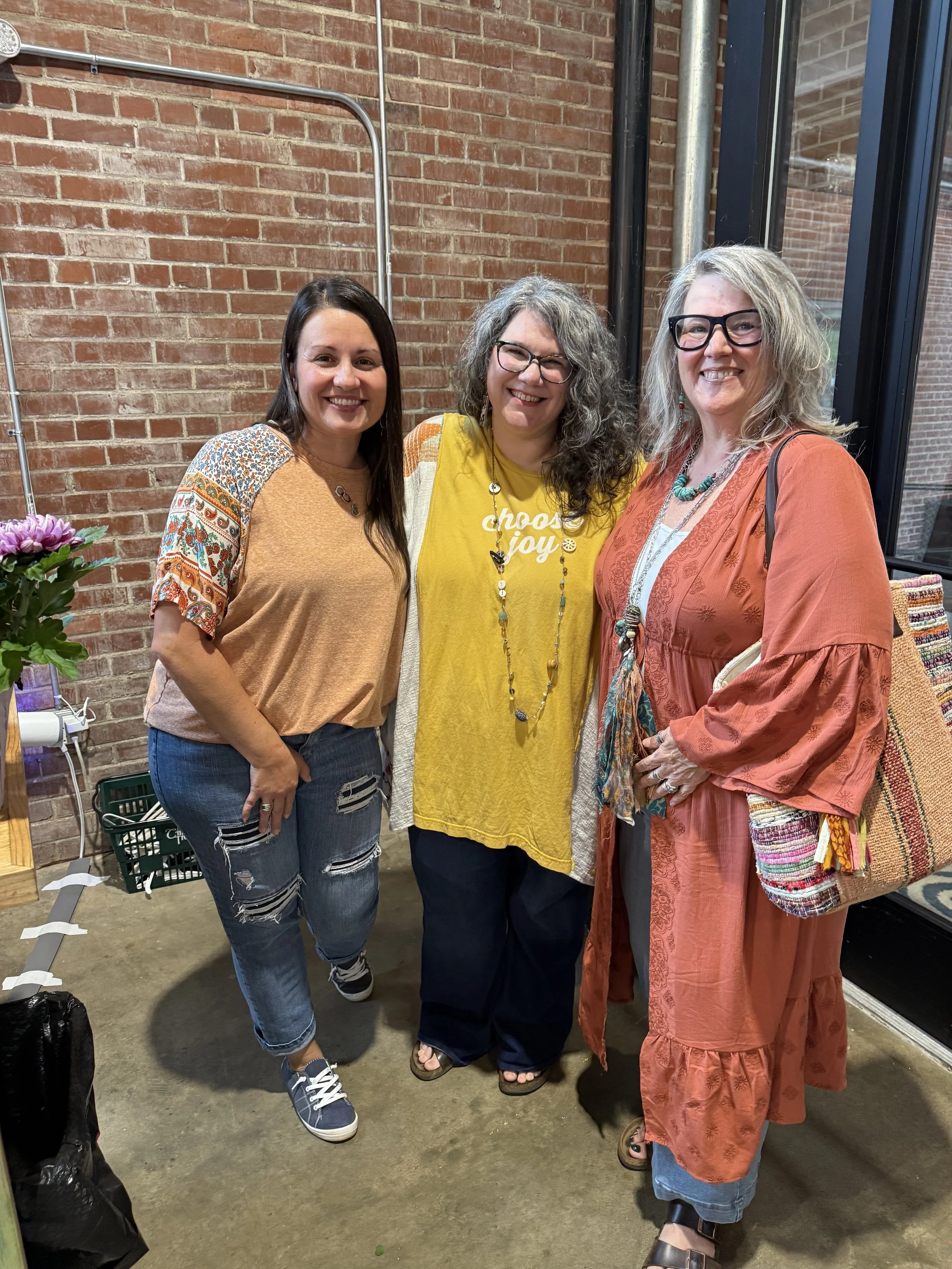

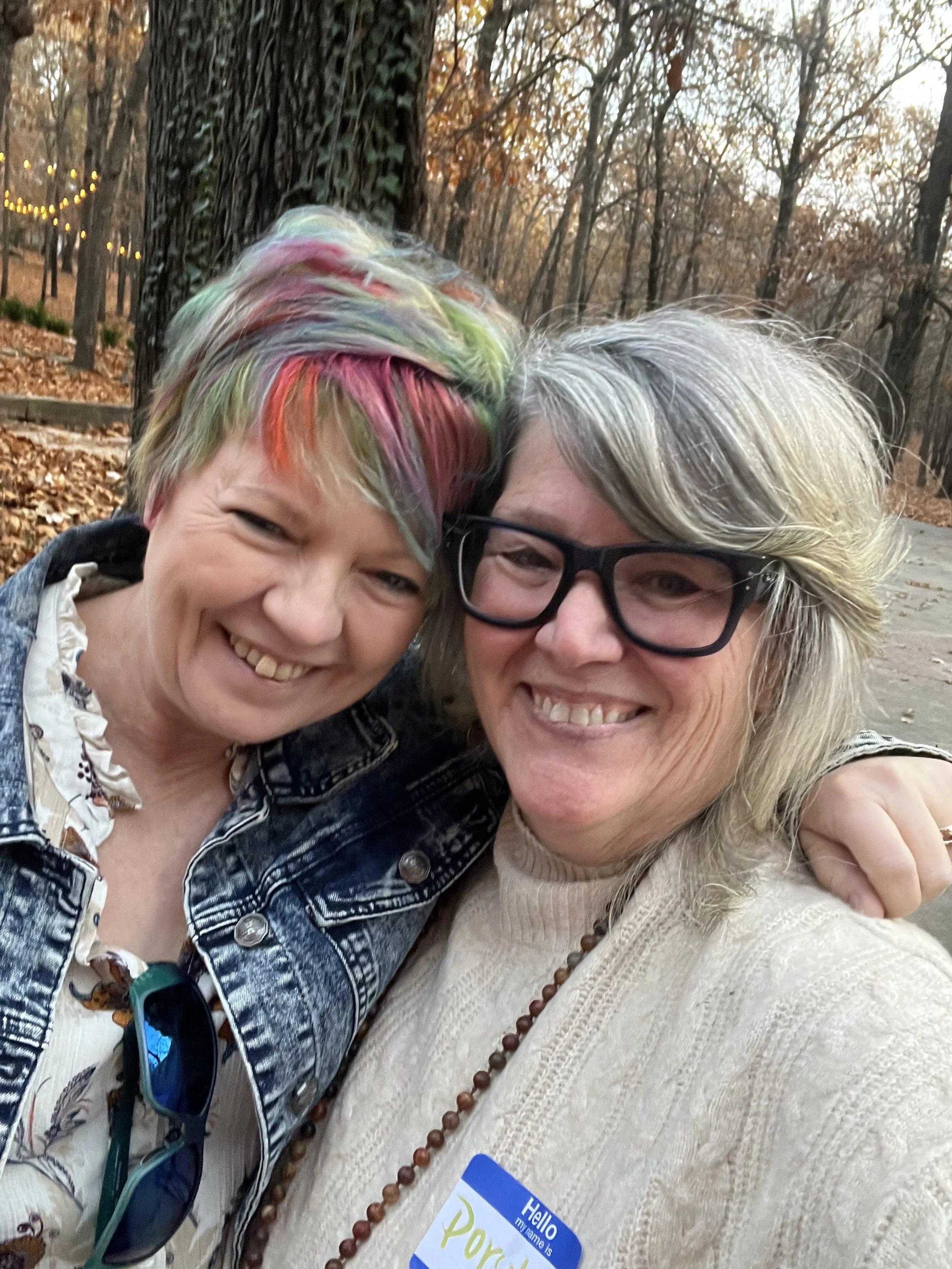
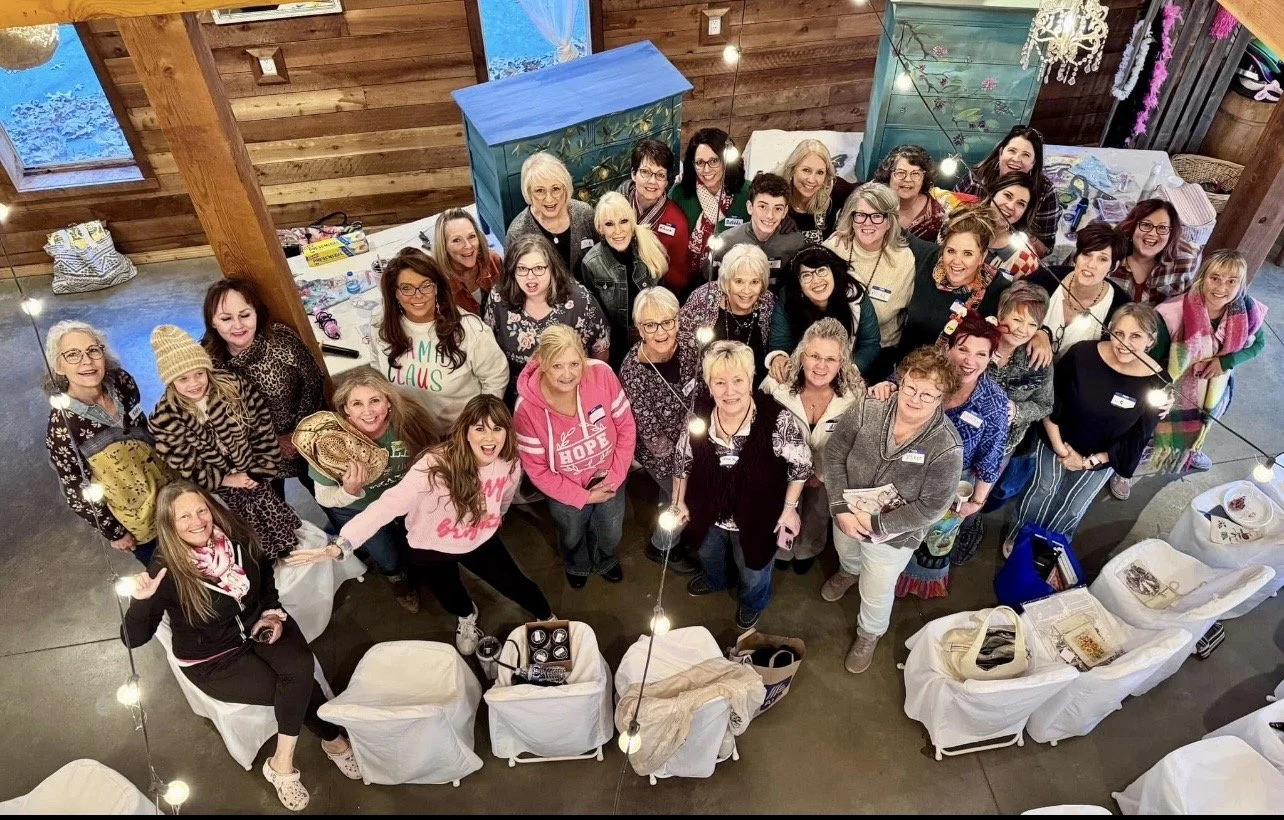

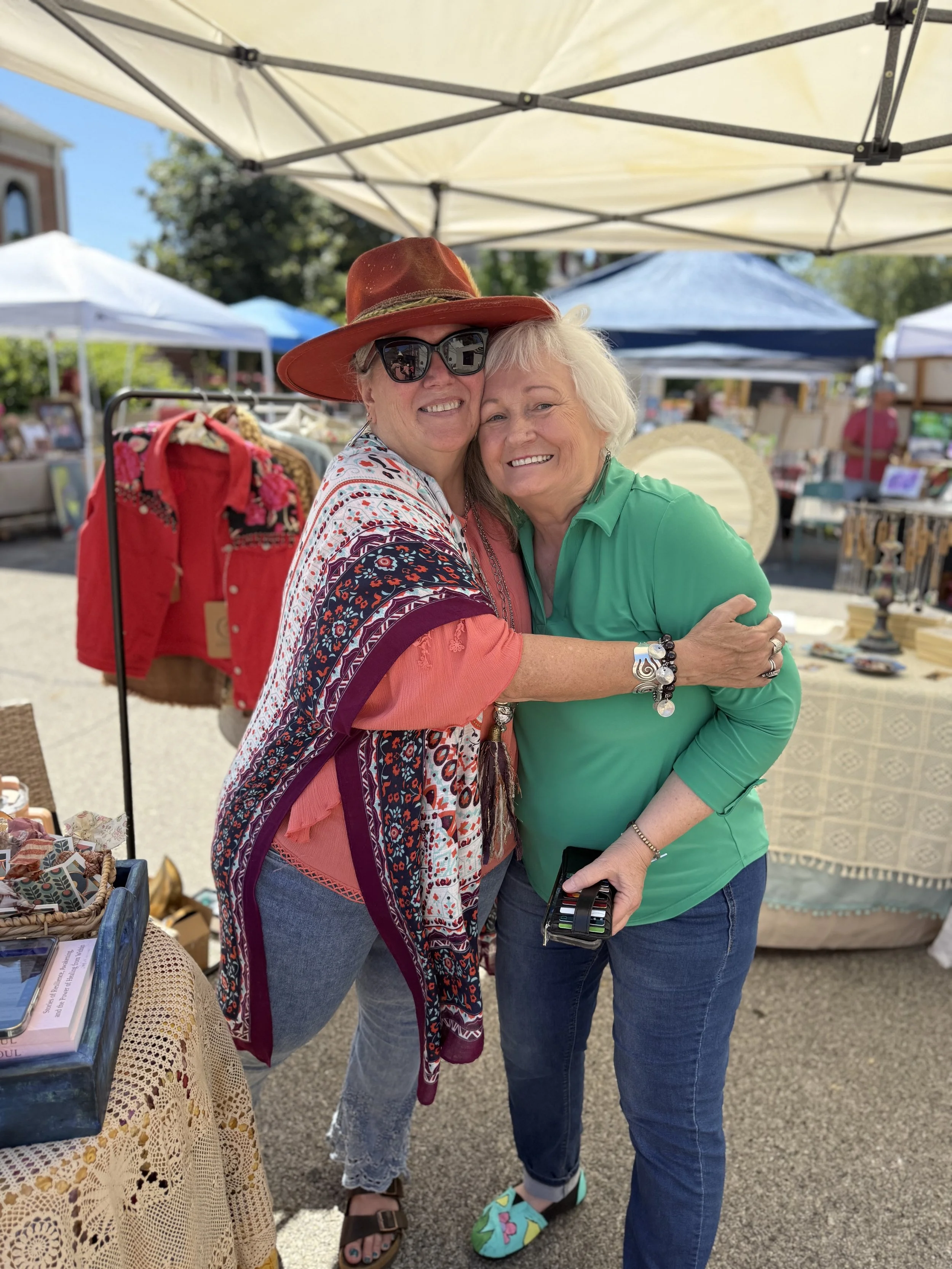
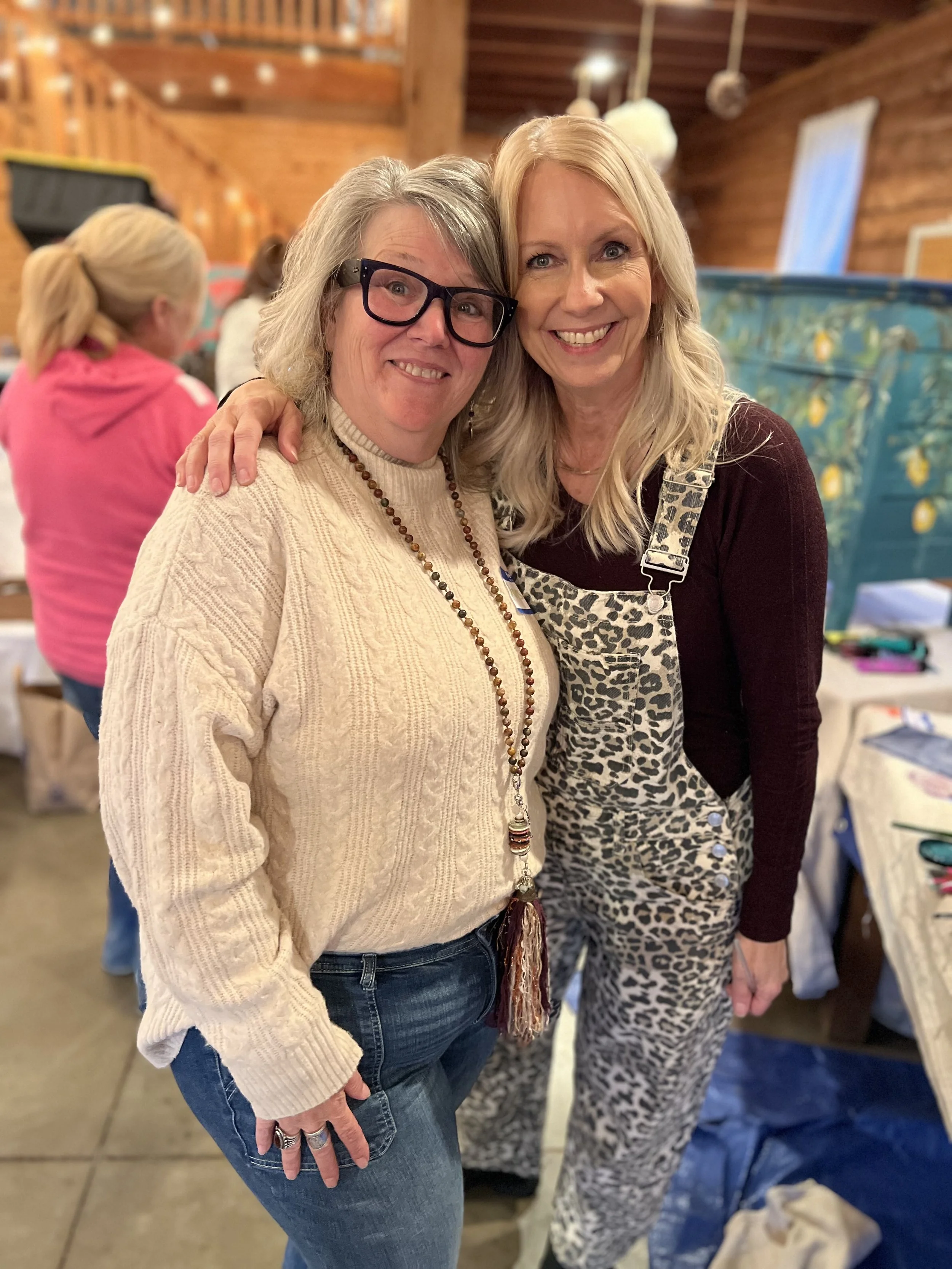
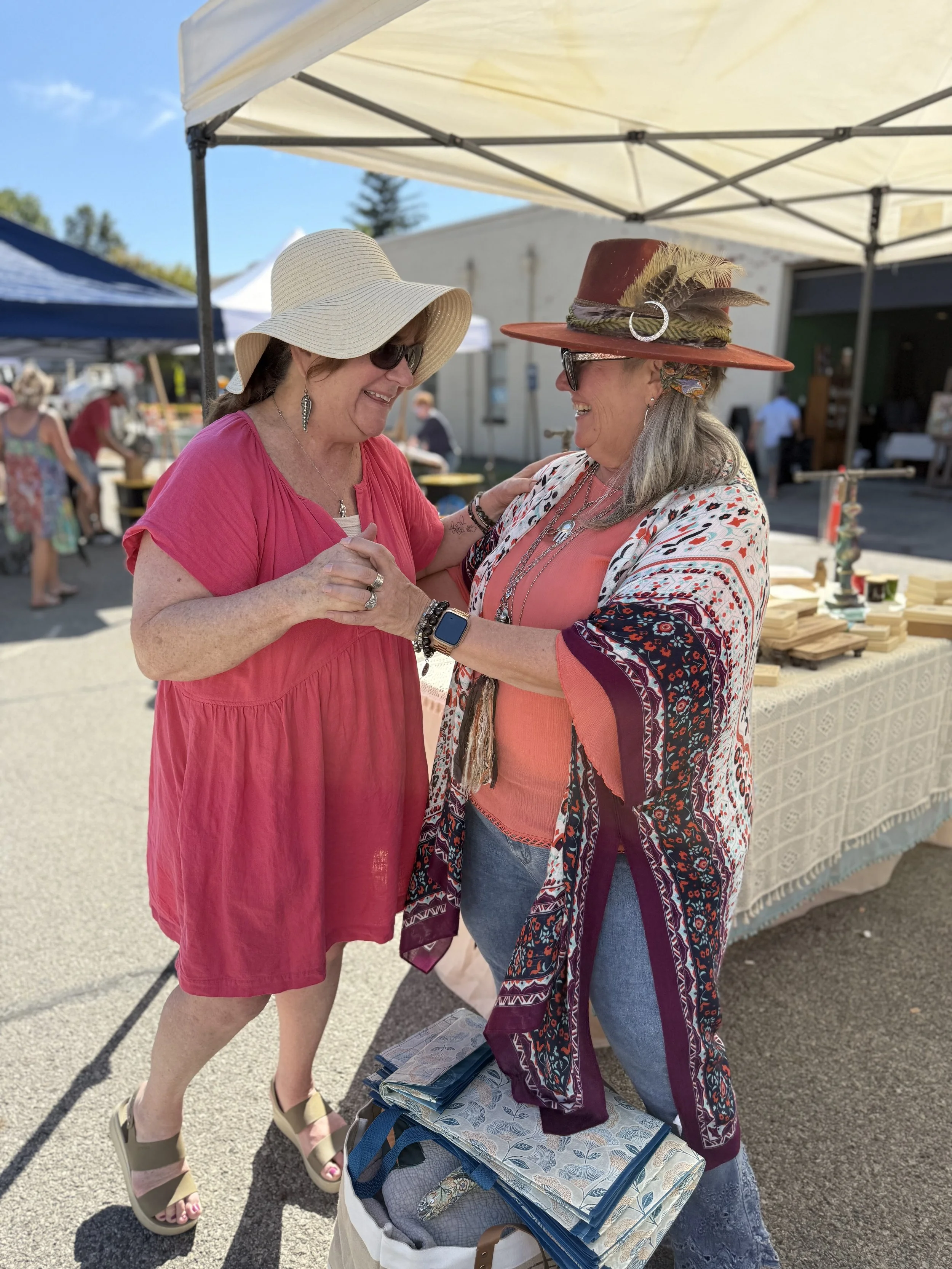
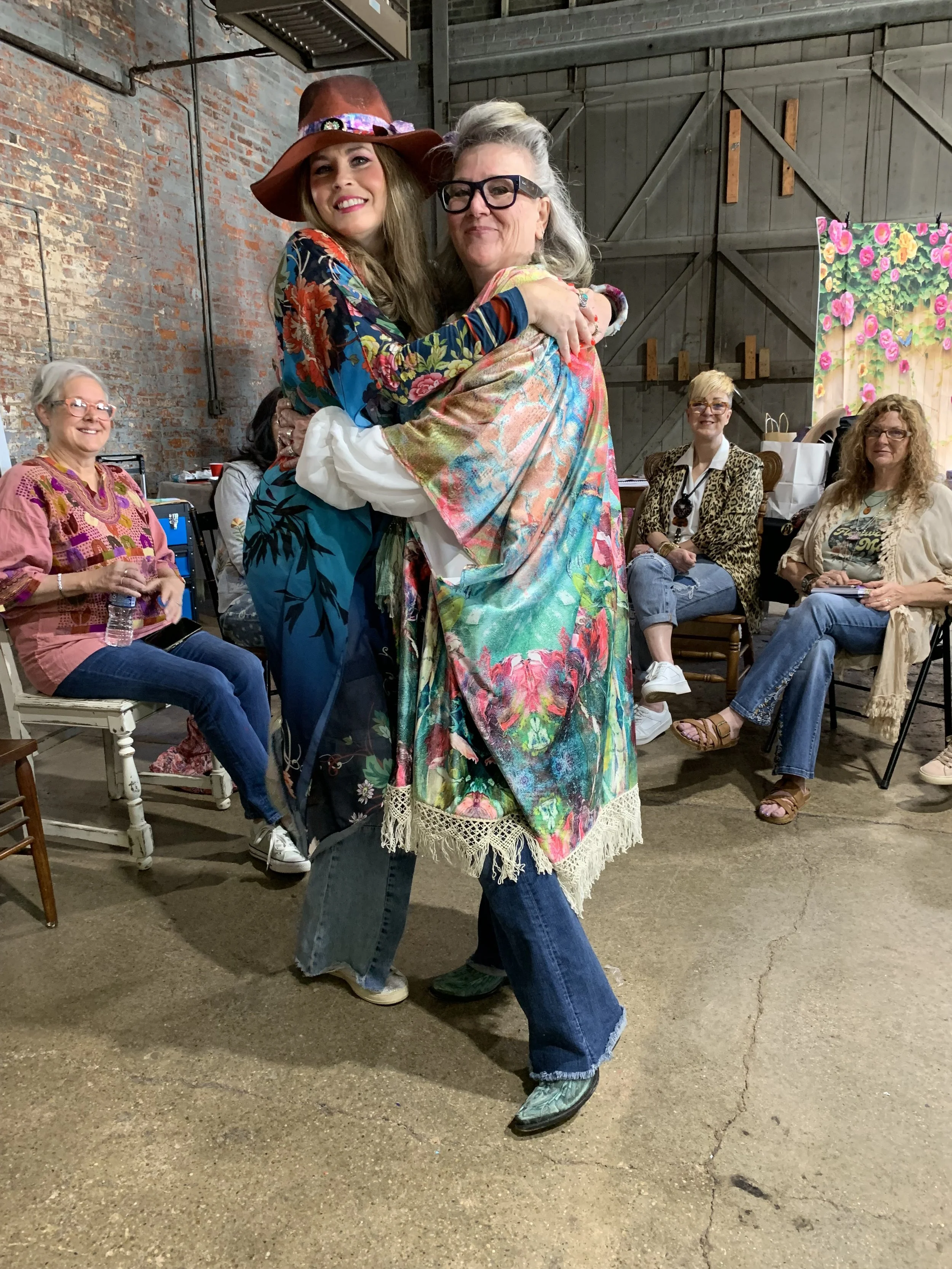
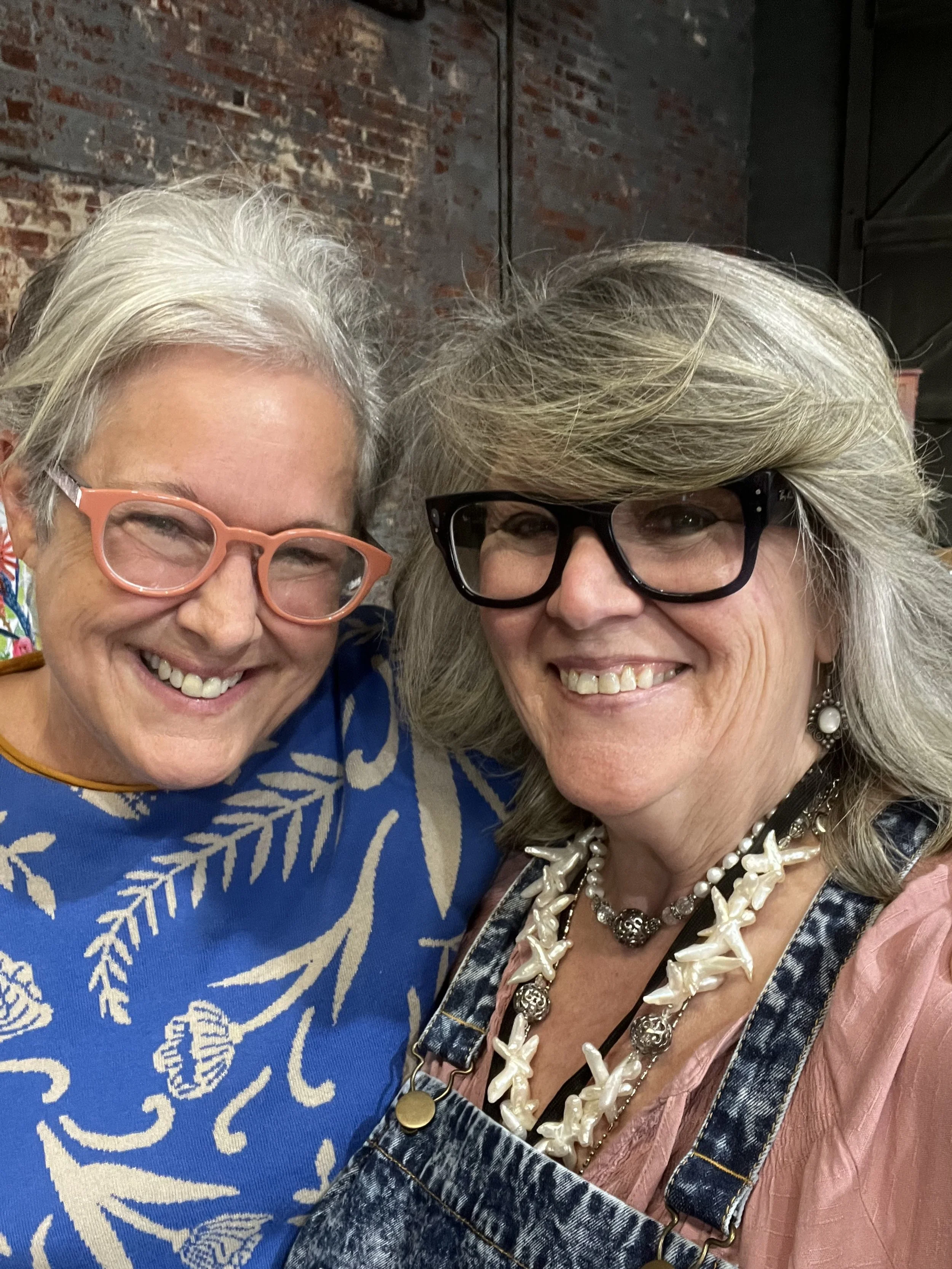
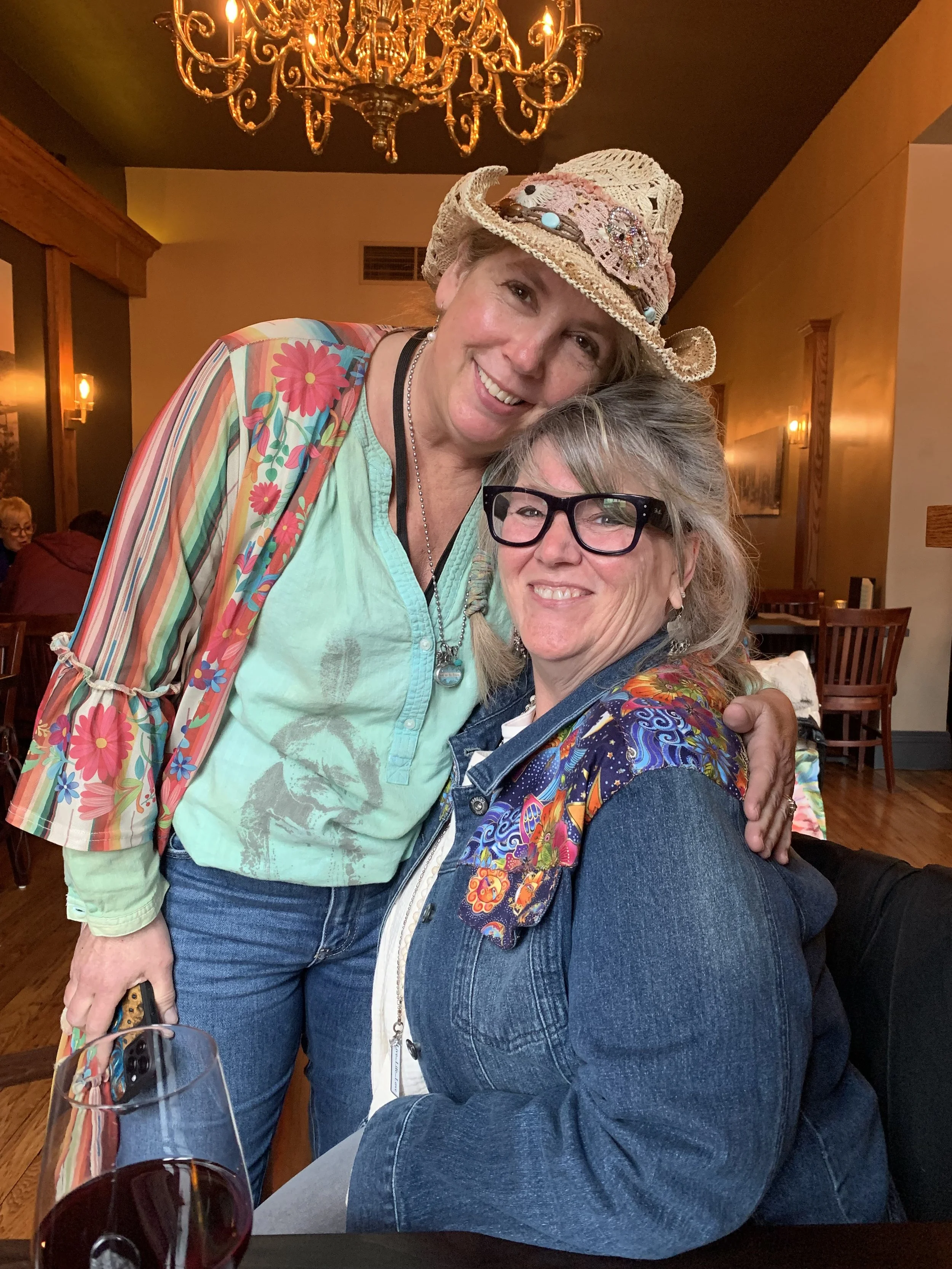
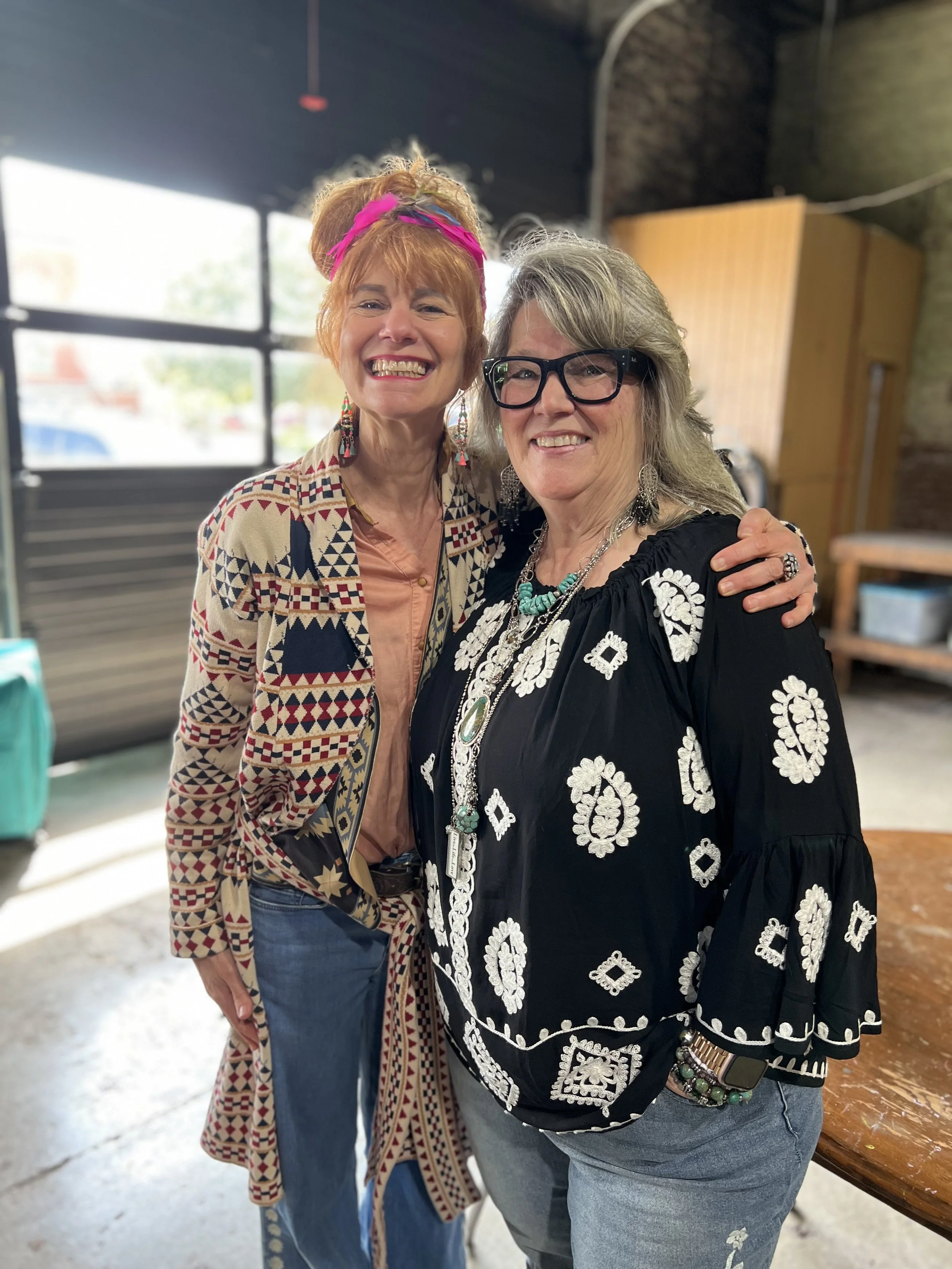
The rhythm of paintbrushes … the smell of coffee … conversation … laughter … it all became a kind of homecoming.
Since that time, my path has unfolded in ways I couldn’t have imagined.
I’ve moved from attendee to curator, to writer, to retreat leader. But none of that was about striving.
It was about returning.
Returning to what matters … to creativity, to connection, to presence.
And somewhere in that return, this poem found me.
What Happens When Women Gather
by Porsha Chalmers
What happens when women gather
is more than laughter echoing off painted walls,
more than paint on fingertips or
stories stitched into worn fabric.It is memory rising …
from the scent of cedar,
from a song half-remembered,
from eyes that say,
"I see you. I still see you."It is healing,
not loud and sudden,
but a mending kind …
quiet as thread pulling through cloth.
Sure as tea poured into a second cup.It is remembering who we were
before the world told us otherwise …
and choosing her again.It is bearing witness …
to grief that shaped us,
to joy that saved us,
to the way our hands know
how to make beauty from broken.It is sacred.
It is sanctuary.
It is circle, not ladder.
Enough, not hustle.
Becoming, not performing.When women gather,
We remember:
We were never meant to do this alone.
Every time I read this, I think of the women who’ve sat in circles with me … the ones who showed up with stories, laughter, tears, and courage. I think of how creativity and compassion weave together like thread through cloth.
That’s what Soul Map: The Art of Release is built upon.
It’s a retreat designed to help you remember what’s been waiting quietly within you … to reconnect through sound, movement, and mindful making.
To gather, to breathe, and to find beauty again in the space between.
If your soul has been whispering for rest or renewal, this may be the invitation you’ve been waiting for.
Soul Map: The Art of Release
Madison, Indiana – October 23–26, 2025
Reserve your spot here →
A Thought to Carry
“There is a sacred rhythm to rest, creation, and connection.
When we honor all three, we begin to hear ourselves again.”
May this week bring you moments of stillness that spark something new …
and remind you that the most meaningful journeys often begin in quiet company.
“Circles of women give us back the parts of ourselves we’ve forgotten.”
— Marian WoodmanWant to be notified when the next blog is posted? Sign up here so you don’t miss a thing!

Love, Time, and a Muscadine Vine
Twelve years ago, I stood barefoot in the mud beside my dad as a gentle fall rain began to fall. The ground was cool and soft beneath my feet … the kind of damp that carries the scent of leaves, earth, and endings about to become beginnings.
We were planting two muscadine shoots in my yard. No more than twig-like stems, really. Spindly, small, and unimpressive to anyone but us. But we believed in them.
The feel of Georgia clay between my toes and the sound of rain tapping the earth is etched in my memory, as is the way my dad and I worked quietly … no big declarations, just love in action. It wasn’t just about planting vines. It was about rooting something for the future, something that would grow alongside the life I was just beginning … and a legacy for when he was gone.
Because that same fall, I met Jim.
And though neither of us could’ve predicted the chapters to come, we knew … deep down … that something had taken root. Our love didn’t begin with fireworks or fanfare. It began with steady presence. Just like the roots of the muscadine vine.
We were two people who had lived enough life to value the quiet miracle of being seen and chosen.
Ours was a slow unfolding. Trust was built step by step, word by word, like branches reaching toward sunlight. We were starting a life in the wake of grief and growth, carrying past stories but daring to imagine new ones. Just like those vines, we were finding our footing … growing toward something lasting.
“We were two people who had lived enough life to value the quiet miracle of being seen and chosen.”
Year after year, the muscadine vines stretched across their trellis … green, alive, but never bearing fruit. Still, I kept watering them … kept believing in their quiet promise.
Life, too, was unfolding … sometimes gently, sometimes in ways that rattled us. But we kept going … kept tending … kept choosing each other.
This year, something changed.
For the first time, the vines are bearing fruit.
Twelve years.
The same number of years Jim and I have been writing our shared story.
The same number of years since we chose each other—deliberately, wholeheartedly.
The same number of years I've spent leaning into love, creativity, grief, and grace.
It’s not just fruit. It’s a marker of time. A reminder that slow growth is still growth. That what’s planted in love … even when it looks like nothing is happening … is quietly preparing to bloom.
Because the truth is … growth takes time, and so does maturity.
It takes years of deep roots, of weathering storms, of showing up when it’s hard, of learning when to stretch and when to rest. It’s that steady faithfulness that finally makes the vine strong enough, mature enough, to produce fruit.
And as I stood beside the vine this year, seeing it finally bear fruit, I couldn’t help but think of the words from John 15:5:
“I am the vine, you are the branches. He who abides in Me, and I in him, bears much fruit; for without Me you can do nothing.”
John 15:5 (NKJV)
This muscadine vine is more than a plant.
It’s a living timeline.
A witness to devotion, resilience, the quiet wisdom of waiting …
and a reminder of what becomes possible when we remain connected to love, to time, and to the true Vine.
And this?
This is the sweetness of love, time, maturity, and a muscadine vine.
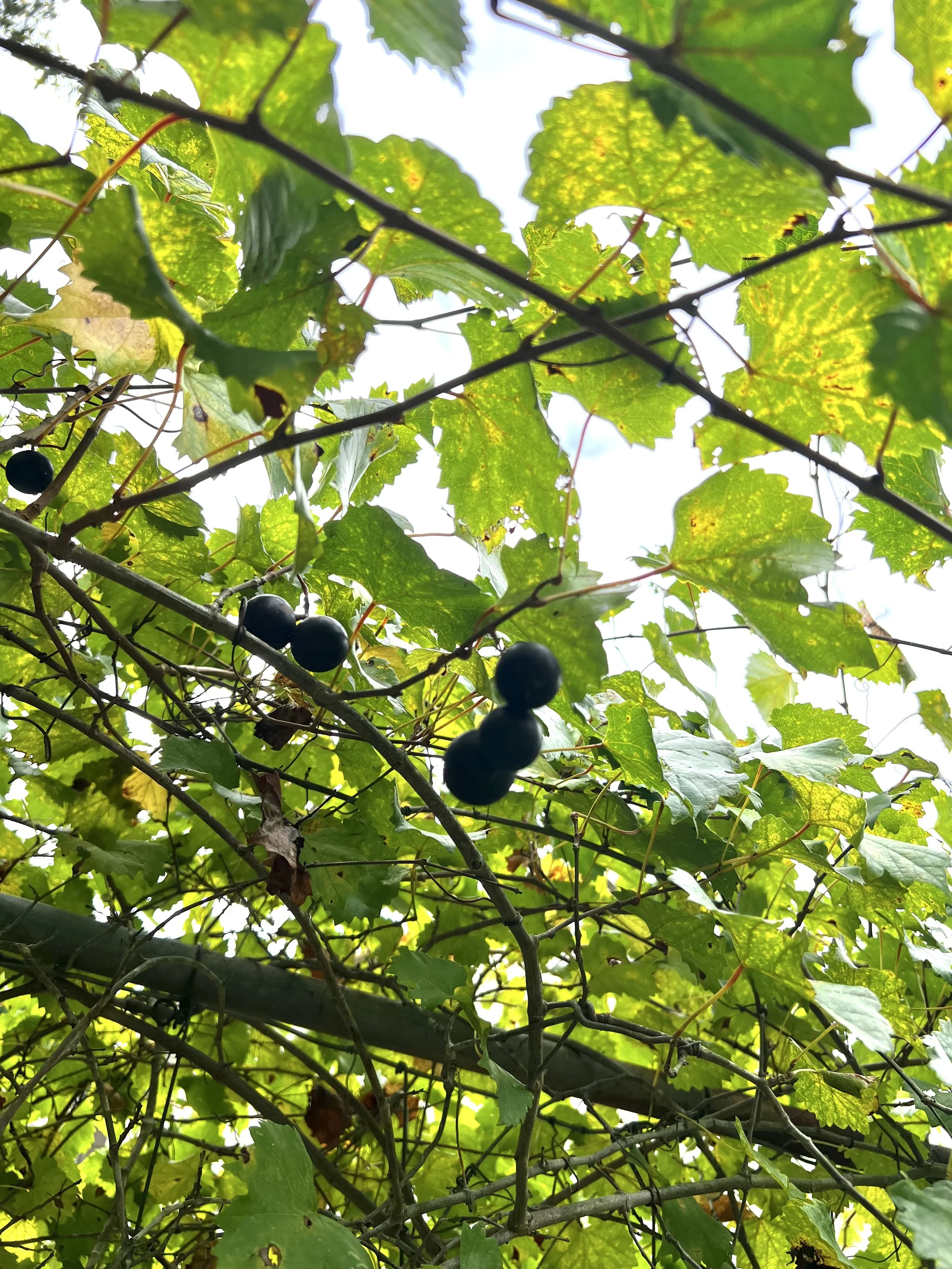
Quote to Carry
“Adopt the pace of nature: her secret is patience.”
Ralph Waldo Emerson
Thought to Carry
What have you planted—physically, emotionally, or spiritually … that has taken its time to bloom?
What quiet promise are you still tending, even if it hasn’t yet borne fruit?
Want to be notified when the next blog is posted? Sign up here so you don’t miss a thing!